Saturday, September 27, 2008
THE SUDDENLY BARREN PLAZA ROMA

Mayor Alfredo S. Lim was astonished and alarmed when he passed by Intramuros to see the trees which included six narra and two mahogany trees at the IA-regulated Plaza Roma opposite Manila Cathedral had been cut.
How could Mrs. Bambi Harper, the Intramuros Administration chief, do such a thing? -- he must have thought. Mrs. Harper was not answering her cell phone so the mayor called the police station nearest to the scene of this environmental chainsaw massacre.
It was later discovered that Mrs. Harper was planning to plant about 22 fire trees at the plaza so she had ten narra and three mahogany trees – all endangered species, as well as 17 fruit bearing trees (neem, mango, langka and atis) cut and transferred elsewhere. However, her failure to announce her intention to do some tree-cutting astounded and irked many powers that be.
Executive director Corazon Davis of the Department of Environment and Natural Resource’s National Capital Region office wasted no time to file charges against Mrs. Harper -- for violation of Presidential Decree 953, Republic Act 3019 (Anti-Graft and Corrupt Practices Act) and Republic Act 9175 -- before the Office of the Ombudsman.
PD 953 penalizes the unauthorized cutting, destruction, damage and injury of trees, plants and vegetation. RA 9175, on the other hand, regulates the ownership, possession, sale and use of chainsaws. RA 3019, well, astounded and irked many of Mrs. Harper's allies.
However, Mayor Lim, a lawyer, read the legal ramifications of this environmental misdeed correctly and cleared Mrs. Harper, ordering City Hall’s legal department to charge instead the contractor, Fernando Simborio of the Batangas based Green Philippine Nursery Plant, with five counts of violation of PD 953.
Rene Martel, in a Manila Times opinion column claims, "We didn’t hear any verbal thundering from from Davis when DENR Secretary Lito Atienza, in his previous role as Mayor of Manila, ordered (despite an uproar by the caring environmental community) well over two hundred trees to be chopped down at the two historic sites of Mehan Garden and Arroceros Forest Park. And ironically, Harper’s voice was one of the loudest to rail against Atienza at that time."
Be that as it may, poor Mr. Simborio the contractor. He was, after all, simply following what he was ordered and paid to do.
View photo of the shady Plaza Roma here before its ten-decade old trees were chainsawed.
*
THE BARREN PLAZA
© 2008 Señor Enrique
Aperture: F3.5
Shutter: 10/200 sec
Focal Length: 27mm
ISO: 100
THE BARREN PLAZA
© 2008 Señor Enrique
Aperture: F3.5
Shutter: 10/200 sec
Focal Length: 27mm
ISO: 100
* * *
Please note:
I very much appreciate my articles and photos appearing on fellow bloggers' sites, popular broadsheets, and local broadcast news segments, but I would appreciate even more a request for permission first.
*
I very much appreciate my articles and photos appearing on fellow bloggers' sites, popular broadsheets, and local broadcast news segments, but I would appreciate even more a request for permission first.
*
Labels: current affairs, Intramuros, life in Manila, politics
posted by Señor Enrique at 2:32 AM
| 28 comments


Tuesday, February 27, 2007
A COLORFUL NEIGHBORHOOD

Once I asked my nephew how come I no longer see him wearing the authentic NBA jersey I got him in New York. Sheepishly, he replied, “Nasungkit, Tito.”
It wasn’t until I was walking along these streets of Intramuros last Saturday when I once again thought about that particular incident. Without a safer place to hang dry their newly-washed clothes, some folks hang them right outside their windows; making them easier for petty thieves to pinch with the aid of a long stick.
This row of houses, by the way, is on the same street — but about a couple of hundred meters away — from the colorful house pictured below, which happens to be my favorite building in Intramuros. This may be the last enclave where squatters are allowed to reside within Intramuros.
During the 17th-century, the parian neighborhood of Sta. Cruz commanded the highest in rental prices, compared to those in other districts of Manila. Businessmen, especially the foreigners, preferred the structures of Sta. Cruz, especially those warehouses along the Pasig River, which facilitated the swifter delivery of their merchandise through the cascos or boats that plied the city’s esteros.
Among the big time landlords of that era was Doroteo Jose who owned six residential homes located at Calle Obando. They were built of mamposteria and wood with galvanized iron roofing. His properties were valued at P9,000.00 at that time.
Another was Pedro Roxas, who lived in the tony neighborhood of San Miguel district. He owned buildings in Sta. Cruz — a residential house at 40 Calle Quiotan; a warehouse with bakery at 14 Curtidor; and another warehouse at 64 San Pedro. His properties were collectively assessed at a total price P18,300.00.
To date, Sta. Cruz and Binondo remain to be the priciest pieces of real estate in the entire City of Manila.

Source:
Santa Cruz Church
A Living Heritage
By Anna Maria L. Harper
Santa Cruz Church
A Living Heritage
By Anna Maria L. Harper
Labels: Intramuros, Manila, Manila history
posted by Señor Enrique at 4:48 PM
| 25 comments
Monday, February 12, 2007
SAN AUGUSTIN CHURCH

With nothing better to do yesterday morning, I decided to drive out to San Augustin at Intramuros. I’ve been to this church a couple of times during Carlos Celdran’s walking tour, but haven’t really seen the interior of this church during a mass with all its chandeliers lit. It was incredible. This has got to be Manila’s most ornate and garish church. No wonder many weddings are held here; it’s quite colorful and photogenic.
Touted as the oldest church in the Philippines, its very first structure was made of nipa and bamboo built in 1571 by the Augustinians who arrived in the Philippines with the Legazpi expedition in 1565. It was originally named the Church and Convent of Saint Paul. It was destroyed when Limahong invaded Manila in 1574, but was rebuilt in 1581 to become the venue of the First Diocesan Synod.
Unfortunately, one of the candles at the funeral of Governor-General Gonzalo Ronquillo de Penalosa set the drapes of the funeral bier on fire, which burnt the entire church down. The fire raged uncontrollably and soon the entire Intramuros was in flames. The structure that replaced it was also razed to the ground by another fire in 1586. It was only after then that Juan Macias was commissioned in 1604 to design a stone church. It proved formidable; sustaining only minor damages from earthquakes; that is, until in 1880 when a tremor severely cracked one of the belltowers, which was later torn down.
 When the British invaded and occupied Manila in 1762, San Augustin was looted; the altar ornaments were stripped of their gold and precious gems, while the graves of the conquistadores were desecrated. The Augustinians were driven out of the convent; several were arrested and shipped off to England only to return two years later after the occupation.
 During the Spanish-American conflict in 1898, then Governor-General Jaudenes prepared the terms of the surrender of Manila to the victorious American forces in the chapel of the Nuestra Senora de las Augustias. And during the last days of the Battle of Manila in 1945, the Japanese soldiers used the church as a massive holding cell for hostages, but the Americans shelled the church anyway. San Augustin went through a series of repairs and renovations since then. Architect Angel Nakpil conceived and built a museum within the premises in 1965; construction of which lasted until 1969.
San Augustin Church is across the street from Casa Manila Museum making it an interesting place to visit on a lazy Sunday afternoon.
Labels: church, Intramuros, Manila history
posted by Señor Enrique at 8:40 AM
| 31 comments
Saturday, January 27, 2007
THE MANILA CATHEDRAL
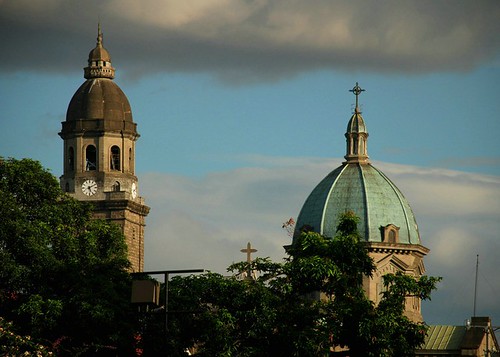
The present Manila Cathedral in Intramuros is the sixth structure erected on the site. The very first one, made of nipa and bamboo, was built in 1581 but was razed to the ground by a fire two years later. Another one, this time made of wood and stone, was built in 1593, but earthquakes weakened its foundation; it had to be completely demolished. A new cathedral was later built on the site. It was the most impressive with three naves and seven side chapels; however, it was destroyed by an earthquake in 1645.
 A makeshift chapel next to the ruins was built, though temporarily, while the new Archbishop of Manila, Miguel de Poblete begged for alms from Manila’s residents to fund the construction of a new cathedral. In 1645, having collected sufficient funding, the fourth cathedral began its construction; it was completed in 1662 and would last for two centuries.
Unfortunately, during a Mass in 1863, it collapsed and killed hundreds of worshippers due to a massive earthquake. A fifth church was eventually built in 1879, and although it survived the 1880 earthquake, its toppled belltower was never rebuilt.
During the Battle of Manila in 1945, many local civilians were held hostage and subsequently massacred by the Japanese inside the cathedral. The American liberating forces, in retaliation, carpet bombed the entire cathedral and the surrounding vicinity to smithereens. Ruins remained on the site for many years until concerned Manila residents convinced the Catholic church in 1953 to build a new cathedral.
In 1958, the sixth Manila Cathedral was inaugurated. It was designed by Fernando Ocampo; Filipino and Italian artists created the interior artworks; and the stained glass windows were designed and built by Galo Ocampo.
Pope John Paul, during his first visit to the Philippines in 1981, elevated the Manila Cathedral to the rank of Basilica Minore and was officially named Basilica of the Immaculate Conception.


* * *
Please note:
I very much appreciate my articles and photos appearing on fellow bloggers' sites, popular broadsheets, and local broadcast news segments, but I would appreciate even more a request for permission first.
Thank you!
I very much appreciate my articles and photos appearing on fellow bloggers' sites, popular broadsheets, and local broadcast news segments, but I would appreciate even more a request for permission first.
Thank you!
Labels: Intramuros
posted by Señor Enrique at 8:19 PM
| 28 comments
Saturday, November 25, 2006
INTRAMUROS IN THE EARLY MORNING


This is Intramuros about 6:30 in the morning. My workshop doesn’t start until 9:00 o’clock but I wanted to get here early this Saturday morning so I can take some pictures just before this part of the city begins its usual grind.
Next Sunday, the first Sunday of December, this place is going to be aglow with a procession of about a hundred carrozas. They are illuminated floats of Marian images from all over the country in celebration of the Immaculate Conception — Cofradia de Intramuros Grand Marian Festival. The floats will start gathering at around 3:00 pm at Plaza de Roma; hence, the entire Intramuros will be closed to vehicular traffic at 2:00 pm.
And later that evening at 7:00 o’clock, at the Manila Cathedral will be the gala performance by Belgian artist Luc Ponet on the newly restored organ. It is open to the public and free.
It should be a wonderful evening next Sunday in the walled city so join the festivities and bring your camera with you.
* * *
Please note:
I very much appreciate my articles and photos appearing on fellow bloggers' sites, popular broadsheets, and local broadcast news segments, but I would appreciate even more a request for permission first.
Thank you!
*
I very much appreciate my articles and photos appearing on fellow bloggers' sites, popular broadsheets, and local broadcast news segments, but I would appreciate even more a request for permission first.
Thank you!
*
Labels: Intramuros
posted by Señor Enrique at 9:18 PM
| 13 comments