Sunday, August 10, 2008
TWO TONS OF CHROME

In the hands of artists Alfredo Juan and Isabel Aquilizan, the folksy jeepney peels the layers of history, returns to the object's military origin, and freights it with gleaming domestic items -- from shovels to steamers.
"M201: In God We Trust" is the title that refers to the model of jeep and the aphorism chosen by many drivers to inscribe on their jeepneys. This jeep was first presented to the Zone of Urgency exhibition in the 50th Venice Biennale in 2003. It was acquired by the Singapore Art Museum which has lent it to the National Art Gallery of the Philippines for a limited trip, or pasada.


The jeepney in the photo below was the once ubiquitous all stainless, 'for-family-use' version. Although I have many fond childhood memories of which -- and learned how to drive in one, in fact -- the most remarkable image of it ingrained in my memory was that owned by a wonderful physician in Subic, Dr. Novales.
Every afternoon around four, people in our barrio with ailing family members would wait by the roadside, and as soon as they see Dr. Novales' owner jeepney, they would wave for him to pull over.
Dr. Novales attended to those afflicted with various illnesses regardless of whether they could afford to pay him or not. But oftentimes, by twilight time, on his way back to the main town of Subic where he lives, you could see various vegetables and a chicken or two at the back seat. Payments, I'm sure for his kind and diligent attention.
My personal interaction with Dr. Novales composed of a series of visits to his office when I was bitten by a dog. The little plastic toys and candies that he gave me after I had one of those anti-rabies shots were of no use to assuage my tears. The sight of that frightening long needle was enough to make me cry.
Through the ensuing years, Dr. Novales continued to make his regular trips in his jeep to the many barrios along the main roads and out in the hinterlands. When I returned to Manila a few years ago, an aunt told me that Dr. Novales had just received a special award for his tireless service to the indigent people of Subic and its neighboring regions. He is now retired.

* * *
Please note:
I very much appreciate my articles and photos appearing on fellow bloggers' sites, popular broadsheets, and local broadcast news segments, but I would appreciate even more a request for permission first.
Thank you!
*
Please note:
I very much appreciate my articles and photos appearing on fellow bloggers' sites, popular broadsheets, and local broadcast news segments, but I would appreciate even more a request for permission first.
Thank you!
*
Labels: art matters, Growing up memoirs, jeep, Museums
posted by Señor Enrique at 9:40 AM
| 13 comments


Saturday, August 02, 2008
GUIDED TOUR OF THE NATIONAL MUSEUM

If you're tired of the malls and now looking for something truly worthwhile to spend your time on, how about taking a guided tour of the National Museum with John Silva?
John is Senior Consultant of the National Museum and has the most fascinating stories and insights about the collection. He guides in an interesting and humorous manner, delighting and inspiring his audience to be proud of their culture and history.
Each tour is three hours in duration, beginning at 10:00 am sharp (ending at 1:00 pm) at the rear entrance of the Museum of the Filipino People, (former Finance Building) Agrifina Circle, Rizal Park.
Tour dates are August 2, 10, 13, 20, 23, 27, 30, and 31st, and September 6, 10, 13, 14, 17, 24, and 27th, 2008.
Attendees are requested to wear walking shoes (please no heels) and reservations are strongly encouraged by texting or calling John Silva at 0926 729 9029. Or email him at jsilva79@mac.com
A portion of the fees (700 pesos for adults, and 500 pesos for children up to 18 years) goes to John's I LOVE MUSEUM PROGRAM, bringing public school teachers to the National Museum to appreciate the arts and later bring their students. Studies show that an arts educated child has higher grades, loves reading more, and make better citizens.

* * *
Related link:
National Museum of the Filipino People
*
THE NATIONAL MUSEUM OF THE FILIPINO PEOPLE
Padre Burgos Street
in the former Finance Building on Rizal Park, Manila
Telephone: +63 2 527 0278
Fax: +63 2 527 0306
Monday - Saturday, 8:30 am to 5:00 pm
Admission: P100
National Museum of the Filipino People
*
THE NATIONAL MUSEUM OF THE FILIPINO PEOPLE
Padre Burgos Street
in the former Finance Building on Rizal Park, Manila
Telephone: +63 2 527 0278
Fax: +63 2 527 0306
Monday - Saturday, 8:30 am to 5:00 pm
Admission: P100
* * *
Please note:
I very much appreciate my articles and photos appearing on fellow bloggers' sites, popular broadsheets, and local broadcast news segments, but I would appreciate even more a request for permission first.
Thank you!
*
I very much appreciate my articles and photos appearing on fellow bloggers' sites, popular broadsheets, and local broadcast news segments, but I would appreciate even more a request for permission first.
Thank you!
*
Labels: Museums, walking tour
posted by Señor Enrique at 6:29 AM
| 20 comments
Friday, May 11, 2007
THE UST MUSEUM OF ARTS & SCIENCES
 Reputedly the oldest museum in the country, the UST Museum of Arts & Sciences began collecting and classifying specimens as early as 1865. In the beginning, it was merely a co-curricular arm of the UST Faculty of Medicine and Surgery, but it eventually began amassing a number of items which were not necessarily related to the medical endeavor.
The museum was founded in 1870 by Fr. Ramon Martinez Vigil, professor of Natural History. However, it was Fr. Casto de Elera who systematically gathered, identified, and catalogued most of the specimens needed for a natural sciences museum. Armed with well-documented collections, the university soon participated at several international exhibits where it won precious awards.
It was only in 1941 when it also became a Museum of Arts. It came about after the organization of the First National Painting Exhibit by Fr. Silvestre Sancho who was then the university rector. The museum began acquiring paintings of the masters of that time — Carlos B. Francisco, Galo Ocampo, Vicente Manansala, Fernando Amorsolo, and etc.
Unfortunately, due to a lack of space, there is no formal art gallery within the UST museum; most of the collections are hung along the walls, while the rest are stored in cabinets for security and protection. Besides the problem of space, the museum also faces the high costs of cleaning and restoration. The antiquity of most of these paintings and the lack of optimal maintenance magnify the great need for many items in its collection to be restored. Many frames, which are works of art by themselves, also require much-needed repairs.
Some of these paintings and murals are displayed outside of the UST museum. In the lobby of the main building are four large murals by Antonio Garcia Llamas which depict the university’s history. Along the sides of the wide stairway and on the landing leading to the entrance to the museum are the large paintings by Carlos “Botong” Francisco, Galo Ocampo and Dante Fabie. Likewise, in the Medicine Building lobby are murals by Vicente Manansala, which portray the history of medicine in the Philippine Archipelago.
The UST museum also boasts a wide collection of rare books and printing paraphernalia, native santos, coins, medals, Oriental ceramics, and ethnographic artifacts. It also exhibits the university’s memorabilia such as antique chasuble, gold monstrance, and various ceremonial items.
The museum was able to safeguard its extensive collections when it moved from Intramuros to its present location; hence, avoided the massive destruction precipitated by the American carpet bombing sorties during the Battle of Manila. The campus was also declared a neutral zone during the war, while the Japanese converted it into an internment camp for their American prisoners of war.
The museum’s current special exhibition is the 60th Anniversary of the Liberation of the Santo Tomas Internment Camp.


The UST Museum of Arts & Sciences
Mezzanine, Main Building
University of Santo Tomas
Telephone: 781-1815
Open Tuesdays to Fridays - 9:00am to 4:30pm
Admission fee: Students - P20.00 / Adults - P30.00
.
Mezzanine, Main Building
University of Santo Tomas
Telephone: 781-1815
Open Tuesdays to Fridays - 9:00am to 4:30pm
Admission fee: Students - P20.00 / Adults - P30.00
.
Labels: Museums
posted by Señor Enrique at 7:13 AM
| 36 comments
Tuesday, May 08, 2007
NATIONAL MUSEUM OF THE FILIPINO PEOPLE
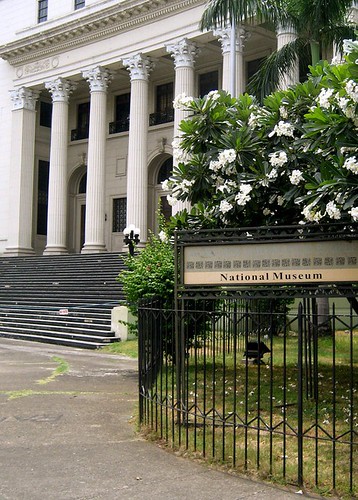 On August 12, 1887, a royal decree established Museo-Biblioteca de Filipinas — a museum and library in Manila under the auspices of the Spanish Governor General of the Philippines. It was inaugurated two months later on Cabildo Street in Intramuros, Manila.
There were three sections opened to the public. The Anthropology and Ethnography exhibited weapons, household object, costumes, anitos, and other specimens from the tribes of the northern part of the Philippines. Two galleries were designated for Natural History while a Gallery of Fine Arts and Industries displayed oil paintings by scholars of the Escuela de Dibujo y Pintura, as well as products of Tayabas Province.
In its early years, the museum was headed by notables such as the eminent botanist, Sebastian Vidal y Soler, and in the 1890s, by Filipino lawyer and intellectual, Pedro Paterno.
During the American period, a new and separate museum, The Insular Museum of Ethnology, Natural History and Commerce was established in 1901. From thereon during the American colonization, the museum would be constantly re-organized and moved from place to place. Despite this instability, more than 20,000 documentary photographs and 40,000 specimens were collected before the Second World War. Unfortunately, the American bombings during the Battle of Manila, only one-third of the ethnology specimens were saved.
The Finance Building, built in 1940 as the Commerce Building, has been designated as the "Museum of the Filipino People.” It was designed mainly by Filipino architect, Antonio Toledo. This structure was also bombed by the American forces during the height of the war to flush out the remaining Japanese soldiers holed up there. It was later rebuilt by the architect Antolin M. Oreta and was then occupied by the post-war Department of Finance.


THE NATIONAL MUSEUM OF THE FILIPINO PEOPLE
Padre Burgos Street
in the former Finance Building on Rizal Park, Manila
Telephone: +63 2 527 0278
Fax: +63 2 527 0306
Monday - Saturday, 8:30 am to 5:00 pm
Admission: P100
Padre Burgos Street
in the former Finance Building on Rizal Park, Manila
Telephone: +63 2 527 0278
Fax: +63 2 527 0306
Monday - Saturday, 8:30 am to 5:00 pm
Admission: P100
* * *
Related link:
Guided Tour of the National Museum
* * *
Guided Tour of the National Museum
* * *
Please note:
I very much appreciate my articles and photos appearing on fellow bloggers' sites, popular broadsheets, and local broadcast news segments, but I would appreciate even more a request for permission first.
Thank you!
*
I very much appreciate my articles and photos appearing on fellow bloggers' sites, popular broadsheets, and local broadcast news segments, but I would appreciate even more a request for permission first.
Thank you!
*
Labels: Museums
posted by Señor Enrique at 12:49 PM
| 49 comments
Wednesday, May 02, 2007
THE NCCA TEACHER ORIENTATION PROGRAM

It was with great pleasure that I joined a group of public school teachers (in photo above) and some folks from the National Commission for Culture and Arts (NCAA) in their all day four-museum tour last Monday. This was a significant part of the efforts of the NCCA 16-member Sub-Com on Science and Technology Museums to bring museums closer to the hearts and minds of the Filipino people.
In New York where I lived for many years, museums, science expo centers and theme parks play a vital role in peoples’ culture and heritage. In fact, no tourist will come to New York without visiting at least a couple of its museums. Sadly, here in Manila, oftentimes our local folks favor going to the malls and leisure parks instead of an art or science museum. And since having moved back to Manila, not once was I invited by a relative or friend to any local museum. This is because, they haven’t gone inside a museum themselves nor had any interest for our native flora and fauna.
Thus, the NCCA has established the Teacher Orientation Program (TOP) on Science and Technology Museums. Its goal is to address this cultural dilemma of ours. The idea is to target the participation of teachers, as well as tour coordinators, so as to increase their awareness on the valuable and incomparable education in which their students can discover by visiting any of its member-museum, science center and botanical and zoological park.
And last Monday, I was with this group of teachers and enjoyed a guided tour of the UST Museum, Museo Pambata, National Museum, and Orchidarium.
Personally, I hope that in this upcoming school year, instead of our students going on tours to amusement parks, malls or television game and variety shows, our teachers will now take them to our science and technology museums.
 UST Museum of Arts & Sciences
 National Museum
 Museo Pambata ng Maynila
 The Orchidarium and Butterfly Pavilion
The following are members of the Science & Technology Museums, a sub-committee of NCCA Committee on Museums:
The Coca-Cola Pavilion
Malabon Zoo and Aquarium
Manila Zoological and Botanical Gardens
Museo Pambata ng Maynila
National Museum
Nayong Pilipino
NFA Grains Industry Museum
The Orchidarium and Butterfly Pavilion
Ninoy Aquino Parks and Wildlife Center
Philippine Air Force Aerospace Museum
Philippine Science Centrum
Philippine Science Heritage Center
IRRI Riceworld Museum and Learning Center
UPLB Museum of Natural History
UST Museum of Arts and Sciences
For more information, call:
National Commission for Culture and the Arts
633 General Luna Street
Intramuros, Manila
Telephone: 527-2192
The Coca-Cola Pavilion
Malabon Zoo and Aquarium
Manila Zoological and Botanical Gardens
Museo Pambata ng Maynila
National Museum
Nayong Pilipino
NFA Grains Industry Museum
The Orchidarium and Butterfly Pavilion
Ninoy Aquino Parks and Wildlife Center
Philippine Air Force Aerospace Museum
Philippine Science Centrum
Philippine Science Heritage Center
IRRI Riceworld Museum and Learning Center
UPLB Museum of Natural History
UST Museum of Arts and Sciences
For more information, call:
National Commission for Culture and the Arts
633 General Luna Street
Intramuros, Manila
Telephone: 527-2192
.
Labels: Museums
posted by Señor Enrique at 8:22 PM
| 28 comments