Monday, September 18, 2006
MANILA'S PLAZA GOITI
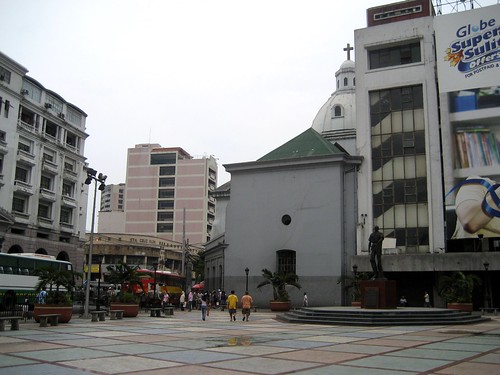
I was inspired to post this entry about Plaza de Goiti after seeing a very old photograph of it with horse-drawn carriages, as well as a postcard published in 1932 showing the area teeming with what look like Model T Fords. What a remarkable difference compared to the above photo.
It is now known as Plaza Lacson; a tribute for the soccer player at Ateneo de Manila University and amateur boxer who once challenged Ferdinand Marcos to a fistfight and called Ernesto Maceda (who was then a Manila councilor) “so young and so corrupt.” Arsenio Lacson was supposedly the best mayor the city of Manila ever had. His statue stands tall on a pedestal across the old Roman Santos Building.

To the left of Mayor Lacson’s statue is the LRT Carriedo Station. It was on Carriedo Street and Avenida Rizal where Henry Sy’s original ShoeMart once was. One block south of Carriedo is Carlos Palanca Street, named after Don Carlos Palanca whose real name was Tan Quien-sien; a wealthy and influential Chinese trader in Manila during the late 19th century. And right off MacArthur Bridge was the popular Clover Theatre; a vaudeville theater where Don Jose Zarah’s Extravaganza and jazz pianist Ping Joaquin (brother of writer Nick) entertained many of Manila’s inhabitants. The annex building of City College of Manila now stands on its spot.
The very first school, however, that established itself at Plaza Goiti was Adamson University, but it was originally called Adamson School of Industrial Chemistry. The Philippines’ steady progress towards industrialization during the early thirties demanded people to be trained in technology to man the increasing number of local industries. Inspired by this economic trend, three Greek cousins — Dr. George Lucas Adamson, Alexander Adamson and George Athos Adamson — founded the Adamson School of Industrial Chemistry on June 20, 1932. The School, which was set to train young men and women in Industrial Chemistry, was housed at the Paterno Building at Plaza Goiti. It opened on July 1, 1932 with only 42 students. A year later, the population grew to 300, which necessitated its transfer to more spacious quarters.
After the war, Dr. George Lucas Adamson re-opened the school, this time, in the premises of the Vincentian Fathers at San Marcelino Street. In 1964, the University was turned over to the Vincentian Fathers, which signaled the transformation of Adamson University to a Catholic Institution of learning.
Another learning enterprise that had its start at Plaza Goiti is the Far Eastern Aeronautics School, which in 1946 offered the first aeronautical classes in the country. It consequently received commendation from the Philippine Educational System for having pioneered in aeronautical education. In 1959 it became FEATI University with expanded academic programs, including architecture and fine arts. Among those who became dean of FEATI's School of Architecture was Juan Marcos de Guzman Arellano who designed the Post Office, Metropolitan Theater, and Legislative building. FEATI's five-storey building at Carlos Palanca Street behind the Plaza Fair building was completed in 1953.
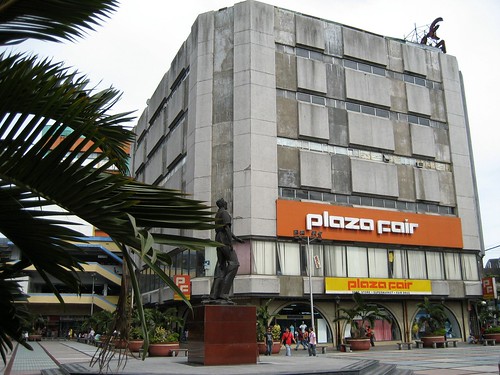
A major banking concern established on June 18, 1951 at Plaza Goiti was Security Bank and Trust Company. It has prospered even in the most trying times, remaining steadfast amidst the economic, political and social upheavals in the country’s history. It has steadily moved with the brisk pace of economic growth that characterized the 1950’s. Three years later, the corporate headquarters moved to Escolta, fittingly at the nation’s pre-eminent business district.
Another interesting, though somewhat morbid piece of trivia I dug up online: Citing its source as Turn of the Century by Gilda Cordeo Fernando and Nick Ricio, DLSU-D Website mentions La Funeraria, the first funeral parlor in the Philippines. It was supposedly established by Carlos March at no. 3 Plaza Goiti. It advertised hermetically-sealed coffins imported directly from Europe, embalming at moderate prices, “French Style Packing” of corpses, and an assortment of epitaphs. La Funeraria sternly warned the public against imitations and assured the public of guaranteed airtight coffins!
Its main competitor, the Phelipino Undertaking, a funeral parlor owned by Mr. Feliciano Quiogue, located at Calle Salazar, Trozo No. 2, offered luxurious funeral services consisting of one hearse with four horses, a metallic coffin and four attendants, with two carriages for mourners, all for P85.00!
The DLSU-D Website also mentioned a John Bancroft Devins who in 1905 wrote that the Spanish Friars collected varying fees for funeral services, depending on what robe they wore for the service and the length of prayers they offered. Every stroke of the church bell announcing the death would cost from tent cents to a dollar (P0.20 to P2). The Funeral itself could be ordinary, solemn or most solemn, with corresponding fees. Burial charges were extra. If the friar went all the way to the grave, it is twice as expensive if he went only half way. If death and funeral fees were not forthcoming, there can be no bells rung, no services held. Dying was expensive even for the poor who paid P30.00 for burial services!
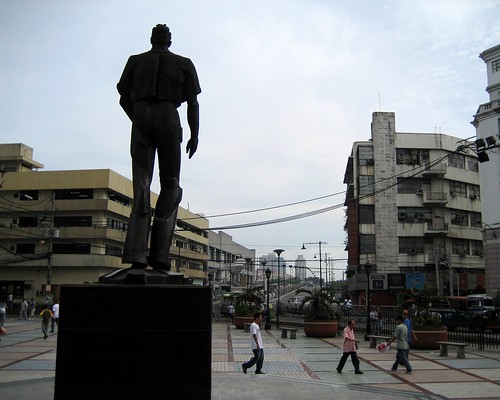
Martin de Goiti, for which this plaza was originally named after, was a Spanish conquistador and explorer who tricked the Muslim kings into believing that the Spaniards who came and camped in the shores of Manila Bay on May 8, 1570 were only visiting for a short period. As what usually happens with any overstaying visitors, the welcome mat would eventually get worn out and the host’s inhospitable thoughts would begin manifesting themselves. In short, the natives grew restless and started bickering with the visiting Spaniards.
Only sixteen days after their arrival, Goiti has had enough of these quarrels. He marched his 300 soldiers towards Tondo were they met thousands of native defenders, but somehow managed to defeat and kill most forces of Suliman, Lakandula and Matanda. Goiti took the rulers as prisoners; summarily torturing and executing those who refused to accept Spanish rule. Goiti and Juan de Salcedo, his second in command, then marched their armies towards the Pasig River and captured the city of Manila on June 6, 1570 and burnt it to the ground, killing more natives in the area.
After the battle, both sides were still unable to negotiate an agreement; hence, sporadic bloodsheds and sieges continued for another ten months. The Spaniards, on the other hand, fortified their outposts by erecting Fuerza de Santiago. Nonetheless, some battle-weary Spaniards would sometimes seek shelter aboard their fleets in Manila Bay.
Upon Legazi’s arrival in Manila on June 24, 1571, the Spaniards had finally taken control of the settlements and a peace agreement was put into effect. It was Goiti's bloody conquest that paved the way for the establishment of Manila as a permanent Spanish settlement and capital city of the Philippines. He later explored Pampanga, Pangasinan and founded several cities in Luzon from 1571 to 1573.
in the early periods of 1574, Goiti also fought against the invasion of 3,000 Chinese pirates and warriors who attacked Fuerza de Santiago, besieged certain parts of the city of Manila, and massacred most of the Spaniards in the city. Goiti was killed by the pirates’ leader, Lin Tao Kien, now known as Limahon or Li Ma Hong.
Spanish reinforcements came all the way from Vigan and Cebu. Juan de Salcedo left Ilocos Sur after learning of Goiti’s death and headed for Manila, which he later discovered as having fallen to the Chinese pirates. Salcedo's forces succeeded in driving out the Chinese pirates out of Manila. Li Ma Hong and his surviving soldiers retreated to Pangasinan, but were later captured. The death of Goiti was avenged by the Spaniards by burning Li Ma Hong and his warriors alive. Their warships were also burnt.
Martin de Goiti was laid to rest in a tomb inside the San Agustin Church in Intramuros.
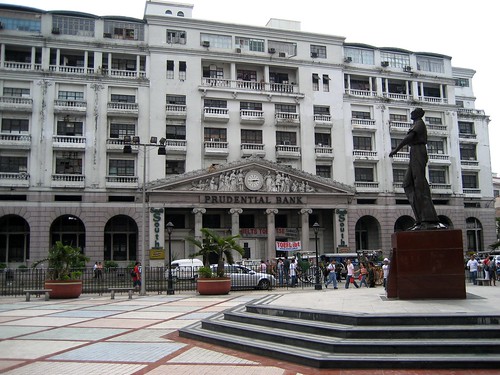
And finally, this Greco-Roman building — The Roman Santos Building — built by a successful businessman who also founded Prudential Bank.
Dona Marta Rodriguez y Tuason married Don Hilarion Santos. They had two children: Rafaela Santos y Rodriguez who married Vicente Fernandez and Roman Santos y Rodriguez who married Juliana Andres. After the death of Don Hilarion Santos, Dona Marta Rodriguez, viuda de Santos married Don Domingo Carlos.
Roman Santos y Rodriguez was raised as a ward by his first cousin Dona Florencia Sioco de Gonzalez in Barrio Sulipan, Apalit, Pampanga. Her elder sister, Dona Sabina Sioco de Escaler, lent him the initial capital to purchase his first bamboo "casco" (raft) with which he ferried the dry goods he was buying and selling in various towns.
Don Roman Santos y Rodriguez founded Prudential Bank. The building named after him still stands across from Plaza Goiti.
* * *
Please note:
I very much appreciate my articles and photos appearing on fellow bloggers' sites, popular broadsheets, and local broadcast news segments, but I would appreciate even more a request for permission first.
Thank you!
*
I very much appreciate my articles and photos appearing on fellow bloggers' sites, popular broadsheets, and local broadcast news segments, but I would appreciate even more a request for permission first.
Thank you!
*
Labels: life, life in Manila, Manila history
posted by Señor Enrique at 2:54 PM
| 35 comments