Wednesday, November 29, 2006

SUPPORTING THE LOCAL TAILOR


While looking at my shirts drying in the sun one day, I thought it might be fun to experience what it’s like to have something custom-tailored these days.

Having lived in New York, I had grown accustomed to buying my clothes off the rack — be it at Macy’s, Barneys, Bloomingdale’s, and Bergdorf Goodman’s Men store. Unlike as a kid when my father took me along to his neighborhood tailor; while ordering a shirt or a pair of pants for himself, a pair of shorts would sometimes also be requested for me. And during my early teens, I would go to Divisoria or Central Market with my brothers and cousins to shop for fabrics, and then take them to the tailor to be made as shirts or pants.

Ready-to-wear clothing then was unexplored territory; even our corduroy and denim jeans were custom-made. Nowadays, it’s the other way around, boosted by designer labels, retails sales of local and imported RTW garments (including its knock-offs) remain strong; consequently forcing most tailors to close shop.

As it was, when getting something custom-made, the first step is to shop for the fabric. Divisoria has always been “the place” to go to, but you really have to invest a lot of time and effort to search for the best merchants with the best selections; a couple of hours’ trip isn’t going to cut it. Thus, I was only able to find one piece of fabric with the color and pattern I like — P150 (three US dollars) for two yards of Korean cotton — for a short-sleeved shirt. For this job, the tailor in my neighborhood charges P400 for labor (eight US dollars). Had he supplied the fabric, it would have cost me P1000 (twenty US dollars) for both the fabric and labor. Incidentally, the tailor carries a nice collection of Swiss cotton fabrics for dress shirts.

As for the trousers, the cost for labor is P450 (nine US dollars). You can also select from the shop’s collection of fine fabrics — P1350 for both the fabric and labor (twenty-seven US dollars).

Barong Tagalog is this shop’s specialty as well for which the labor is P1500 (thirty US dollars) with lining which they would supply; however, if your fabric is of heavier quality, no lining would be necessary so the labor charge is lesser. If the shop supplied the fabric for the Barong Tagalog, the entire custom-made order would cost you P5000 (one hundred US dollars).

My initial custom-made order for a short-sleeved shirt cost me a total of P600 (twelve US dollars). The tailor didn’t have to take my measurements, because I brought one of my favorite Banana Republic short-sleeved shirts for him to measure and copy its cut.

The second order was for a pair of chinos in khaki. I couldn’t find a nice fabric in Divisoria so I chose from the tailor’s selection of U.S. twill cotton. For the fabric and labor, I was charged P1350. I brought along an old pair of trousers from the Gap which they measured and copied its styling.

The third was for a Barong Tagalog. I really cannot figure out how some locals can comfortably wear even a lightweight suit in this tropical weather. Last time I wore a suit I felt so uncomfortable I promised myself that I would get a Barong Tagalog soon. I already have the fabric, a Christmas gift from a cousin, so I was charged P1500 for labor; a lining they had to include because of the thin fabric. This time, unlike my order for the short-sleeved shirt and chino trousers, I had to be measured for a perfect fit.

It took about a week for my entire order to be finished. I was happy with each item and very much impressed by their workmanship. Actually, before I left the shop, I placed another order; this time for a pair of dress pants in black to go with my Barong Tagalog.

When I moved to Manila, I still continued shopping in New York through the Internet and had all the items shipped to my brother’s house. He would toss them into a balikbayan box and ship it door-to-door once filled. But the problem I had with this arrangement was that since I don’t need as much new clothing nowadays, it would take many months to fill one balikbayan box plus a couple of more for it to arrive in Manila. So I thought, for a change, why not support the local tailor instead. I’m glad I did.


*

posted by Señor Enrique at 4:42 PM | 21 comments


Monday, November 27, 2006

LINES OF STARS


I spent most of Sunday with my sister and a cousin from San Francisco. I took them to Carlos Celdran’s tour of Fort Santiago and San Agustin Church in the morning (which they loved and raved afterwards) and then we headed to SM’s Mall of Asia (MOA); my sister who loves this mall just had to show my cousin something from a certain store.

But before going to that store, I told them that I’d just sit and wait for them at the ground floor open area. I’ve lost the fascination for malls; only time I would go to one is if I had to buy something, or park the car in their lot (which is safer) and then head over somewhere else. This was my very first time to go to MOA; one thing I noticed immediately is that it has upscale retailers that used to be only in Makati’s tony Glorietta and Greenbelt malls.

Anyway, since my camera bag was with me, I started looking around for something hip and interesting to photograph like a store signage or façade, but didn’t see any from where I was sitting. However, when I looked up in the sky, a big smile appeared on my face. I immediately whipped out the camera from the bag and started shooting. I love these bright yellow star lanterns with the blue sky and white clouds as backdrop. And thank God there wasn't any SM security guard to stop me from taking some photographs.

When my sister and cousin came back, they apologized for having kept me waiting, but I immediately hushed them. I then assured them that I had managed to enjoy myself somehow while I waited. We then headed to Binondo for some steamed dumplings.

posted by Señor Enrique at 7:54 PM | 16 comments


Sunday, November 26, 2006

BOOK SALE AT GATEWAY MALL


Since I am one of those who read up to expand my understanding and enjoyment of things that I usually get into, I’ve recently asked fellow members of my camera club what books they own which they would recommend to nephytes on digital photography.

Besides
The Photoshop CS2 Book for Digital Photographers by Scott Kelby, which was previously mentioned to me by Senorito Ako, I now have two other titles that I'm excited to check out as suggested by fellow camera club members — Humble Masterpieces (Everyday Marvels in Design) by Paola Antonelli; and Digital Photography Handbook by Doug Harman. The former is not strictly a photography book, but its overall content should help photographers in terms of learning about composition and style.

Much to my delight, another fellow camera club member had just informed me that Gateway Mall in Araneta Center in Cubao, Quezon City will be holding a mall-wide sale event from November 30th to December 3rd.
Fully-Booked, one of this mall's retailers and among Metro Manila's largest bookstores, will be participating in this event. Supposedly, all its imported books, coded as "D" will be reduced by 20% when paid in cash, or 15% off for credit card payment. Books, coded as "N" will be 10% off for cash 5% for card payment accordingly. Not bad at all.

What adds to this excitement is that instead of driving to Cubao, I will instead take the MRT railway system for the very first time; it shouldn't take me more than fifteen minutes from Recto to Cubao.

So if you have any particular book in mind you wish to purchase for yourself or as a gift to someone this coming Christmas, Fully Booked at Gateway Mall is the place to go to beginning later this week.

posted by Señor Enrique at 11:08 PM | 8 comments


Saturday, November 25, 2006

INTRAMUROS IN THE EARLY MORNING


This is Intramuros about 6:30 in the morning. My workshop doesn’t start until 9:00 o’clock but I wanted to get here early this Saturday morning so I can take some pictures just before this part of the city begins its usual grind.

Next Sunday, the first Sunday of December, this place is going to be aglow with a procession of about a hundred carrozas. They are illuminated floats of Marian images from all over the country in celebration of the Immaculate Conception — Cofradia de Intramuros Grand Marian Festival. The floats will start gathering at around 3:00 pm at Plaza de Roma; hence, the entire Intramuros will be closed to vehicular traffic at 2:00 pm.

And later that evening at 7:00 o’clock, at the Manila Cathedral will be the gala performance by Belgian artist Luc Ponet on the newly restored organ. It is open to the public and free.

It should be a wonderful evening next Sunday in the walled city so join the festivities and bring your camera with you.


* * *

Please note:
I very much appreciate my articles and photos appearing on fellow bloggers' sites, popular broadsheets, and local broadcast news segments, but I would appreciate even more a request for permission first.
Thank you!


*

Labels:

posted by Señor Enrique at 9:18 PM | 13 comments


Friday, November 24, 2006

DUET


So I spent the whole of yesterday, Thanksgiving Day in America, busily preparing to submit via email the assignments in my digital photography workshop. Days before, I was grappling how to perform certain configurations with my camera; seriously, they have got to write better manuals. Ever wonder why almost no one bothers reading them?

Anyway, instead of succumbing to frustrations, I put everything aside and decided to go to bed. The next day, after having my breakfast, I took out the camera from its bag — and lo and behold — with a calmer disposition, I was able to figure out how to go about what I needed to do. I also came up with an ingenious method to guide my manual settings.

This experience somehow reminds me of Carl Jung’s Theory of Synchronicity; that supposedly, what happens on the planetary plane also occurs simultaneously in the spiritual. And this may be why Albert Einstein, whenever stumped, would opt to take a nap. And upon waking, voila! He had the answer in mind. The same thing happened with Alan Turing whose work helped made personal computers a reality. While lying on the grass in a meadow and just about to be lulled to sleep, a certain algorithm came to his mind which soon led to his creation of the Turing machine — able to turn thought processes into binary numbers (ones and zeroes). It was a form of artificial intelligence aimed to solve a problem or task, which eventually became one of the key turning points in the history of electronic computing.

Carl Jung went on to argue that the mental state between waking and sleeping is most often the point in which humans are subconsciously able to draw from the spiritual plane. At other times, it would be what some would nowadays refer to as the zone.

Ever notice when you’re tinkering with your car or some mundane household chores when a brilliant solution to a nagging problem suddenly comes into mind? What about the time when you unexpectedly find yourself drawn into buying a certain newspaper or magazine which you never have purchased before only to discover in one of the articles or press release blurbs about a clue that would soon lead you to that elusive solution?

Or how about this: the Copyright Office of the American Library of Congress states that a copyright does not protect an idea; rather, it is the unique expression of that idea that can be protected with a copyright. In other words, if I were to apply for a copyright to protect my idea to turn white metal to gold, that application would be summarily rejected. However, if I were to include in my application how I intend to turn white metal into gold, I would then be issued copyright protection.

I mention this because for any particular idea, the Copyright Office would simultaneously receive an average of three thousand applications pertaining to that very same idea. Now here comes another question: ever notice that Hollywood sometimes churns out two or three films with basically the same theme? Or how about this: you hear a certain song on the radio for the very first time yet it seems so hauntingly familiar.

Actually, it is in the field of music in which Carl Jung’s theory of synchronicity is always evident. When Elton John (after having been released from a drug rehab center) was asked by a reporter why a highly successful artist like him would resort to drugs, he merely retorted, “I was afraid it would stop coming.” This should explain how Mozart was able to write complete operas and symphonies without the aid of a piano or any musical instrument. And this should also explain — when watching those glitzy annual music awards — how many artists would spontaneously thank God when receiving their awards. Now compare this incidence with the other award shows that you watch.

I have met many music enthusiasts in my life — from students to some of the most influential and powerful icons of the American music industry — and what I notice is that the ones on top are often the nicest, while those at the bottom are the nastiest (and sometimes relegated to doing day jobs as music store clerks). Perhaps, the reason why those on top are so nice is because they know that their music that put them up there actually came from a higher source.

Finally, I am going to go on a limb here and claim that God doesn’t need any man-made music to glorify Him. I think what He wants is for us to hear more of the great music from the spiritual plane that some of our artists are able to pick up, record, and make a million bucks from. Because for the most part, what makes this music great is because of only one element — it heals our soul; hence, making our journey on this planetary plane a little lighter, so to speak.


Photo title: Duet
Camera: Nikon D80
Focal length: 62.0mm
Flash: not used
Exposure time: 0.100s (1/10)
Aperture: f/5.3
ISO: 100
Exposure bias: 1.330
WB: auto
Metering mode: matrix


Click photo for larger image

Labels:

posted by Señor Enrique at 8:07 AM | 18 comments


Wednesday, November 22, 2006

BREATHING LESSONS – Part 2

It was a week before Christmas. Although it wasn’t yet six o’clock in the evening, the snowfall sent most pedestrians scurrying home; making the sidewalks looked virtually deserted in contrast to Fifth Avenue’s snarled traffic in this Friday evening rush.

I was living in Yorkville at that time. Going home from work, I would take the Lexington Avenue subway line at Grand Central Station. To get there, I would usually cut through 42nd Street from Fifth Avenue.

However, on that particular evening, I decided to first head on over to West 45th Street to check out the holiday window display of Harvey’s Electronics. At that time, this was New York City’s premier store when it came to high end sound system components.

As was often the case, I would stand in front of the window and admire some of the latest esoteric home entertainment systems and equipment. Oh God! Give me one of these and I’d definitely share it with others. This was a phrase I would repeat to myself like a mantra whenever I ogled at the store's window display. I knew then that it would only be through the grace of God that I was to acquire such impeccably-engineered components.

Many years passed before the universe did provide a series of opportunities that subsequently allowed me to acquire the sound system of my dreams. I was already in my early thirties by then and living an upwardly mobile life, so to speak. I was home one night and had just installed the final component to complete the setup which was delivered earlier that afternoon by none other than Harvey’s Electronics. Afterwards, as I enjoyed a CD by Jade Warrior, trying to figure out what else I could possibly add to it, the memory of that evening when I stood in front of Harvey’s window suddenly came back to mind; most significant was the part in which I promised to share it with others.

But how was I to go about it?

As I pondered on this question, another memory consequently came back to mind — the time when the cancer that precipitated my father’s liver cirrhosis had metastasized to affect his mental faculty. He was released from UST Hospital after it was concluded that nothing else could be done for him. He was to spend the rest of his time at home; mostly in bed and no longer able to communicate, though he could still walk about for brief moments.

In the afternoons when there was no school, I would gladly look after him while my mother sought respite at Espiritu Santo Church. At fourteen, I had willingly become my father’s part time caregiver. Surprisingly, I was never repulsed by some of the tasks involved (such as cleaning him up after he had gone to the bathroom). I simply attended to each one as best I could, though sometimes I needed to be stern with him, especially during those times when he would become impatient and point to his bedroom; wanting to go back immediately without my having completely cleaned him up. As for his baths, it was my mother who would attend to it with the assistance of our household help.

But unbeknownst to my mother, as soon as she had left the house for church, I would open all the windows in my father’s bedroom and bring in my portable Sony stereo reel-to-reel tape machine and some pre-recorded tapes that one of my brothers had brought home from the States. I would play my father’s favorite music first and then mine. At times I would sing along with some of the tunes. I’d also light up a cigarette and have my father enjoy a couple of puffs while I held it to his lips. I knew that a cigarette or two couldn’t possibly inflict further damage to his already irreversible condition.

Besides the music and cigarettes, I would also read him the news from the newspaper and tell him stories about mundane events in school, as well as synopsis of the movies I had seen with school friends or cousins. And since I was designated to pick up his check at the office, I’d fill him in on whatever news I had picked up, including messages from everyone. Through it all, he would only stare at the ceiling mindlessly or stare at my face; unable to say anything. However, through his eyes, I knew he enjoyed those afternoons I spent with him.

And just before my mother returned from church, I would have already cleaned up and aired out all traces of our secret activities. By the time she walked in, the room was back to its pristine condition — perfectly suitable for a chronically ill patient. Naturally, the household help knew all along what was going on, but they knew better than to tell my mother on me. At home, with the rest of the family and everyone else, I started to become edgy; subject to intense mood swings; and had become too smart for my own good. It was a demeanor they had never seen in me before. A month or so afterwards, my father slipped into a coma and would spend the rest of his life in a hospital. It was a long arduous ordeal for everyone, indeed.

It was this memory of my father which consequently gave me the idea on how I could best share the blessings I had just received. I called my salesman at Harvey’s and ordered some additions. The next day, my setup now included two CD players, two turntables, a reel-to-reel tape recorder, two cassette recorder and player, and a mixer. And with my extensive collection of vinyl albums and CDs (received from major record labels as promo copies when I worked in the industry, including recently purchased CDs), I began putting together onto cassette tapes a series of soothing music. I would then donate them to people who were terminally ill or who were coping with life-threatening illnesses.

My friends helped me give them out. Eventually, through word of mouth, I started getting many requests; one of whom was from a staff member of a hospice in New Mexico, which I ended up donating tapes to its lending library on a regular basis. About three years later, that hospice received substantial endowments from private foundations that enabled them to build a building of their own. In its inauguration the ceremonial ribbon was cut by their senator who was also instrumental in their receiving some federal funding. I was invited but unable to attend.

By the late ‘80s, interest in alternative healing was at its peak — yoga, creative visualization, and various holistic disciplines. In lockstep, the power of music to heal generated much wider attention including constant media attention. Soon thereafter, many recordings from independent labels were released to meet a growing demand. Even hospitals began installing sound systems in their operating rooms for a growing number of surgeons who prefer to play soothing music while performing complex and lengthy procedures. By that period, I felt I had done my job and would just point to these commercially available recordings whenever I would receive further requests for copies of my tapes.

However, by the mid-‘90s, bored by the New Age music genre and the usual catalogue of classical music (re-released but now dubbed as soothing music), I started receiving inquiries once again. Some even offered substantial money just for me to provide them with tapes for their loved ones coping with cancer or AIDS. They knew it wasn't going to miraculously heal them, but they also knew about the power of music to assuage the debilitating pain associated in their illnesses. Finally, to address these growing requests, with a group of some friends, we devised a plan to broadcast this particular kind of music programming through the Internet, which would enable everyone to listen to its streaming broadcast 24 hours for free.

Unfortunately, what hindered us from launching this startup effort was the inability by the music industry and the federal government to develop the ideal business model that would establish fair licensing fees for us to broadcast music online. On top of this great delay, the Internet bubble finally burst; hence seed monies for our startup venture suddenly became scarce. We had to fold our project and move on our separate ways.

A couple of years later, a great interest for it reemerged. It was the time when America was struggling with the aftermath of 9/11. Alas! I was already intent on moving to Manila by then, while the other members of our group had gone on to sign lucrative deals with other Internet-based companies.

I believe there’s a certain cycle and rhythm in life. And the ideal time for us to get together once again to breathe life into this project, if ever, would be in a couple of more years; however, by then, it would entail exploiting a different technology.

Be that as it may, the many years I was involved in this personal effort with programming soothing music assures me that I had sincerely lived up to my end of the bargain, which I made many years ago; one evening a week before Christmas.

Breathing Lessons — Part 1

posted by Señor Enrique at 6:05 PM | 18 comments


Tuesday, November 21, 2006

NOITE BRASILEIRA EM MANILHA

Translated from Portuguese, it means Brazilian night in Manila, which aptly describes what happened at the Rajah Soliman Plaza Sunday night during the final series of the Philippine American Jazz Festival.

After
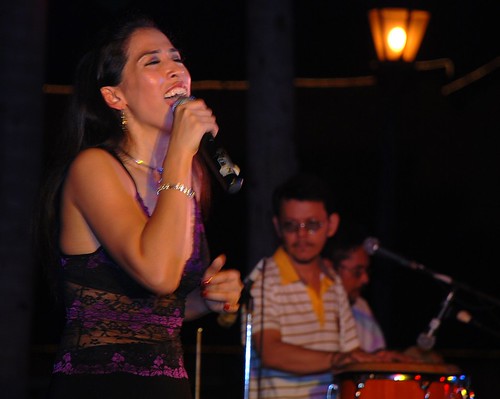
Bob Aves and Grace Nono had finished their set, Escola de Samba de Manila took over the stage (see top three photos) and transformed this part of Roxas Boulevard into a sizzling Copacabana with their exhilarating rhythms of samba. Eileen Sison led her samba school students into wowing the audience with their colorful clothes, gigantic headdresses, blurring hip gyrations, and infectious high-energy carnival music.

Guarana then took the stage. Eileen was once again at the forefront; however, this time, it was to enchant the audience with the sensuous sounds of bossa nova. This music — evocative of discreet charms and impermanence of life in which elements of nature are sometimes used allegorically to mask the true intentions of smitten lovers — flowed seamlessly with the warm breeze coming from Manila Bay. Many in the audience were certainly captivated by the alluring bossa nova as evidenced by the spontaneous applause not only at the end of every song, but during its performance as well. Hence, proving once more that bossa nova, though a native of Brazil, has an endearing power to find a warm spot in any one’s heart and call it home.

It is for this reason why many American artists from jazz to rock (such as Sarah Vaughn, Shirley Horn, Diana Krall, Ahmad Jamal, Herbie Mann, Brian Ferry, George Michael, David Bowie, Michael Franks, and etc.) have intimate relationship with Jobim’s original compositions and/or with his bossa nova. And in the Philippine jazz scene, Eileen Sison, Richie Quirino and the rest of Guarana have become this music’s leading proponents.

As for Guarana’s finale last night, they were joined by Escola de Samba to prompt the audience to get up and dance, or as the Brasileiros would say, samba the night away.




posted by Señor Enrique at 12:04 AM | 20 comments


Monday, November 20, 2006

A NIGHT AT THE CONCERT

The concert surprisingly started promptly at eight o’clock immediately after the arrival of the U.S. Ambassador Kristie A. Kenny. Bob Aves with Grace Nono kicked off the evening’s performance; followed by Escola de Samba de Manila; and finally, Guarana with Eileen Sison.

I’m not articulate enough when it comes to handing critiques of music performances; however, based on my deep love for music — including the many years I’ve spent in the American music industry and having attended many jazz festivals in New York and Newport, Rhode Island — I am confident enough to conclude that our local artists in last night's roster were simply superb.

The original music by Bob Aves and as performed by his group was a unique admixture of world music and jazz. Peter Gabriel and David Byrne ought to take notice and include these artists of ours in their respective world music summit.

Eileen Sison’s Escola de Samba de Manila and Guarana are just as outstanding, and should be appointed as our country’s ambassadors to the annual carnival in Rio de Janeiro. Moreover, Guarana should do early evening as well as late night performances in Baywalk on a weekly basis. That’s how much I fell in love with this band last night. Incidentally, I think in Manila, by the bay is the ideal venue for this kind of music.

Anyway, for today’s feature, it will be the photos of Bob Aves and his group; next will be those of Guarana and Escola de Samba de Manila.


posted by Señor Enrique at 8:37 AM | 12 comments


SUNDAY'S SUNSET


Manila Bay, 11/19/06
Nikon D80

posted by Señor Enrique at 1:00 AM | 14 comments


Saturday, November 18, 2006

THE WORKSHOP


My workshop in practical digital photography started today and I couldn’t have asked for a better place for it to be held — in Intramuros; a couple of blocks away from the gates of Fort Santiago. Last I went to school here was when I was in high school at Mapua Institute of Technology. This workshop is a whole day affair held in three-and-a-half Saturdays. It is being conducted by two renowned local photographers, Ador Paminyuan and Ed Yap.

I didn’t realize how little I know of photography until today. Although I’ve been involved in its creative aspect, I knew zilch about most of its scientific elements (i.e., exposure, aperture, shutter speed, lenses and etc.).
You see, I’ve been spoiled rotten by the auto mode feature since its inception more than 25 years ago — starting with Minolta’s Maxxum and Canon’s T70 programmable 35mm film cameras.

And with today’s new generation of digital point & shoot and SLR cameras, it is even more enticing to just let the camera do the entire configuration when shooting photographs. However, with their innovative features, manual settings become a welcome challenge as well, especially for those who intend to explore and nurture their artistic spirit. And to become proficient with a digital camera, taking some classes is a good start. It’s like opening the window to allow a new breeze inside the room.

If I do well on this one, as a reward, I will treat myself to another series of seminars in February presented by
Photoworld Manila; the biggest photography event in Southeast Asia. For 2007, its trade fair will be held in Glorietta, while the seminars will be at the Asian Institute of Management (AIM); both venues are in Makati City.


posted by Señor Enrique at 9:08 PM | 21 comments


Friday, November 17, 2006

Photo of the Week: QUIAPO CHURCH
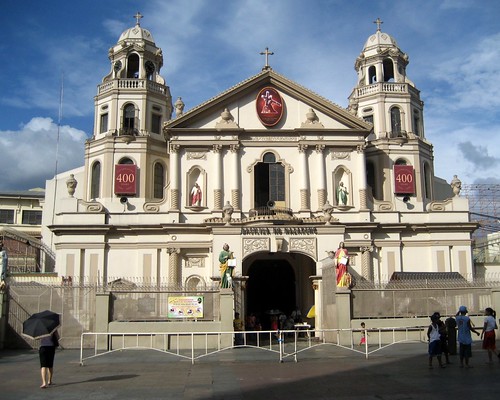


In reviewing all the pictures I took this week, I had chosen this as my favorite, and thereby decided to post it and refer to the entry as my photo of the week feature. I took it on the same day I went to Hidalgo Street to get my old film camera fixed and the day I searched and found Globe Lumpia House at Raon Street.

This picture of Quiapo Church, to me, conveys serenity; and quite an appropriate choice not only due to aesthetic reasons, but spiritual as well. You see, this past week has been quite a mental roller coaster due to a couple setbacks that I had to contend with. But I figured no matter how serious or important they may appear at the moment, a hundred years from now they won’t mean a thing. So instead of getting dragged down by these events, I instead chose to let go and let God.

And as if by some divine affirmation, I received an email from Cathy about her post for today,
Six Worry Busters To Live By. Talk about perfect timing. Also, Larry King’s show this evening was aptly entitled, Your Thoughts Create Your Future, in which he had a panel of interesting people who are proponents and successful practitioners of a certain school of thought — creating first in your consciousness whatever condition you want to manifest in your life. So Cathy’s blog entry and Larry King’s show reminded me not to empower the problems by constantly thinking about them; rather, I should give power to the ideal condition I want to experience in my life by filling my mind with a vision of it.

So does that mean that I have now ignored my problems altogether? Not really. What I had done was release them to the universe; confident that the perfect solution will unfold effortlessly and in a timely manner. In so doing, I am now able to focus and become even more appreciative of the good things. In other words, although I may not have full control of things and events that occur in life, I do have, however, full control to pick and choose what I allow to occupy my mind. And supposedly, whatever it is I think about will happen in my life. Thus the adage, “thoughts manifest themselves”

Have a joyful and creative weekend everybody!

posted by Señor Enrique at 7:38 PM | 23 comments


Thursday, November 16, 2006

JAZZ BY THE BAY


Presented by the Philippine American Jazz Festival

Friday, November 17th at 8pm:
RCBC Auditorium, Ayala corner Buendia, Makati
Featuring: The Executives Band, Ateneo chorale, UP Jazz Ensemble, Mon David

Saturday, November 18th at 8pm:
Greenbelt 3 Lagoon, Makati
Featuring: Sandra Lim-Viray with JFK band, Johnny Alegre Affinity, Brass Munkeys

Sunday, November 19th at 8pm:
Rajah Soliman Plaza
Alongside Aristocrat at Roxas Boulevard, Manila
Featuring: Bob Aves/Bo Razon, Escola de Samba de Manila, Guarana


This is Rajah Soliman Plaza facing Manila Bay. I will most probably attend the jazz concert to be held here this Sunday evening because I love bossa nova and samba; so much so that I even took classes in capoeira in New York City which led to a freak accident causing me to pinch a nerve at the bottom of my spine. I was only in my early twenties then. Thank God for my doctor who gave me only two choices: either I face the possibility of enduring chronic back pains from that moment til the rest of my life, or learn to sleep on the floor without any cushion from that moment forward to allow my body to heal naturally. I opted for the latter and has gone on through the years without suffering from any nagging back pains; I also got to enjoy sleeping with just a mat on the floor.

Anyway, in my attempt to get into and enjoy the jazz scene here in Metro Manila, I had emailed this jazz group, Guarana, to inquire if they still perform at some public venue in Cubao. Eileen Sison responded to advise me that what I had come across was a year old schedule of their concert performances. The band, however, performs regularly in Café Havana in Greenbelt 3. Not much of a Makati enthusiast, I haven’t gone over there to see them, but now I will this Sunday at Baywalk.

Guarana is the leading proponent of both traditional and authentic Bossa Nova and Samba in the Philippines. Eileen is the lead vocalist and band leader. She is also the founder of the Bossa Nova Club of the Philippines and hosts a radio segment called “Understanding Bossa Nova” which airs 5 times a day, Monday thru Saturday on Crossover 105.1 FM. She is also the Founder and Dance Director of Escola de Samba de Manila, a samba school (composed of drummers and dancers) she founded in September 2005 headquartered at Steps Dance Studio in Makati every Saturday.

I am looking forward to meeting her, as well as photographing her entire band as they perform their repertoire of sensuous bossa nova and exhilarating samba. So if you guys aren’t doing anything this Sunday evening, come on over to Baywalk to enjoy the gorgeous sunset and then an evening of cool jazz.

I hope it doesn’t rain, though.

Click here for more about Guarana.

posted by Señor Enrique at 10:40 PM | 19 comments


QUIAPO'S FAMOUS LUMPIA

I was on my way to Hidalgo Street yesterday to get my old Canon T70 SLR camera fixed and cleaned when I decided to search for this restaurant (since it was on my way), which according to Ladybug serves excellent fresh spring roll (lumpiang sariwa).

As it turned out, it wasn’t hard to find at all. Heading towards Quiapo Church along Quezon Boulevard, I turned right on G. Puyat Street; and only a few meters from the corner on the left side of the street is where Globe Lumpia House is located.

What's surprising about this eatery is that it only offers lumpia and nothing else, except for the mineral water and soft drinks. It has been that way since its inception in 1957. The lumpia here — which is one of the best commercially available I have tasted in Metro Manila — costs only P16.00 each. And most customers order a double. The ingredients are all fresh while the caramel-peanut sauce has just enough touch of sweetness to it.

This restaurant started as a kiosk within the old Globe Theater where it also got its name. Its initial loyal customers were the moviegoers; followed by ardent shoppers of the various stores at Raon Street; and then the devotees of the Quiapo Church. When Globe Theater finally closed its doors for good many years ago, the customers kept coming back for the lumpia, which has since moved from a kiosk to a narrow section of the cinema's building right next to where its entrance used to be.

During the feast of the Black Nazarene, the restaurant would open at two o’clock in the morning to serve the beginning of a swelling number of pilgrims. Also of interest, according to Jenny, the owner's daughter, some of their loyal customers also include a number of film and TV personalites (from Dolphy to Cesar Montano); stopping by every now and then to delight on their fresh lumpia.

Nonetheless, with or without the presence of these celebrities, prepare yourself to wait for a few minutes before getting seated, because this restaurant is teeming with customers throughout the day.


Globe Lumpia House
740 G. Puyat Street (formerly Raon)
Telephone: 733-2918

posted by Señor Enrique at 3:37 AM | 30 comments


Wednesday, November 15, 2006

YACON: THE HEALING ROOTCROP


These are not yams or sweet potatoes (kamote). These are yacon. I first found out about this rootcrop from Watson. Neither did he know anything about it until he received an SMS from a friend asking him to get some for him while he was in Baguio. Yacon is claimed to contain medicinal attributes. I was intrigued enough to ask my sister to bring back some from Baguio. I finally got a taste of it the other day. Watson was right; it does taste good.

It can be eaten raw. Its crunchiness resembles that of
sinkamas; however, Yacon is sweet with a slight tinge of a gingerly taste to it. And although sweet, it doesn’t affect one’s sugar level. No wonder it's popular among those with diabetes and those watching their weight. The reason for this is that supposedly, yacon store carbohydrates in the form of insulin and not starch. Its high fiber content makes it effective against constipation as well. And there are those who claim that yacon also purifies the blood.

It costs P30 per kilo at the Baguio market. From what I understand, about ten years ago, one could get them in Metro Manila at the weekend markets of Cubao in Quezon City and Magallanes in Makati only. The price then was about a hundred pesos per kilo. Nonetheless, many people purchased yacon for its healing properties.

And since my 88-year-old mother likes its taste and texture, my sister had arranged for a weekly supply to be delivered to our house for her to munch on while she watches her favorite Korean telenovelas.

posted by Señor Enrique at 9:11 AM | 10 comments


Tuesday, November 14, 2006

GARDEN & PET SHOW


Please do not ask me for the exact names of these exotic flowers and love birds; I do not know. I just happened to be driving along Quezon Memorial Circle when I took notice of the huge banner announcing the Garden & Pet Show at the Quezon City Orchidarium Park that is within the city hall complex. Wanting to take some pictures, I drove another full circle around the memorial and then headed towards the parking lot of the city hall.

I took all these shots with a Canon IXUS63, which is ideal for spontaneous photo opportunities such as this; unlike the D80 dSLR which is too bulky to lug around, except for planned photoshoot adventures.
For all photography enthusiasts who want to include shots of exotic plants and flowers to their portfolio, I recommend heading over to this garden show immediately. This is also the place to go to for those planning to spruce up their home gardens anytime soon.

posted by Señor Enrique at 6:45 AM | 20 comments


Monday, November 13, 2006

DUMPLINGS AND PORK CHOPS

I’ve passed by this restaurant in Ongpin right across from Binondo Church so many times but never once felt compelled enough to go in and check out what they have to offer. It must have been its name, Tasty Dumplings, which turned me off about it; reminds me of some eateries I’ve been to back in New York and New Jersey named Good Food Diner, Delicious Bread Bakery, and Sumptuous Soup Kitchen. Oftentimes, eateries with such self-affirmation barely live up to their names.

However, after reading what
Ladybug had to say about its pork chops, I finally went in one day to try it for myself; it was, in fact, really tasty. I had since then gone back a couple of times with friends in tow who appreciate this kind of meals. For eighty-five pesos, you get a piece of pork chop, rice, a small bowl of broth and some cabbage, which I usually mix with my rice. Everything is tasty, indeed. I also noticed that most people who come in usually order the pork chop.

I had also tried their steamed dumplings — kuchay (chives). They were tasty as well, but I find the wrapper too thick. I am one of those who prefer thin wrappers, especially with steamed dumplings. The pork chop is truly delectable; not to mention reasonably-priced. As for the dumplings, I know of another place around the corner from Tasty Dumplings that is far more superior. I will feature that Chinese eatery next time, but I’ve a feeling most of you already know about it.


posted by Señor Enrique at 11:23 AM | 24 comments


Sunday, November 12, 2006

BREATHING LESSONS — Part 1


Here in the Philippines, believe it or not, the malls would usually start playing Christmas carols through their PA systems in September. Meanwhile, certain sections of the selling floors would be gaily setup for artificial Christmas trees and assorted colorful holiday ornaments and dizzying lights. Private homes and public arenas have started as well to adorn their vicinities with all sorts of festive display of lights as a way to usher in the spirit of Christmas.

Such an early anticipation of the holiday season I can only experience in Manila. In New York, the Friday right after Thanksgiving — celebrated on the last Thursday of November — heralds the Christmas shopping frenzy. However, although a New York Christmas may be more picturesque and sometimes white, for those who grew up in the archipelago, there’s still nothing more heartwarming and joyful than a holiday season spent back home.

The eight of us kids grew up without the usual tradition of presents under the Christmas tree. The wrapped gifts often came from godparents; hence, we grew up receiving a gift of cash instead from our parents on Christmas day to buy whatever we wanted. And with such predictable Christmas gifts, imagine my great surprise one Saturday about two weeks before Christmas when I was thirteen years old.

This is the way it happened: After a movie and merienda at a Chinese noodle shop in Sta. Cruz, my father and I walked into a combination music and sporting goods bazaar near Avenue Theater in Avenida Rizal. This was where we bought the 45 rpm singles that my older siblings had listed the night before. And so on this particular Saturday, while the saleslady was bagging our purchase, out of the blue, my father asked if I wanted the set of drums displayed on the floor at the far end of the store. It was a beautiful set made by Pearl. I felt as if the air was sucked out of me; too stunned to reply.

Playing drums was what came to me naturally; I never took any lessons. I started with a pair of chopsticks and some newspapers and moved up to playing with my cousin’s set of drums on weekends. I also had a classmate whose band played cover tunes. He would sometimes invite me after school to sit in on their jam sessions whenever their drummer couldn’t make it (he was a rather incorrigible character always grounded by his parents). I somehow managed to do a decent job with time-keeping that I got invited repeatedly; playing mostly the music of The Kinks and The Zombies.

My friend’s house was in Santa Ana and my father would usually come to pick me up after work. My father was a music enthusiast who favored jazz and big band music. Gene Krupa, the legendary jazz drummer, happened to be one of his favorites. I was sure for certain that deep inside, he delighted in my skills in playing the drums. Thus, I was fully aware that he must have been greatly disappointed when I declined his offer to buy me that set of drums on that Saturday afternoon. When asked why, all I could say to him was that I preferred a set of Ludwig drums like what Ringo of The Beatles used. That was a lie.

As a youngster, when it came to my interest in music, it was my oldest brother Junior I felt most at ease to discuss such matters with. After dinner that Saturday evening, I told him what happened earlier at the bazaar, and when he asked for my real reason for declining, I told another lie — that I was afraid it might incite resentment from the other brothers. Although he somewhat agreed with me, it was obvious he was puzzled why I chose to forego such a rare opportunity.

After a couple of weeks, I did tell my mother the truth — what I really wanted was a piano. For a more dramatic effect, I added that God wanted me to play the piano because of the long fingers He gave me. She remained silent as she went on with whatever she was doing at that moment. I then told her that I had even picked-out the ideal piano teacher. Finally, my mother responded with what I was afraid I’d hear from her — that a piano and those lessons with a private teacher would cause a tremendous strain on the family budget.

My intuition proved to be correct and this was exactly the reason I couldn’t tell my father the real reason why I declined his offer to buy me a set of drums. Especially since it had to do with music, I knew it would devastate him not to be able to buy me that which I really wanted. Neither did I tell this truth to Junior, because he might only nag my parents on my behalf. Junior was a very quiet kid, which made my parents pay even more attention to him in those rare moments that he would choose to speak.

Despite that setback, my intense desire to play the piano went unwavered even as I got older; it gnawed at my soul. And no matter how impressive my achievements at work, it seemed as if I’d hear a voice asking, “but what about your music?”

There was also that time during my early twenties when as a rising junior executive at a leading publishing company in Manhattan with a powerful publisher as my mentor, I threw all caution to the wind and quit my job to follow my bliss — to get a job in the unstable music industry for less than half the salary I was making. Everyone was astonished and disappointed; suspecting I was on drugs or had gone mad. But what everyone failed to understand was that had I not followed my inner desire, my bliss, I might have drowned spiritually; becoming utterly miserable for the rest of my life.

The pay may be less than desirable but the fringe benefits were pretty amazing at the record company where I finally got a job. An entry level position was what I got; however, within six months I was promoted as the assistant to the vice president of merchandising, and thereby reaped further benefits for holding a higher profile position. I got invited to very exclusive showcases in which the audience was strictly music industry folks and artists only. It was indeed a heady experience to be seated within arms reach of rock stars whose music I’ve collected through the years. Yet, despite all that, after about three years, I handed in my resignation. I was sure my sudden departure gave the impression that I was offered a better position at a competing company. Truth be told, something inside had urged me to move on although I was dismayed upon realizing that my having worked at the music industry was not enough to appease my soul. Apparently, it turned out to be a mere phase of a long arduous journey.

Nonetheless, through it all I managed to remain true to my dream — to learn to play the piano. Eventually, through sheer determination and with the help of a patient music teacher, I did! The very first piece I learned how to play was Ave Maria by Bach and Gounod. After that, the blues captivated my fascination. Learning to play the piano at a matured age has great disadvantages; foremost, the loss of nimbleness with one’s fingers. However, with the advent of computers, sequencers and electronic keyboards, I was able to pursue making music, but this time, I shifted my focus more on composition and orchestration.* I was to discover later on that it was absolutely the loneliest endeavor in the realm of music making.

To this very day I am in awe of those proficient with a musical instrument. Percussions are quite easy unlike say, string and wind instruments that are more demanding — requiring their players to be knowledgeable with scales, key signatures, pitch, chords, harmonics, and etc.

Oddly enough, the most significant work that I had done with music and could brag about at heaven’s gate upon my death, so to speak, had nothing to do with the glamour of writing original music or doing live performances; it was of a more deeply spiritual endeavor. I had no idea whatsoever that I was heading towards that direction.


To be continued…

* The Atari ST - my blog entry of 11/04/05 about my private music lessons and online activities during the pre-Internet days.


posted by Señor Enrique at 9:43 AM | 16 comments


Saturday, November 11, 2006

DREAMS DO COME TRUE IN MANILA


They do, indeed! Exactly a week ago, the universe once again provided the opportunity for me to actualize a long-held dream — to get myself a Nikon digital SLR camera. I then spent a week familiarizing myself with its basic features. Yesterday, I drove over to Baywalk at Roxas Boulevard to take some photos of the sunset, which I haven’t done in quite some time. It was a cloudy afternoon due to a storm on its way to the island so there wasn’t any magnificent sunset to photograph, but I did manage to find some other interesting subjects in the area. The following photos were from my photo shoot adventure yesterday using my new Nikon D80 dSLR.

Incidentally, I have another thing to be thankful for. After about six or seven weeks of waiting, PLDT (the local major telephone service provider) finally fixed the problem I had with my landline. I am now once again able to surf the Net at the comfort of my home with my mug of decaf coffee. Thank you, PLDT!

To borrow Monty Python’s famous line — and now for something completely different — I thought for a change I’d recommend an entry written by another fellow blogger for each of my photograph below, which I think best reflects its essence. So here we go…


Wilson’s The Blue Ocean Strategy


DOPS’ The One Who Comes In When The World Has Gone Out


Philippine Phil’s
Enemy Within


Jase’s
Five Sins That Stop The Philippines From Being A Tourist Destination

posted by Señor Enrique at 8:56 AM | 20 comments


Friday, November 10, 2006

ON BUYING A LECHON


For the upcoming holiday season, many will once again go for the lechon as the centerpiece of their family’s buffet table. It remains to be the most delightful local delicacy that widens the eyes of children and adults alike; secretly desiring to be among the first to peel off some of its delectably crispy skin.

Traditionally, no festive gathering is ever considered grand without a lechon. And with that in mind, there’s nothing more disheartening than to serve a lechon in which the skin has lost its crispiness while the meat had become tough and too chewy even for those with strong jaws and complete set of natural teeth. This is what typically happens to a lechon that hasn’t been sold or consumed in a few days. The main concern here then is how to be certain that the lechon you are about to purchase is truly freshly-roasted.

I live near the lechon central of Metro Manila — La Loma, Quezon City — and had on a number of occasions talked to some people in the business and seasoned customers. I had also made purchases in the past couple of years (for family parties). Thus, my main advice is this: if at all possible, choose from a selection as they are about to be done roasting (see top photo). This is the only way you can assure yourself of a freshly-roasted lechon upon making a purchase.


However, for those who are faced with selections already removed from the roasting pit and now on display as in above photo, rule of thumb is avoid those with dark spots and with several cracked skins which indicate they had been reheated and merely brushed with oil. Out of the entire selection in the above photo, the second from the right is the only one I would consider; the rest I am not sure about.


The ones in above photo clearly demonstrate lechons in their even worse state; absolutely a must to avoid. Besides their dark spots and cracked skin, the wrinkles further indicate these lechons had gone unsold for many days and now only suitable for paksiw (stew).


There is no particular store I will recommend because all sales employees are required by store owners to convince unsuspecting customers to choose from the older stock. During the last time I was shopping for a lechon, the selection in the above photo was what the saleslady led me to. I immediately declined and insisted that I be allowed to choose from the ones being roasted in their pit at that time. She agreed, though reluctantly.

Oftentimes, I had to wait an hour or two before the lechon was completely roasted and ready to be purchased. However, since I buy these pricey lechons only on special occasions, I provide enough time necessary for my shopping so as to get the best deal for my money and the best lechon for the guests to enjoy. Waiting, in this case, is no big deal. Almost always, those who buy in haste only get the less desirable return for their money.

Therefore, I can only recommend buying from those who will allow you to choose from the roasting pit. And the best time of the day to do so is early in the morning when the lechons are usually roasted. As for those living abroad who buy lechons online to be delivered to their loved ones anywhere in the Philippines, best bet is to ask for the recipients’ honest critique once they’ve received and consumed the lechon, and then base future purchases from their responses.


The last purchase I made I had chopped at the store where I bought it from. No sooner was it unwrapped when over-excited family members attacked it; scrambling for the incredibly crispy skin. Its meat, on the other hand, was juicy and easily chewable. Was I upset that they didn’t wait for the buffet table to be setup completely before jumping on the lechon? Not really, because such delirium can be incited by a lechon at immediate-family-only parties.

This medium-sized lechon cost P3500 and was served (whatever was left of it) at my mother’s birthday party last August. Of course, none of these commercially available lechons can equal the excitement of serving indigenous homemade versions from the provinces which are spiced according to the region’s taste, and roasted right in one’s own backyard. The Cebu-style lechon is one special and prime example of which. However, for those of us stuck in Metro Manila, the lechon central over in La Loma, Quezon City is a good enough alternative.

The usual suspects: some of the incorrigible attackers of our mother’s birthday lechon; the toddler in stroller was just as feisty in grabbing his share, while the little guy at the back waving to the camera started the whole pandemonium. The 88-year-old birthday celebrant is seated up front.


* * *

Recommended read : Sidney's La Loma's Lechon photoblog entry


* * *

Please note:
I very much appreciate my articles and photos appearing on fellow bloggers' sites, popular broadsheets, and local broadcast news segments, but I would appreciate even more a request for permission first.
Thank you!


*

Labels: ,

posted by Señor Enrique at 1:50 PM | 17 comments


Thursday, November 09, 2006

SAN LAZARO HIPPODROME


The Manila Jockey Club — the first racing club in Southeast Asia — was formed in the summer of 1867 by a group of racing aficionados led by Jose de la Gandara y Navarro, then Spanish General of the Philippines. Its original founders were from Manila’s affluent Filipino, Spanish and English families in the 19th century such as the Ayalas, Zobels, Tuazons, Elizaldes and Nietos.

When it was moved from Santa Mesa to a part of the San Lazaro estate, it then became better known as the San Lazaro Hippodrome. A couple of years ago, it was once again relocated, but this time outside of Manila to a much bigger complex at Carmona, Cavite. It is now called The San Lazaro Leisure Park. What now stands on its place right on Tayuman and Felix Huertas Streets is SM City San Lazaro Mall. And behind it are two housing development projects — Celedron Park (townhouses) and Avida Towers (high-rise condominium apartments); the ongoing constructions of which are featured in the photo below.

When I was a kid, the karera (races) were then held on alternate weekends at San Lazaro and the Santa Ana Hippodrome. On late Sunday afternoons, if the family wasn’t engaged in any wedding or funeral or any other social concerns, my father would sometimes take me with him to the San Lazaro racetrack, which was walking distance from where we lived. We only stayed for a couple of races and then went home in time for supper. While my father shared racing tips with his friends, I would usually indulge on either hotdogs or hamburgers and vanilla ice cream. By the time we got home, I was too full to eat anything else. It was always a fun experience whether my father won or not.

As a young adult in New York, on a weekday, I would sometimes take the Long Island Railroad to the Belmont Racing Park; there I would spend the entire afternoon. I’d bet two dollars the most on a race; if lucky, I would win about eight dollars, which I would spend five bucks on a hotdog and a can of soda, while the rest was for betting on the next race. It was more a leisurely way to spend an afternoon with a touch of adrenalin rush to boot.

Just as enjoyable was the pre-race ritual in which the trainers would parade the horses at a special area within the race park. Those beautifully-kept and well–trained horses were truly a sight to behold — incredible creatures, indeed. Besides the horses and racing, Belmont Race Park also offered live jazz concerts during the late afternoons at another part of the park. I was once fortunate enough to have enjoyed Lionel Hampton and his band performed about two hours of cool jazz music in that park. I rarely got a weekday time off so it wasn’t that often that I’d get a chance to spend an afternoon at the Belmont Race Park. But then again, I was not a serious enthusiast to begin with; besides, none of my friends were into horse racing so I didn’t miss it all that much.

However, I can see myself living in one of the townhouses being built in the old San Lazaro racetrack, because I grew up in the area and still feel a close connection to it — not so much for the karera, but rather for the community of my youth itself. The Espiritu Santo Church is only two or three blocks away, while the commercial centers of Quiapo, Santa Cruz, and Divisoria are mere short distances away. In this case, a calesa would definitely become my main mode of transportation.

Unfortunately, there is one major downside to this prospect: the streets that surround this old San Lazaro racing complex get flooded during major rainstorms — at least, under two-feet of water in some areas. Only a few months ago, I drove along Oroquieta Street (from Claro M. Recto Avenue to N.S. Amoranto Street in La Loma) and didn’t see any land at all. It was like driving through a river. So for those contemplating on buying real estate in this complex, beware of the flooding that occurs in the surrounding areas and better trade in your sedans for an SUV before moving in.

SM City San Lazaro Mall at Tayuman and Felix Huertas Streets


The construction of the housing developments on the old racetrack of San Lazaro


Vintage photo credit:
Photographer unknown
Photographic reproduction by Clifford S. Torres
Santa Cruz Church - A Living Heritage
By Anna Maria L. Harper
Published by the Sta. Cruz Parish Pastoral Council

posted by Señor Enrique at 4:18 PM | 13 comments


Wednesday, November 08, 2006

MUNING

That is what we call her — Muning. She’s a stray cat, actually. We first took notice of her when as a kitten she stared furtively at us from the edge of the roof as we enjoyed an afternoon barbeque in the backyard. She was probably born or moved up on the roof from somewhere else by her mother. We never saw the rest of the litter, though; only her.

When she got big and agile enough, Muning started to come down from the roof to wander around the yard. Before we knew it, she had single-handedly gotten rid of those pesky rodents that once ran rampant in the yard. Earning her keep, she had become a member of the household and no longer had to look elsewhere for her daily meals.

Muning was heaven-sent. Although barely a year old and weighing no more than eight pounds the most, she certainly applies her predatory skills into good use. Rats are not fun to deal with. Not only do they pose health risks, they can also scare those with a faint heart. On a couple of occasions, balikbayan friends of my mother from New York were startled upon the sight of rats prancing around the yard in broad daylight. I had resorted to placing poisoned food around the yard, but it was only effective in the beginning. Those rats probably sensed soon enough the cause of death among their peers so they stopped consuming those foodstuffs that suddenly appeared in the yard much like an offering to the gods. Another option I had considered was to get a Jack Russell, but I was discouraged by the responsibility that comes with caring for a dog, especially after having one for seventeen years. And just when I was finally exasperated by it all, Muning came along.

To this day, we have no idea where she sleeps at night. However, she’s out there in the yard in the mornings — doing her rat patrol duty diligently. Later on, she could be found lounging somewhere shady — licking her paws or taking a nap. She would never go inside the house, though; always remaining outside. At night right after eating her dinner, she’s gone.

I am more of a dog-lover if you asked me, but I had a pet cat once that I adored. She was fat and cuddly. She instinctively knew the time I would come home from school (I was in first grade then) and would always be sitting by our door to meet me when I arrived. Unfortunately, she got ran over by a cab. My father later got another one; supposedly from a lineage imported from Texas. Her colors were similar to Muning’s. However, she was a real bitch. She hated everyone in the household, except for my father. If ever I got within three feet near her, she would hiss and expose her sharp teeth and claws at me. Remember the old wives’ tale that it would rain if you wet a cat? Well, not true at all. I used to douse this Texan with a glass of water in the mornings when I didn’t feel like going to school. It never rained afterwards.

She would also disappear for weeks on end and return pregnant. In less than a few days, underneath our stove would be filled with crying kittens. We never once had to put any of them in a sack to throw out in the garbage like others did. Her kittens, I must admit, were always very cute and so had many takers. But I didn’t want to keep any of her offspring; certain it would only grow up nasty like her. However, when I was in the fourth grade, she had a kitten that appeared sickly and had a crooked tail; it was ugly. He was definitely the runt of the litter. However, I told my father not to give him away. With my aunt’s help I learned how to feed him milk with a plastic syringe (without that nasty needle). Eventually, he grew up healthy and strong, though he still had that crooked tail.

I loved it most when he brushed his warm and soft fur against my leg whenever I was doing my homework or eating my meals. He loved it when I’d squeeze him with my bare feet while he grappled to break free. Once free, he’d come back and egg me on again by ramming his head against my ankle. He never bit or scratched me during our play.

Incidentally, going back to rodent control, I was once told that if all else failed, that I should consider letting loose a python in the household. I thought the guy was being sarcastic if not outright obnoxious for making such recommendation. However, as it turned out, it was, indeed, common practice in Manila to buy a snake in Arranque Market in Azcarraga and then put it up in the ceiling.

There was once an American schoolteacher, Josephine Craig, who chronicled domestic life in Manila in 1904 before she proceeded to her final destination in Mindoro. She claimed that for rats, some local folks believed a snake in the ceiling proved more efficient that household cats. She wrote:

Well, we have a perfectly good snake of the python variety living in our roof! The ceiling of the living room is made of sawali, that matting-like material which covers boxes of tea from China. Evenings I hear a slithering sound overhead and the sawali bulges down under the weight of the snake’s body; then there is the squealing of rats as he pounces, and all grows quiet again while the snake digests his meal. I asked Austin if there we re any danger of his coming down to make our acquaintance, but he thinks not so long as the supply of rats remains plentiful.

Personally, I’d rather have Muning on rat patrol out in the yard than have a huge python crawling up in my ceiling. The last thing I wanted to happen is for my ceiling to give under the weight of a python, and have it land on my face as I sleep at night. No, thank you!

Source:
Impressions of an American Schoolteacher
Bonifacio’s Bolo by Ambeth Ocampo
Anvil Publishing

Photos:
Muning - Nikon D80
Bahay na bato in Luneta – Canon IXUS63

posted by Señor Enrique at 11:04 AM | 9 comments


Sunday, November 05, 2006

FOR HIS LOVE OF FREEDOM

This is a story about two men. One whose love for freedom destined him to a life of greatness, while the other allowed hubris and megalomania to destroy him and everyone under his command. In Metro Manila, the former was honored with a towering monument built on a prime spot at Rizal Park facing Manila Bay; the latter got a gated community in Makati named after him that gets flooded even during minor rainstorms.

The protagonist:

His name was Lapulapu; the son of Kusgano and Inday Puti; and grandson of a legendary powerful barangay queen, Matang Mantaunas, from which the name of the island of Mactan originated from. Lapulapu’s wife Bulakana, was a beautiful princess, the daughter of Datu Sabtano. Their union produced a son, Sawili. As one of Mactan’s chieftains, Lapulapu’s altruistic benevolence earned him much respect and loyalty from those under his rule. His main goal as their leader was to assure his people a life of continued peace, abundance, and freedom. Their idyllic existence was threatened upon the arrival of large ships from Spain commandeered by a man with insidious intentions.

The antagonist:

The fall of Constantinople in 1453 and the rise of the Ottoman Turks closed the former trade routes to the East. Henceforth, Portugal and Spain produced intrepid explorers to blaze new routes across the seas. Ferdinand Magellan, a master navigator and seaman, renounced his Portuguese citizenship and went to Spain when snubbed by the Portuguese royalty. With the help of his father-in-law and some influential friends, Magellan gained an appointment at the royal court of King Charles I to unveil his bold venture to find a new route to the Moluccas. The King of Spain, impressed by Magellan’s pioneering vision — which promised immense profit for Spain if successful — approved and agreed to fund what would turn out to be a voyage of great historical significance.


The conflict:

On March 16, 1521, three big ships under the command of Magellan reached the coast of Samar after sailing westward across the Pacific. The next day, Magellan dropped anchor at the flourishing port of Cebu, impressing its ruler, Rajah Humabon, with their huge sailing vessels and armaments. Humabon offered them bananas and fish; Magellan, in reciprocity, gave them a large wooden cross, converted them to Christianity, and took possession of their land in the name of Spain.

The natives’ willingness to comply must’ve caught Magellan by surprise; making him think he was, indeed, another Hernan Cortes who easily conquered Mexico when the natives mistook him and his men as “white gods.” Humabon, an important chieftain of Cebu even helped convince the other datus to do the same. But for the recalcitrant Lapulapu, Humabon sent an emissary, Zula (the other datu of Mactan) to do the talking for him. Unlike most other chieftains, Lapulapu used his intelligence well and was not so gullible as to readily concede with Humabon at all times.

Lapulapu must’ve been perplexed and asked himself why he would give up a life of freedom and abundance just to appease the audacious demand of this windswept, sun-burnt foreigner. He refused to engage in any concession with this white man. Unbeknownst to others, Lapulapu summoned his son Sawili to go to Cebu and spy on these foreign intruders. On April 26th of 1521, Zula also summoned one of his sons, but it was for the purpose of presenting Magellan with two goats and the bad news that Lapulapu refused to recognize Spanish sovereignty. Magellan was astonished, not by the two goats, but by Lapulapu’s defiance and disrespect. With his ego badly bruised by a half-naked native, Magellan swore to teach this datu of Mactan a lesson.

The battle:

On April 27th of 1521, at dawn, with an army of no more than 50 armor-clad Spaniards and about a thousand Cebuano warriors, Magellan, before ordering an invasion of Mactan, sent Lapulapu one final message, “Submit to the King of Spain, accept Humabon as the Christian King, and pay tribute, or else face death through our guns, swords and cannons.”

“Bring them on, fool!” Lapulapu must’ve roared back in response, which could’ve only further incensed Magellan. Intoxicated by excessive pride, Magellan told Humabon and the Cebuano warriors to stay in their boats and just watch how white men fight. Unfortunately for Magellan, the tide was against them which prevented their boats from getting closer to the shore; hence, the enemy territory was out of range of their cannons. Nonetheless, Magellan was determined to confront Lapulapu and his men even if only with their handheld weapons.

Backed by at least 1,000 warriors, Lapulapu overwhelmingly outnumbered Magellan and his men. In addition, Lapulapu’s son Sawili, returned beforehand from his intelligence-gathering mission in Cebu with pertinent information — certain weak spots in the Spaniards’ armor plates, especially at the joints of the armplates. Sawili also told his father that the Spaniards were most vulnerable in the legs, which were unprotected. Armed with this information and facing imminent invasion by the Spaniards, Lapulapu’s foresight guided him to devise appropriate tactical strategies.

And so on that fateful morning of April 27th, while Magellan and his men waded across the shallow waters filled with brittle corals and mangrove roots, Lapulapu and his warriors waited patiently. When two Spaniards reached the beach and ran straight to set fire on the native huts, the defenders yelled their furious cries and charged. Arrows and spears rained on the legs of the invaders. When an arrow hit Magellan’s right leg, he ordered a retreat. The Spaniards were not about to argue; they raced back to their boats. Those busily engaged in combat and overwhelmed by the sheer number of the defenders were unable to flee.

Lapulapu finally recognized the conceited captain amongst the handful of invaders left behind and approached him. He knocked his helmet off as a native warrior lunged to hurl a spear into Magellan’s face, but Magellan quickly ducked and plunged his lance into the attacking native. And as he withdrew his weapon off the dead body, Lapulapu hacked his leg causing him to fall facedown. Many natives then rushed upon Magellan with swords and bamboo spears; piercing his body with ferocious intensity.

An eerie silence then engulfed the battle scene. It was all over. Humabon and his warriors were awed and dumbstruck with what they had just witnessed — a native datu and his men successfully defending their land against foreign invaders; preserving the freedom passed on to them by their honorable ancestors. Just before sailing back to Cebu, Humabon sent word to Lapulapu requesting for Magellan’s cadaver, but Lapulapu’s immediate response was, “We will not give away the captain’s body for all the riches in the world, because his body is the trophy of our victory against white invaders of our shore!”

Lapulapu was to live the rest of his life as a free man. All the other chieftains including Humabon paid him with utmost respect since then. And as for the large cross which was given as a gift of Magellan to the Cebuanos, it was eventually chopped as firewood.

The letter of apology:

Towards the end of that same year, 1521, the King of Cebu received a letter from Hernan Cortes, which should have been addressed to Lapulapu instead. Ambeth Ocampo summed it up as an admission by Cortes that Magellan had, indeed, went beyond his orders and deserved his fate; blaming it on the man’s egocentricity and overzealousness.

Cortes also offered a ransom to any Spanish held captive from that battle. He wrote, “And in order that you and all the other kings and signors of those districts to give you satisfaction for it, the emperor, our Lord, will be much pleased if you will deliver to the captain any of the Spaniards who are still alive in your prison. If you wish a ransom for it, he shall give it to you at your pleasure and to your satisfaction; and in addition you will receive favors from me …”

Regrettably, there were no Spanish survivors left; Lapulapu and his men sold them off as slaves to the Chinese traders.


Sources:
THE PHILIPPINES — A UNIQUE NATION
By Sonia M. Zaide
All-Nation Publishing Co., Inc.
AGUINALDO’S BREAKFAST
By Ambeth Ocampo
Anvil Publishing
SILENT STORMS
Inspiring Lives of 101 Great Filipinos
By Fernando A. Bernardo
Anvil Publishing

posted by Señor Enrique at 11:22 AM | 17 comments


Saturday, November 04, 2006

CHICKEN AT SAVORY'S


Most of those who love the fried chicken from Chow King, Jolibee or Kentucky Fried Chicken would sometimes argue over which of these fast food eateries serve the best gravy with their chicken. Unbeknownst to most is that if they really wanted to taste authentic fried chicken gravy of old, all they have to do is try Savory’s.

Still at the foot of Jones Bridge at the tip of Escolta, Savory Restaurant is one of the few remaining Chinese restaurants in Binondo that was once as popular as Max’s and Aristocrat. I had lunch there the other day and ordered Chicken Rice, which is a combination plate consisting of a quarter piece of chicken, fried egg, a cup of fried rice, and a generous serving of their famous chicken gravy. It costs about a hundred pesos.

The fried chicken at this restaurant is just as good if not even better than Max’s; a whole order is P300. Their bountiful serving of pancit canton guisado for P160 is also recommended. The only other branch of Savory that I know of is at Francisco del Monte Avenue near corner Banawe Street in Quezon City.


posted by Señor Enrique at 11:19 AM | 37 comments


Friday, November 03, 2006

THE MERCADOS

By the 1800s, the Chinese had assimilated into the Filipino culture; a large percentage had converted into Catholicism while some had taken on native women for their wives. A descendant of one of these migrant workers from China had surreptitiously changed the tribute lists so that his family would be classified an Indio. He did this as a measure to be relieved of the heavier taxes imposed on the Chinese mestizos by the colonial government. His name was Juan Mercado.

He had served three times as gobernadorcillo of the town of Binan, Laguna; discharging his duties with kindness, utmost diligence and greater honesty than his predecessors (although he had falsified the tribute lists). He lived in a large house at the center of the town’s plaza in which he had inherited from his wealthy father.

Capitan Juan, as he was popularly known, was blessed with thirteen children and a prosperous life. However, although his landholdings were extensive, once divided among his thirteen children, wouldn’t amount to much. For this reason, once of age, the youngest left Binan to seek his fortune elsewhere; settling in a town along the southwestern shores of Laguna de Bay called Calamba. As a son of a distinguished gobernadorcillo of Binan, Francisco easily obtained from the Dominican friars a lease for several hectares of sugar cane and rice land. An obliging elder sister, a spinster, managed his household while he rounded up his poor neighbors to till the land with him on a profit-sharing venture. The earnings made from his agricultural enterprises were promptly invested in more land so by the time of his sister’s death, he had already accumulated a certain stature in the town of Calamba. He married Teodora Alonzo soon thereafter.

A well-educated and devout Catholic, Teodora was born and raised in the city, and moved to Calamba with her mother some years earlier. She came from an admixture of Spanish blood; one of her forefathers was a descendant of Lakandula, the Malayan rajah who ruled Manila during the Spanish conquest. Her brothers and uncles were professional men — lawyers, priests and doctors — held in high esteem by their communities. She was only twenty when she married Francisco, but was a dutiful wife, managed the household affairs efficiently, and had eleven children by him. However, only nine reached maturity and of these only two were sons.

n 1849, after their first child was born, the governor-general decreed that all Indios should bear a surname regardless where it was obtained. The local mayor added the family name of Rizal to Mercado. Nonetheless, neighbors remained calling each other in the old way and Francisco’s family continued for many years to be known as Mercado instead of Rizal.

Francisco and Teodora, through the years, pursued a prosperous life. They were a busy couple; pretty much occupied by the daily routine of managing a hacienda, as well as by the feeding, clothing, and educating a large family. It was a pleasant, uneventful existence typical of the archipelago’s landed gentry. The couple was able to build a large triangular-shaped house in the center of Calamba made of adobe stone and hardwood with a red tiled-roof — traditional features of an affluent abode. It boasted a tropical orchard of fruit-bearing trees at the extensive yard behind the house.

Carlos Quirino in his book, The Great Malayan, provides a detailed account of this enchanting backyard:

The atis, with its delicately-flavored fruit, drooped it branches as if to save children the trouble of reaching up for them. The broad-leafed papaya bore drak green fruit that tempted birds as well as human beings. Nearby grew the sweet santol, the fragrant and honey-like tampoy, the purple makopa, further away the plum, the cashew with its fibrous meat, the tamarind, the jackfruit and breadfruit trees. The orange trees in the bloom diffused an aroma of sweetness, while the balimbing with its abundant foliage and beautiful flowers furnished a pleasing contrast to the eye. Here and there huge coconut palms laden with enormous clusters of nuts swayed in the breeze. At sundown, dozens of birds of all kinds frequented the garden, and little three-year-old Jose amused himself watching them hop and fly from tree to tree.

As for the house’s interior furnishings, one of Jose’s sisters would later donate some of the furniture from their family house in Calamba. Most are on exhibit at the Baluarte de Santa Barbara in Fort Santiago. It is presented by the National Historical Institute in coordination with the Intramuros Administration of the Department of Tourism.

posted by Señor Enrique at 11:34 AM | 6 comments


Wednesday, November 01, 2006

BROKEBACK PARIAN

In 1598, the archbishop of Manila wrote the king of Spain about the ongoing practice of sodomy within the Chinese community. He went so far as to accuse the Chinese of spreading the habit not only in Manila, but throughout the Philippine archipelago.

Also in that same year, the king’s court received a letter from Antonio de Morga, a civil official, strongly suggesting that the movements of the Chinese be restricted. He claimed these overseas workers from China had become extremely troublesome — committing crimes and wantonly engaging in sodomy among themselves.

Meanwhile, the Augustinian missionaries in Iloilo were horrified to have discovered this widespread sexual practice among the Chinese. They sternly voiced out their revulsion to such deviancy; petrified that God might repeat in Iloilo what was done in Sodom.

Miguel Benavides, archbishop of Manila and founder of the
University of Sto. Tomas, demanded stringent measures. In 1603, he fired off a missive to the king citing the case of an Ilocana who was sodomized by a Chinese man. To protect the Filipinos — both male and female — he requested for a new parian to be set up to segregate the Chinese. He also recommended that those who engaged in such wicked behavior to be expelled and shipped back to China. In addition, he suggested that only the merchant Chinese be allowed into the colony, but to be placed on ships in the harbor during the night.

However, much to his dismay, the king’s court sent no response. Benavides was so enraged for having been ignored turned his ire on the Jesuits instead. Their greed, he pointed out, made them ignore sodomy and other sinful acts being committed in their midst by those who comprised the backbone of their lucrative enterprises — the Chinese who provided the Jesuits with indispensable services as artisans, carpenters, and merchants. Unbeknownst to the archbishop, the Jesuits may have been early proponents of the “don’t ask, don’t tell policy.”

The friars were credited with having chronicled this peculiar proclivity within the Chinese populace. Although prudish, they spared no detail in describing sodomy in their official records. They even applied linguistic argument to pound their point — that since no Filipino word existed for sodomy, it could only have been introduced by the Chinese. But then again, no word for hell existed in the local vernacular, either, until the Spanish introduced inferno.

For the most part, whether aware of it or not, these Spanish historians only revealed their anti-Chinese sentiments by constantly pointing their fingers on the Chinese for having caused every social ill in the Philippine archipelago — from crime to communicable disease to economic sabotage to kinky sex. Despite the friars’ relentless objection, the Chinese, out of spite, continued practicing sodomy throughout the Spanish regime.

The Chinese tradition of kinship-based immigration might have encouraged sodomy or (at least) made it suspect as a contributing factor. Kinship Immigration seemed to follow a general pattern. Once a Chinese had established a foothold in the Philippines — achieving financial success however modest — he would send for, or else go back to China and bring back a teenage son or nephew (almost always, they were adolescent boys, no females). They often apprenticed as store clerks or bookkeepers. Subsequently, the other relatives would arrive in the archipelago in the same manner until a fragmentary family was created.

Consequently, the sex ratio in the Chinese community remained unbalanced. During the latter part of the nineteenth-century alone, in 1870, the ratio was eight females per 1,000 males, or 193 women against 23,000 men. About sixteen years later, official statistics indicated 194 women in a general Chinese population in Manila of about 50,000. Another sixteen years passed, in 1903, the census registered 517 China born women in the general Chinese population of 41,035.

As it turned out, most of these women were prostitutes or concubines; therefore, normal family patterns were rarely, if ever, established in the Philippine Chinese community. It was also most likely that a majority of relationships among the Chinese were borne out of financial indebtedness — employee and employer or a merchant and financier. And in such cases, sexual favors may come in to play, especially when carousing with a roomful of sexually-deprived yet oftentimes aroused virile young men during lonely nights.

Sodomy then, in this case, may neither be a means to establish dominance over a weakling (as in a maximum security prison setting), nor incited by an amorous homosexual bonding between, say, a textile clerk and a bookkeeper. Rather, sodomy might have been a mere act to release sexual tension regardless of the partner’s gender; a basic need to get off, so to speak. Thus, a Chinese community suffering from a great disparity in its sex ratio, sodomy might have become a condoned practice however deviant and despicable it may have seemed to outsiders.

Now, whether or not sodomy was in fact a Chinese import — or the incidence of homosexuality among the Indios increased due to influence by either the Chinese or Spanish or both — will remain an arduous task reserved for learned anthropologists to ascertain.

Sources:
BONIFACIO’S BOLO
By Ambeth R. Ocampo
Anvil Publishing
THE CHINESE IN PHILIPPINE LIFE
By Edgar Wickberg
Ateneo de Manila University Press


Afterword:

To borrow from Jerry Springer: Just because it’s unpleasant and embarrassing, it doesn’t mean we ought to look the other away and ignore it altogether.

Therefore, in fairness to the Chinese of Manila during the previous centuries, it should be noted (though it doesn't necessarily make it any more right or moral) that the Arab world, to this day, unabashedly practice sodomy. Stories abound about some Filipino overseas foreign workers who were sexually harassed by Arab men simply because they sport no moustache or beard. Lawrence of Arabia was, in fact, sodomized by an Arab sheik. The best-selling novel, The Kite Runner, contained graphic details about the adverse effects of forced sodomy and child abuse in Afghanistan. And in Uganda, the children — both boys and girls — are abducted and used as sex slaves by the L.R.A. (Lord’s Resistance Army); a grotesque, zombie-like militia, reminiscent of Christian Khmer Rouge, and has for the past 19 years set a standard of cruelty and ruthlessness. Its leader is Joseph Kony.

posted by Señor Enrique at 3:49 PM | 16 comments


Life in Manila as observed by a former New Yorker who with a laptop and camera has reinvented himself as a storyteller. Winner of the PHILIPPINE BLOG AWARDS: Best Photo Blog in 2007 and three Best Single Post awards in 2008.


About Me

Name: Señor Enrique
Location: Manila, Philippines

View my complete profile

Links


www.flickr.com
This is a Flickr badge showing photos in a set called Flickr Badge. Make your own badge here.
 
 
Señor Enrique Home
Designed by The Dubai Chronicles.
All rights and lefts reserved.