Thursday, September 28, 2006
YSLA DE BINONDO AND THE CHINESE REVOLT
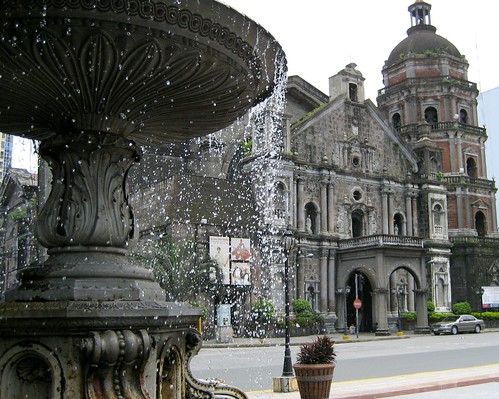
Located at Plaza Calderon de la Barca, Binondo Church, also known as Minor Basilica of Saint Lorenzo, was founded by the Dominican Friars in 1596. It has sustained considerable damage over the centuries from earthquakes and other natural disasters, as well as from fierce bombings during World War II. It wasn’t until 1972 that it was restored, but the octagonal bell tower and some foundations remain of the original 16th century structure, which is typical of colonial Spanish architecture. Today, its maintenance is largely funded by the members of the Catholic Chinese community; most reside and operate business establishments in the area.
Binondo, an hacienda once like Makati, is an island between two estuaries or esteros — Estero de la Reina and Estero de Binondo. The village of Binondo sprang in the banks of the Pasig River, and was once called Ysla de Binondo. It was already a hub of Chinese commerce even before Martin de Goiti and his men forcibly took over Manila in 1570 from its Muslim kings.
Two years before this church was built, in 1594, the Spaniards gave the land to the Catholic Chinese tax-free and Binondo was established with limited self-governing privileges. This was to encourage their loyalty to Spain while keeping them culturally at a distance. Nonetheless, just across the Pasig River, from the gated walls of Intramuros, the Spaniards aimed the range of their cannons at this Chinese enclave in case of an uprising.
The Galleon Trade ensued thereafter which sailed between Manila and Acapulco and linked the Chinese junk trading system to Mexico and to the rest of Europe. For 250 years, galleons sailed 9000 nautical miles. When the Spaniards settled in the country, more Chinese came. And as the population of the Chinese grew in Manila, the mutual feeling of fear and distrust between them and the Spaniards rose as well. Consequently, such mutual suspicions manifested persecution and harassment including large-scale massacres.
In 1581, Governor General Gonzalo Ronquillo Peñalosa's heightened fear of the Chinese led him to issue a directive to round up the scattered communities of early Chinese migrants and forced them to settle at the Settlement of San Gabriel. They were also subjected to forced labor in building the Walls of Intramuros. Travel to the island was through the Duente de Spaña Bridge built by the Spanish authorities in 1632 (where it was replaced by Jones Bridge). At that time, by law, all Chinese were forced to reside in the areas of Ysla de Binondo, San Nicolas and Sta. Cruz.
The Spaniards separated the Chinese in quarters called Parian. By 1596, led by their padrinos, most citizens of Parian, were baptized as Catholics, thus creating the Chino cristianos. By virtue of their new faith, they were granted more freedom than the unconverted Chinese and could marry the natives. In 1790, when the last Parian was destroyed, the Chinese were allowed to join the baptized Chinese in Binondo and Santa Cruz. Sangley, the term used by the Spaniards for the Chinese, comes from the word siong-tay, literally "often comes" in Hokkien. The Sangleys came as merchants, laborers, and artisans. Due to massacres or fires, the Spaniards changed the location of the Parian nine times.
The first major Chinese revolt against the Spaniards occurred on October 25, 1593. It was led by Pua Ho Go (P’an Ho Wu in Mandarin) who, along with 250 Chinese, was enlisted compulsorily as boat rower for a military expedition to Moluc¬ca Islands in Indonesia, led by Governor-General Gomez Perez Dasmariñas.
It was a series of failed expeditions — in 1582, he had to go home after two-thirds of the expedition were downed by epidemic; 1584, no luck, either. Finally, in 1593, Dasmariñas had with him in his galley 80 Spaniards and 250 Chinese galley slaves. The vessel was put into port near Batangas for shelter due to contrary winds. In the silence of the night, when the Spaniards were asleep, the galley slaves led by Pua Ho Go killed them all, except for a Franciscan friar and secretary. Dasmariñas was the only Spanish governor-general and the highest ranking Spanish official in the Philippines ever killed by the insurgents.
On October 3, 1603, the Spanish colonial regime carried out the first massacre of the Chinese in the Philippines, in which more than 23,000 died. It was also the first Chinese pogrom that occurred in Southeast Asia. There was a total of six Chinese massacres in the Philippines in which approximately 100,000 lives were sacrificed. The Chinese, along with the Filipinos, experienced untold sufferings from the brutality of the Spanish rule.
There are now about 1 million ethnic Chinese in the Philippines; a large concentration live in the cities of Manila and Cebu. HIstorically, the relationship between the Chinese and Filipinos has alternated between alienation and acceptance from the pre-Spanish era. However, through intermarriages and the more common use of Tagalog, many Chinese (or Tsinoys) are now active participants in all aspects of Philippine society.

Labels: Binondo, Early Chinese, Manila history
posted by Señor Enrique at 7:40 AM
| 38 comments


Tuesday, September 26, 2006
DON CARLOS PALANCA TAN QUIEN-SIEN
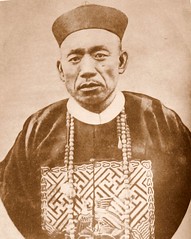 His life was a classic rags-to-riches story: Born of a poor family in T’ung-an hsien, he migrated to the Philippines in 1844. Although starting out in a measly position in the textile business, through hard work, tenacity, and acquired connections, he prospered.
Only about twenty years after arriving in Manila, he had risen as a powerful leader in the Chinese community. His wealth stemmed from importing enterprises, which included sugar and rice. He was also involved in coolie brokerage. Besides the businesses that he presided over, there were many commercial ventures in which his investments raked in enormous profits.
When he converted to Catholicism, his baptismal sponsor was Colonel Carlos Palanca Y Gutierrez — a Spanish forces leader in the Franco-Spanish intervention of 1858-62 in Cohin, China. He then assumed the name of his godfather (padrino); changing it from Tan Quien-sien to Carlos Palanca Tan Quien-sien. He eventually became widely known as Don Carlos Palanca.
He attained the position of gobernadorcillo from 1875-77, and again some years later; serving as the interim gobernadorcillo in 1885 and 1889. And when not in office, he continued to move behind the scenes with undisputed power; an effective arbitrator of disputes as well. For his services as gobernadorcillo, Spain granted him the Medal of Civil Merit and the Grand Cross of Isabel the Catholic.
He was always active in community affairs and philanthropy; raising funds for the community hospital and even provided a building for it himself in 1891. His generous donations extended outside of the Chinese community. There were many exemplary accomplishments attached to his name — the abolishment of vice in the community, the end of police extortions of the Chinese; the abolition of the death penalty for crimes committed by Chinese; and through powerful connections in Spain, softened Spanish legislation on the Chinese
He played a major role in the community’s efforts to obtain a Chinese consulate in Manila during the 1880s and 1890s. When the Americans took control of the country in 1898, he provided the American troops with temporary lodging arrangements, as well as furnished them with coolies to build their barracks. Subsequently, he urged the Ch’ing government to negotiate with the United States for a Chinese consulate in Manila. When the consulate was established in 1899, the Ch’ing government appointed his son, Ignacio Palanca Tan Chueco, to the position of first consul.
When the Philippine Revolution broke out he chose to keep distance; not committing to either side. When the Spanish government charged a number of mestizos with conspiracy, he argued in behalf of some of them and helped secure their release, though his attitude toward the Chinese mestizos was one of contempt. Not a believer of inter-racial marriage, he sent his son to a school in China to thwart his filipinization.
The Spanish and Filipinos, on the other hand, regarded Don Carlos Palanca with mixed sentiments. Their pervasive perception of him was that of a master corrupter; one who would resort to extreme measures just to get what he wanted.
He was thought of as a man obsessed with becoming the Chinese consul. He did assume the interim role of which when his son’s return from China was delayed for several months; unable to immediately fulfill his appointment as consul.
There were speculations among the Filipino intellectuals that Jose Rizal modeled after Don Carlos Palanca his character of Chinaman Quiroga in El Filibusterismo. Jose Alejandrino, a friend of Rizal, confirmed that it was indeed the case. Alejandrino further claimed that Don Carlos Palanca approached Aguinaldo — when he was forming his revolutionary government — about the possibility of creating an opium monopoly.
Despite such controversies, he was, undoubtedly, a powerful force in the Chinese community during the late nineteenth century. When he died in 1901, a statue was erected in the Chinese cemetery as a tribute to his community service and philanthropy.
Source:
The Chinese in Philippine Life 1850-1898
By Edgar Wickberg
Ateneo de Manila University Press
The Chinese in Philippine Life 1850-1898
By Edgar Wickberg
Ateneo de Manila University Press
Photo of Carlos Palanca credit:
Fei-lu-pin Min-li-la Chung-hua Shang-hui san-shi chou-nien k’an ed. Huang Hsiao-ts’ang
(Manila, 1936)
Fei-lu-pin Min-li-la Chung-hua Shang-hui san-shi chou-nien k’an ed. Huang Hsiao-ts’ang
(Manila, 1936)
Labels: Binondo, Early Chinese, Manila history
posted by Señor Enrique at 6:45 AM
| 46 comments
Thursday, September 21, 2006
BANKING AND THE EARLY CHINESE TRADERS

This landmark building (now owned by the GE Money Bank) located on the corner of Plaza de Santa Cruz and Ongpin Street was once home to the oldest savings bank in the Philippines, Monte de Piedad and Savings Bank. It was founded by Fr. Felix Huertas (de Huerta) of the Franciscan Order with the funds of the Obras Pias.
Inaugurated on August 2, 1882, it was originally located at the ground floor of Santa Isabel College, corner of Arzobispo and Anda Streets in Intramuros. In 1894, it was transferred to the Roman Santos Building at Plaza Goiti where President Manuel L. Quezon was at one time employed as clerk. It was then moved to this landmark building in 1938, but the building was destroyed during the Battle of Manila in 1945. It was rebuilt in 1946 and resumed operation in 1947. It was administered by Archbishop of Manila until 1949 when it was incorporated.
Before the 1800s, without any banks in the Philippine archipelago, anyone with a sizeable venture that needed funding would have to obtain a loan from the obras pias.
The obras pias were pious foundations in which two-thirds of their holdings were allocated for the furtherance of commercial maritime ventures at interest — a voyage to Mexico was 50 percent, to China 25, and to India 35 — substantially increasing the foundation’s original coffer. Earnings from such interest rates were then assigned to other pious and benevolent purposes. A third was generally kept as a reserve fund to cover possible losses. Among the biggest obras pias was the Hermanidad de la Miscericordia, established in the late 16th century.
The opening of the Suez Canal largely contributed to a global economic growth during the decades from 1820 to 1870, and thereby producing similar significant changes in the economy of the Philippines as well. With the Spanish government granting shipping subsidies, local commodities such as sugar, fibers, coffee, and many others were briskly exported. A dramatic spike in foreign trade in the Philippines emerged as a result of such bustling commerce.
The British and Americans dominated the foreign trade in Manila while the local Chinese traders acted as primary intermediaries between them and the domestic market.
But access to the funds of the obras pias was absolutely forbidden to the Chinese. Therefore, before 1850, there wasn’t much capital available for the Chinese communities who were, ironically, Manila’s astute merchants.
Nonetheless, a number of Chinese enterprises struggled to remain lucrative. One could borrow at six percent interest from the Chinese community chests or caja, but the funds were never large. Outside of the community, individual Spaniards were a source of venture capital to individual Chinese entrepreneurs during the middle and late eighteenth century. But everything was more of personal level, nothing organized and of larger scale. Although there were a few private banking efforts initiated in Manila during the second quarter of the nineteenth century, it is not known whether they opened their doors to the Chinese.
However, banking was a key function of American and European businessmen in Manila. Funds were entrusted with them by rich families, the Church, Manila entrepreneurs, and even by the native banks that have slowly sprung up. These funds were then loaned out in the form of crop advances. But advances were also made to the Chinese wholesalers to help them dispose of European imports and to buy up produce for export.
Soon thereafter, another source of funds became available to the Chinese. In 1851, the Banco Espanol Filipino de Isabel II (later renamed BPI - Bank of Philippine Islands) was founded to promote the use of savings for commercial investments. Most of the funds from obras pias were transferred to it and the government added other funds of its own, turning it into a government-regulated, quasi-official institution. Although the bank’s first transaction was the discounting of a promissory note for a Chinese, regular transactions with Chinese merchants were facilitated by non-Chinese guarantors for a fee.
When Banco Espanol Filipino de Isabel II would ask the European merchant firms for the names of Chinese businessmen who were good risks, sensing opportunity, they did not provide the names of the Chinese jobbers and purchasing agents they did business with. Instead, these European firms became guarantors for Chinese borrowers from the bank, including forwarding their payments to the bank, and assuming responsibility for settlement with the bank in case the Chinese defaulted.
For the Chinese focused on wholesaling or retailing ventures, obtaining goods on credit was more important than access to cash loans. Hence, the European and American firms advanced their imported goods to the Chinese dealers while these dealers, in turn, made their profits without having to raise the capital to procure the products.
Additional source:
The Chinese in Philippine Life 1850-1898
By Edgar Wickberg
Ateneo de Manila University Press
The Chinese in Philippine Life 1850-1898
By Edgar Wickberg
Ateneo de Manila University Press
.
Labels: Early Chinese, Manila history, Philippine history
posted by Señor Enrique at 11:04 AM
| 39 comments