Saturday, September 13, 2008
SHANGHAI HAND-PULLED NOODLES ON RETIRO

It is simply the best I had ever tasted in the entire Metro Manila area. I have been there several times and the chicken has become my favorite, though the beef, dumpling and fish are just as tasty. The broth alone is incredibly scrumptious.
This small, unpretentious eatery is located on Retiro (now N.S. Amoranto Street) near corner Banawe in Quezon City. Telephone number: 732-7061.
Go and try it for yourself!
The Eateries Along Banawe
I very much appreciate my articles and photos appearing on fellow bloggers' sites, popular broadsheets, and local broadcast news segments, but I would appreciate even more a request for permission first.
Thank you!
*
Labels: featured eatery, Featured food
posted by Señor Enrique at 9:38 AM
| 21 comments


Thursday, September 11, 2008
FRUITS NOW IN SEASON AT MANILA'S STREETS


I very much appreciate my articles and photos appearing on fellow bloggers' sites, popular broadsheets, and local broadcast news segments, but I would appreciate even more a request for permission first.
Thank you!
*
Labels: Featured food, fruits, photography
posted by Señor Enrique at 8:44 AM
| 38 comments
Thursday, August 07, 2008
WAI YING FASTFOOD & MANG INASAL


First learned about about Wai ying restaurant from Moni of Of Places & Food blog site who said, "It is air conditioned but it's not for those who want peace and relaxation. If you consider the food quality and reasonable price as a good tradeoff, then this place might just be for you."
I had no idea about it's exact location but Moni gave me the direction: it's on Benavidez Street only a few meters from the corner of Salazar. It has a huge signage that's tough to miss. From Ongpin Street facing Sta. Cruz area, turn left on the street opposite the appliance center and President Restaurant. Turn right once you approach the corner. That's Benavidez Street and Wai Ying is a few doors away on the right side of the road facing C.M. Recto avenue.
Wai ying offers a variety of congee (lugaw), roasted meats, dim sun, vegetables, dessert and drinks. They also have combination meals from 100 to 120 pesos. I had the white chicken and asado over rice. It was delicious and the serving was plentiful. The dimsum range in price from 50 to 60 pesos per order.
Visit Moni's Of Places & Food blog site for more details, as well as for his critiques of other eateries in the area.
Meanwhile, remember the Mang Inasal restaurant on Ongpin and Padilla Streets that I blogged about last July (Going Against The Grain)? Well, it's pecho -- marinated and grilled chicken breast and wing with unlimited rice -- has become my nephew's and his friends' choice of meal lately. They seem to have forsaken their once-favorite two-piece Chicken Joy at Jollibee. However, the branch they often go to is the one over at the university belt area (Recto near corner Quezon Boulevard).
Anyway, I once went with them at Mang Inasal, and I have to admit the pecho I had was just as delicious as those served at Bacolod Chicken Inasal restaurant. The prices at Mang Inasal are lower, though.
 Mang Inasal over at Ongpin & Padilla Streets in Binondo
I very much appreciate my articles and photos appearing on fellow bloggers' sites, popular broadsheets, and local broadcast news segments, but I would appreciate even more a request for permission first.
Thank you!
*
Labels: Binondo, eateries, Featured food
posted by Señor Enrique at 10:33 AM
| 20 comments
Sunday, July 27, 2008
CHOCNUT, A PINOY DELIGHT

A true Manileño wouldn't be one without a fondness for one of these -- a ChocNut!
I remember my first visit to Manila after a long absence -- while the kids relished the Godiva Truffles, the honey and almond nougat Toblerone bars, and those candy-coated M&Ms that I had brought them -- I was nagging my sister Inday to get me some peanut milk chocolate ChocNuts.
And when I finally got my hands on a 24-piece pack as in the above photo, it took me no time to gobble it all up -- and all by myself, mind you. I must've looked like a starved escaped felon to those who watched me in utter disbelief. But I didn't care.
Now, for those traveling abroad, one of the wonderful pasalubong ideas I would recommend is ChocNut. Trust me, your old friends will love you for it even if you overstayed!
I very much appreciate my articles and photos appearing on fellow bloggers' sites, popular broadsheets, and local broadcast news segments, but I would appreciate even more a request for permission first.
Thank you!
*
Labels: Featured food
posted by Señor Enrique at 9:20 AM
| 32 comments
Wednesday, July 16, 2008
COTTON CANDY VENDOR IN QUIAPO

Imagine my great surprise when I ran into this cotton candy vendor at the corner of Bilibid Viejo and Matapang Streets in Quiapo the other day. It has been ages since I've had one of these sweet treats.
According to CottonCandy.net, although it's made mostly of sugar and food coloring, cotton candy doesn't contain all that much sugar; only as much sugar as one would get from drinking a can of soft drink. Supposedly, a normal serving of cotton candy (about a 1 oz. cone) contains only about 100 calories; that is, compared to anywhere from 130-170 calories in a can of non-diet soft drink.
Nonetheless, watching how cotton candy is made never cease to fascinate me -- sugar, along with some food coloring, is poured into the bowl at the center of the machine. The heated rim melts the sugar and out through the center bowl's tiny holes it gets spun out of. It then solidifies in the air looking like cotton within the large cylindrical metal bowl.
And from this vendor, the small one costs five pesos, while the large is ten.


I very much appreciate my articles and photos appearing on fellow bloggers' sites, popular broadsheets, and local broadcast news segments, but I would appreciate even more a request for permission first.
Thank you!
*
Labels: Featured food, Street foods
posted by Señor Enrique at 7:04 AM
| 24 comments
Friday, July 11, 2008
SAMALAMIG VENDOR IN QUIAPO

Ed, a reader from San Francisco, California had just made me realized that a popular refreshment that I'm yet to feature is the gulaman. So after doing my errands in Quiapo yesterday, I walked over to the southeast corner of Recto Avenue and Quezon Boulevard to take a picture of the samalamig (chilled drink) vendor (above photo).
Since Ed may be away from Manila for quite some time, like me, he may be astonished to learn that the usual sago't gulaman of decades past has evolved to a selection of different flavors from pandan to fruit salad. Typical tropical fruit drinks such as pineapple and coconut have also become regular offerings. Served in plastic cups, the street price of these drinks vary from five to ten pesos.
These samalamig refreshments are also served at Manila's popular restaurants such as Aristocrat's, Chow King, President's, and Max's, to name a few.
Gulaman is made from seaweed called agar-agar, and can be served as gelatin dessert, with fruits included if desired. Sago, other than in samalamig drinks, can also be served in taho and ginataan.
I never bought any of these samalamig drinks from street vendors because of the rumor that they use "magic sugar" as sweetener and not sugar derived from sugar cane. Magic sugar is supposedly a chemical concoction from China created to simulate the taste of sugar; much cheaper in price, too. Sago, on the other hand, is supposedly created from not so sanitary methods. However, I'm not completely sure about these claims, and would appreciate the input of fellow bloggers.
Nonetheless, whenever I crave for a tall glass of gulaman, I always head over to Chow King for its black gulaman which costs 37 pesos.

I very much appreciate my articles and photos appearing on fellow bloggers' sites, popular broadsheets, and local broadcast news segments, but I would appreciate even more a request for permission first.
Thank you!
*
Labels: Featured food, life in Manila
posted by Señor Enrique at 8:51 AM
| 26 comments
Thursday, July 03, 2008
THE BEST TURON SABA VENDOR IN QUIAPO

It remains as one of my favorite merienda foods. I can eat one everyday, in fact. The caramelized deep-fried crispy wrapper and the soft saba banana with a sliver of langka (jackfruit) inside make a heavenly texture.
The ones we make at home are much smaller and only slightly sweetened with brown sugar (above photo) unlike those sold by street vendors. However, the best turon and banana-cue street vendor in Manila that I know of is in Quiapo -- right on Bilibid Viejo and Ludovico Streets (near Loyola Street, formerly Lepanto). She has become so popular that the administration office staff from a couple of major universities in the area order turon by the hundreds from her during special school affairs. Hence, none would be available for the public on those days.
I was also told that the vendor, for sanitary reasons, first boils the sticks that she use for her banana-cues. Moreover, word has it that her earnings from selling turon and banana-cue enables her to send her kids to school. The eldest has already graduated from college and now working abroad.
The photos below were taken from her stall. Both the turon and banana-cue are ten pesos each.


I very much appreciate my articles and photos appearing on fellow bloggers' sites, popular broadsheets, and local broadcast news segments, but I would appreciate even more a request for permission first.
Thank you!
*
Labels: Featured food, life in Manila, Quiapo, Street foods
posted by Señor Enrique at 7:13 AM
| 16 comments
Saturday, May 10, 2008
MAX'S FRIED CHICKEN, AN ALL-TIME PINOY FAVORITE

I have fond memories of Max's Fried Chicken Restaurant. One I vividly remember was on a Sunday afternoon when my father brought the entire family to feast on this restaurant's famous fried chicken. From our table, I could see Manila Bay -- the palm trees gently swaying with the soothing breeze.
However, since my father had taken me to other restaurants in Binondo whose fried chicken were just as good, I wasn't one who immediately went to a Max's Restaurant upon my return to Manila. Actually, I craved more for Aristocrat's barbecued chicken with its unique sauce and Java rice. It was only when I posted a recipe ala Max's fried chicken did I realize how popular Max's fried chicken is, specially for Pinoys living abroad.
The recipe as I had posted it was quite simple:
- Thoroughly wash a whole chicken with salt as usual.
- Fill pan with water (chicken must be totally immersed in water)
- Add 1 tablespoon of whole black pepper and 3 pieces of star anis (sangke)
- Add sliced ginger and salt according to taste
- Boil chicken for 10 to 15 minutes using low fire
- Drain and deep-fry
However, some readers who tried it came back to ask or share certain points such as:
One reader wrote: "I tried your recipe today. It tastes good, almost like Max's, but the meat is a little dry. Do you have a technique to keep the meat moist."
Another suggested to try his father's technique: "yung father ko tinurokan muna ng water tapos freeze nya tapos deep fry."
An irate reader wrote: "anglayo sobra, sinubukan ko, ang amoy sobra ng star anis, tuyo ang laman, the next time you post a recipe, be sure na malapit lapit naman kahit paano. no hurt feelings my friend."
But someone came to my defense: "try this method. rub half chicken (cut lengthwise) with garlic clove, season with salt and pepper or patis and pepper. then rub liberally with cornstarch. steam the chicken until cook. let stand and cool. then deep fry! - fejtrc
Gene wrote a more descriptive suggestion: "Senyor, maraming maraming salamat po sa tip ninyo. Miss na miss na po namin ang Max fried chicken. Sinubukan po namin kanina ang recipe ninyo at meron po kaming dinagdag na ingredient based doon sa iba pa naming pag re research ng recipe na kalasa ng Max fried chicken. Pagkatapos po ng unang boil ng chicken with your recipe ay dinagdagan po namin ng 2 chicken cubes then, simmer siya ng 45 minutes. Ang lambot at juiceness ng loob ng chicken ay na maintain niya matapos namin siyang i drain ng 10 minutes. Sabay lagay sa mainit na mainit na mantika (canola oil) deep fried ninyo lang siya ng 3 minutes tapos baligtarin ang kabilang side at pabayaan din ng 3 minutes. Napansin ko ang ibang comments dito na medyo tuyo ang meat ng chicken nila sa loob. The secret here is don't over-fry it. 3 minutes lang each side ay sapat na yon para mag brown and crispy ang labas. Don't worry about the inside coz malambot at luto na siya due to boiling and simmering. Bago siya i-fry ay puwede ring pahiran ninyo siya (ang skin) ng patis according sa panlasa ninyo. Serve ninyo siya ng pipino at atsara on the side and nakupooo... kalasang kalasa talaga siya ng Max fried chicken."
Kitkat asked if she could use her turbo instead: "hello po! ita-try ko po itong recipe ninyo.isang question pa po.if i'm abput to use a turbo...mga anong temperature po kaya ang dapat kong ilagay and for how many minutes to make it crispy and juicy??? malaking help po sa lahat ang binibigay ninyong recipe...lalo na po sa mga taong nasa ibang bansa na nami miss na ang mga pagkaing tulad nito. God bless!"
Thanks to Gene with the response: "Hi Kitkat, kung turbo ang gagamitin mo I think it's best to set it at the highest level (or medium high...350 to 400 maybe?) and then once na mag brown and crispy ang labas eh yun na yun! You don't need to time it coz the inside of the chicken meat is cooked already (due to boiling or simmering) from senyor enrique's recipe. The secret here is don't over fry it (kung deep fry) or don't over do it (kung turbo ang gagamitin). Yung recipe ni senyor enriquez ang magbibigay ng lasa at aromang ala max fried chicken sa boiled chicken mo. Sa tingin ko senyor enriquez... kung papahiran ng patis with grounded pepper sabay wiwisikan (and I mean wisik lang at hindi pahid or paliguan) ni Kitkat ng cornstarch ang skin ng chicken niya eh magkakaroon ng lutong ang skin nito na akala mo eh ala-crispy pata ang dating... hehehhehe"
Here are some more comments from other readers:
"Hi Senor Enrique, thanks for the recipe. I just did it and the crisp appearance of the Max's Fried chicken that I have grown to love was back before my eyes, ready to be enjoyed. My kids loved it greatly. The skin was so crispy and the bones were crunchy too. Now, I have one thing though... I cannot yet call it "sarap to the bones." I will try what Gene has suggested, but will omit the simmering and go to it straight away. Now for a secret ingredient that most people don't know about Max's, it is deep fried with sweet potato (kamote). Much like Shakey's fried chicken which is deep fried with slices of potatoes which becomes mojos. Try it and please keep me posted for some comments!" - Fide
"hi! thanks for this recipe. its really a great copycat of max's chicken. at first i dont want to believe...but it was just perfect! as for the juiciness...i may suggest you buy a fresh chicken the one na hindi pa na frozen...its better kasi mas juicy ang chicken...anyway thanks!" - Nylre
"Thanks Senor and Gene for that great recipe. -- Hi fellow pinoys loving Max's chicken so much! Have a friend working at Max's and it is a top secret recipe. Their chicken arrives at the store branch in a plastic container and fries it when it is ordered. But one thing they said was they really boil it into a soup stock and they fry it in lard...yes...animal fat. I was amazed and yet scared to what it would do my health. That is why it was soooo good! And old folks say it was deep fried in butter. You might want to try it but think of what it would do to your body. Bon Appetit!!!" -- Anonymous
That's right! Much like Kentucky Fried Chicken's, Max's fried chicken recipe is a well-guarded secret. This version I had posted is a mere attempt to simulate its taste for the benefit of fellow Pinoys living abroad who miss the ever popular Max's fried chicken.
Enjoy!

I very much appreciate my articles and photos appearing on fellow bloggers' sites, popular broadsheets, and local broadcast news segments, but I would appreciate even more a request for permission first.
Thank you!
*
Labels: eateries, Featured food, Local culture
posted by Señor Enrique at 6:58 AM
| 24 comments
Thursday, September 27, 2007
LOCAL BAKED GOODS

"Where'd you get that?" I asked my co-worker Oleg one morning as I passed by his cubicle while he was eating an ensaymada with his morning coffee. "Have you found yourself a Filipina girlfriend?" I teased him.
Oleg was born and raised in Moscow and had immigrated to New York during the IT boom years. In front of the bus stop in Jersey City where he lives, is a Filipino bakery shop. He was always attracted by the ensaymada so, one day he bought one; he has been hooked ever since.
The bakery in the above photo is located right on Plaza Miranda in front of Quiapo Church. I love baked foodstuffs although they're usually consisted of simple carbos -- from pan de coco to ube bread.
But I bet everyone has a certain favorite. What's yours?
By the way, do you guys remember the peanut bar -- those inch-and-a-half, individually-wrapped squares of ground peanut sandwiched in sweetened crispy flakes? I love them, too.
Labels: Featured food, life in Manila, Life in New York
posted by Señor Enrique at 7:47 AM
| 50 comments
Friday, November 10, 2006
ON BUYING A LECHON

For the upcoming holiday season, many will once again go for the lechon as the centerpiece of their family’s buffet table. It remains to be the most delightful local delicacy that widens the eyes of children and adults alike; secretly desiring to be among the first to peel off some of its delectably crispy skin.
Traditionally, no festive gathering is ever considered grand without a lechon. And with that in mind, there’s nothing more disheartening than to serve a lechon in which the skin has lost its crispiness while the meat had become tough and too chewy even for those with strong jaws and complete set of natural teeth. This is what typically happens to a lechon that hasn’t been sold or consumed in a few days. The main concern here then is how to be certain that the lechon you are about to purchase is truly freshly-roasted.
I live near the lechon central of Metro Manila — La Loma, Quezon City — and had on a number of occasions talked to some people in the business and seasoned customers. I had also made purchases in the past couple of years (for family parties). Thus, my main advice is this: if at all possible, choose from a selection as they are about to be done roasting (see top photo). This is the only way you can assure yourself of a freshly-roasted lechon upon making a purchase.

However, for those who are faced with selections already removed from the roasting pit and now on display as in above photo, rule of thumb is avoid those with dark spots and with several cracked skins which indicate they had been reheated and merely brushed with oil. Out of the entire selection in the above photo, the second from the right is the only one I would consider; the rest I am not sure about.
The ones in above photo clearly demonstrate lechons in their even worse state; absolutely a must to avoid. Besides their dark spots and cracked skin, the wrinkles further indicate these lechons had gone unsold for many days and now only suitable for paksiw (stew).

There is no particular store I will recommend because all sales employees are required by store owners to convince unsuspecting customers to choose from the older stock. During the last time I was shopping for a lechon, the selection in the above photo was what the saleslady led me to. I immediately declined and insisted that I be allowed to choose from the ones being roasted in their pit at that time. She agreed, though reluctantly.
Oftentimes, I had to wait an hour or two before the lechon was completely roasted and ready to be purchased. However, since I buy these pricey lechons only on special occasions, I provide enough time necessary for my shopping so as to get the best deal for my money and the best lechon for the guests to enjoy. Waiting, in this case, is no big deal. Almost always, those who buy in haste only get the less desirable return for their money.
Therefore, I can only recommend buying from those who will allow you to choose from the roasting pit. And the best time of the day to do so is early in the morning when the lechons are usually roasted. As for those living abroad who buy lechons online to be delivered to their loved ones anywhere in the Philippines, best bet is to ask for the recipients’ honest critique once they’ve received and consumed the lechon, and then base future purchases from their responses.
The last purchase I made I had chopped at the store where I bought it from. No sooner was it unwrapped when over-excited family members attacked it; scrambling for the incredibly crispy skin. Its meat, on the other hand, was juicy and easily chewable. Was I upset that they didn’t wait for the buffet table to be setup completely before jumping on the lechon? Not really, because such delirium can be incited by a lechon at immediate-family-only parties.
This medium-sized lechon cost P3500 and was served (whatever was left of it) at my mother’s birthday party last August. Of course, none of these commercially available lechons can equal the excitement of serving indigenous homemade versions from the provinces which are spiced according to the region’s taste, and roasted right in one’s own backyard. The Cebu-style lechon is one special and prime example of which. However, for those of us stuck in Metro Manila, the lechon central over in La Loma, Quezon City is a good enough alternative.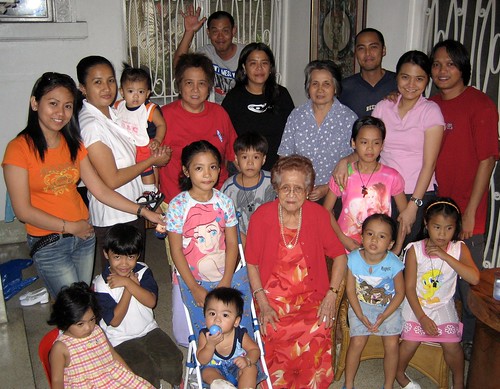
The usual suspects: some of the incorrigible attackers of our mother’s birthday lechon; the toddler in stroller was just as feisty in grabbing his share, while the little guy at the back waving to the camera started the whole pandemonium. The 88-year-old birthday celebrant is seated up front.
* * *
Recommended read : Sidney's La Loma's Lechon photoblog entry
I very much appreciate my articles and photos appearing on fellow bloggers' sites, popular broadsheets, and local broadcast news segments, but I would appreciate even more a request for permission first.
Thank you!
*
Labels: Featured food, lechon
posted by Señor Enrique at 1:50 PM
| 17 comments
Monday, September 25, 2006
ON CARLOS PALANCA STREET

This is Carlos Palanca Street heading towards Quezon Boulevard in Quiapo. The yellow building on the right is the Universidad de Manila (City College of Manila) where the old Clover Theater used to stand and where German Moreno started out as a janitor; behind it is FEATI.
Originally named Echague Street, this strip is quite famous for its affordably-priced housewares.

In addition, there are two longtime stores on this street that are quite popular as well. One is the Kim Chong Tin Hopia Factory; maker of the traditional hopia with thicker and toasted dough as opposed to Polland’s and Eng Bee Tin’s which is thinner and softer. Kim Chong Tin’s mini hopia is its best seller; the hopia mongo’s bag of eight pieces sells for P33.00.
The selling floor may appear spartan, but what most people do not know is that the bulk of this hopia factory’s income comes from the sale of its hopia filling, sold to bakeries nationwide.

Another product this street is famous for is cooked ham. This was where my father bought sliced ham and some freshly-baked rolls to be taken inside a movie theater for the entire family to feast on while watching a movie feature on a Sunday afternoon.

Excelente Cooked Ham is one of two stores on this street usually mobbed during the holidays. One kilo of sweet ham retails at P680.00, but one can buy as small as a quarter of a kilo for P170.00. Besides cooked ham, Excelente also offers other processed meat such as bacon and variants of it.

So the next time you plan on shopping for some cooking and baking wares, explore Carlos Palanca Street. Afterwards, try the traditional mini hopia at Kim Chong Tin and some sliced cooked ham at Excelente. If a ham sandwich is what’s on your mind, the Vienna rolls from the nearby Vienna Bakery are recommended.
At the tip of Carlos Palanca Street (from Plaza Lacson) is the Quiapo Bridge. Many of our wonderful handicrafts are sold at the stalls underneath the foot of the bridge.

Labels: Featured food, Manila history, Quiapo, walking tour
posted by Señor Enrique at 10:40 AM
| 30 comments
Saturday, September 16, 2006
MY DAILY BREAD
 Abundant with affordably-priced cafes and restaurants, some friends in New York often equate my living in Manila with a daily indulgence in great meals that one would pay for handsomely like in Soho’s Filipino restaurant, Cendrillon.
There would be dead silence on the line whenever I’d mention my eating habits could be so bland at times that some well-heeled cousins had ascribed my sometimes austere gastronomical pleasure to some undisclosed life-threatening disease — followed by a whisper of, “Maybe that’s why he came back to Manila … to spend the end of his days.”
Truth be told, I sometimes wonder if my persona does tend to bring bad luck, for my favorite local eateries, which I could tirelessly go to on a daily basis, had disappeared — one is Juan Soy in Greenbelt, the other is Pinoy Don in Robinson’s Malate. I don’t even know if they have any branches anywhere else in the city.
Be that as it may, something I enjoy every morning is the pandesal. I call it the two-biter because its size nowadays only requires two bites to gobble up; average price is two pesos each at the neighborhood bakeries.
A couple of years ago, in my regular attempt to make sure my brain doesn’t go anywhere without my consent, I took a one-week baking class in Diliman, Quezon City. Now, here is what some bakers in my class told me (they were there for the certification required for overseas job applications): the texture of the morning pandesal differs from that of the afternoon which is more airy inside and toasted on the outside. How's that for trivia?

Chow King’s wanton noodle is another favorite of mine, which I would have for lunch whenever possible. It’s tasty and light — I don’t feel so bloated and lethargic afterwards. It costs about 68 pesos for the large bowl. It’s usually served very hot (the camera even caught the steam coming from it) so give it a few minutes before digging in.
I used to go to Ma Mon Luk in Quiapo for mami and siopao, but I noticed I felt sleepy afterwards. It wasn’t until another blogger had written about this restaurant that I found out about the true cause of this sleepiness — excessive MSG (monosodium glutamate). That was the end of that.
Now, some of you may be too young to remember Little Quiapo, but it was once very popular, especially among the students in the university belt area. Like Chow King, they were famous for their mami, siopao and halo-halo.
I very much appreciate my articles and photos appearing on fellow bloggers' sites, popular broadsheets, and local broadcast news segments, but I would appreciate even more a request for permission first.
Thank you!
*
Labels: Featured food, life in Manila, pandesal
posted by Señor Enrique at 11:17 AM
| 31 comments
Friday, September 15, 2006
SOLO TRIP TO CHINATOWN

For the very first time in ages, I was able to gallivant on my own in Manila’s Chinatown and felt completely confident. Joining Ivan’s Big Binondo Food Wok tour certainly got me reacquainted with this area’s narrow streets, which I was once very familiar with as a kid.
Some of the things that piqued my interest as I enjoyed my solo flight walk were the foodstuffs being sold out in the streets such as the roasted chestnuts, which I used to enjoy especially during Christmastime in New York. I even had a friend who showed me how to roast them in a microwave oven.

There was also the tubo or sugar cane which brought back fond memories. As little kids, my friends and I would buy a long cane and have it cut into several pieces for us to share. They were always a sweet and refreshing treat, especially during the hot summer afternoons; however, it was rather challenging for the jaw. Also, you’d better have a good set of teeth to really enjoy them.

The atis was another delight – sweet and delicious, but a lot of work to eat because of its many seeds. This is my brother Taba’s favorite (he was the sixth sibling and aptly nicknamed Taba because he was chubby when young.) I remember him patiently peeling off the skin until there were only those at the bottom left. He would then slowly enjoy eating it, with ecstasy etched on his face. I would get more of a kick by watching him eat one instead of having one for myself.

These red things look fierce. They’re called dragon fruit. Never had one of these intriguing fruits before, but told they’re good. Considering they’re found more in Chinatown than in any other Manila neighborhoods, I’m afraid that if I had one I’d be off hallucinating for days and finding nirvana. However, the vendor assured me this fruit, though red, is not of the Papaver somniferum kind.

In the end, I settled for one of these — tikoy!
I'll be back in Chinatown more often with or without anyone in tow. Now that I know my way around, I will be enjoying this neighborhood as I used to when I was a kid.
I very much appreciate my articles and photos appearing on fellow bloggers' sites, popular broadsheets, and local broadcast news segments, but I would appreciate even more a request for permission first.
Thank you!
*
Labels: Binondo, Featured food, life in Manila, Manila Chinatown
posted by Señor Enrique at 8:13 AM
| 32 comments
Saturday, September 02, 2006
LITTLE TOKYO IN METRO MANILA

Since the past couple of years, I've been meaning to go to Little Tokyo at Chino Roces Avenue in Makati; last Thursday, I finally did. There were many Japanese restaurants in this area to choose from, but decided to check out Heijyoen.
I was craving for sashimi so I ordered their sashimi set that includes miso soup, salad, squid appetizer, a plateful of various sashimi, bowl of rice, mango jelly dessert, and Japanese tea. It was rather pricey at 378 pesos (about 7 US dollars), but it was definitely worth it. The sashimi was fresh and the entire meal was very good.
This restaurant’s specialty is yakiniku — marinated meat that you grill right on your table. The spare ribs cost 348 to 428 pesos; tenderloin is 268 pesos, tongue is 198 pesos; and mixed vegetables are 88 pesos.
The service is excellent and the bathroom (or comfort room) is clean, which can only mean that the restaurant’s kitchen is clean as well.
Heijoyoen is located at 2277 Chino Roces Avenue, Makati City, Metro Manila. Telephone is 888-2288. It is open from 11:00 a.m. to 11:00 p.m.

I very much appreciate my articles and photos appearing on fellow bloggers' sites, popular broadsheets, and local broadcast news segments, but I would appreciate even more a request for permission first.
Thank you!
*
Labels: eateries, Featured food
posted by Señor Enrique at 7:53 AM
| 16 comments
Tuesday, August 29, 2006
SPOONFUL OF LECHE FLAN
 This is my all-time favorite dessert — leche flan or crème caramel; a custard dessert with its top layered with soft caramel.
 Supposedly French in origin, it has spread across Europe and has become known as flan in Spanish-speaking countries. European restaurants love the ease of making it. It can also be prepared in advance, chilled, and served as needed.
Crème caramel is a variant of plain custard (crème) where some caramel syrup is poured into the mold before adding the custard base. After the custard has set, it is turned out, leaving a caramel sauce on top. Like all custards, flan is made with whole eggs, milk or cream, and sugar. The typical flavoring is simply vanilla.
As a kid, whenever my parents took me to fiestas or wedding receptions in which the meals are served buffet-style, almost always, my mother had to ask the host if I could be given a piece of leche flan first; otherwise, I would just as easily spend the entire affair playing with my cousins and not eat. The main dishes held no interest for me, only the desserts; specifically, the flan. Once I had a piece, I would then eat some of the main sumptuous dishes.
In New York City, one of my brothers really excelled in making leche flan. However, whenever I had sudden cravings for it, I’d often stop by Dean & Deluca down in Soho and just get myself some crème burlee. At some restaurants here in Metro Manila, many now offer crème burlee, but leche flan is still my prime choice.
While vacationing in Subic as a youngster, my aunt who had a poultry business would always delight us with leche flan every Sunday. This was her way of thanking us for helping her gather the eggs from the chicken coops in the afternoons. However, there was once an incident which made my aunt to never allow me to gather eggs without the supervision of one of her maids. You see, she once caught me pushing back the egg with my finger as the hen labored desperately to lay it once and for all.
By the way, she was the same evil aunt who unmercifully crucified and burnt my pet pig at the stake. If it wasn’t for her leche flan, I would have never returned to her house for vacation ever again.

Labels: Featured food, Growing up memoirs
posted by Señor Enrique at 8:31 AM
| 22 comments
Monday, August 28, 2006
FOOD BINGEING AT CHINATOWN BINONDO
 Besides the daily grind of commerce, food is one of the main attractions of Chinatown.
 I heard about some of its good restaurants such as the Lido along Alonzo Street; the original Lingnam Restaurant known for its fresh noodles; and the eateries along the estero such as Grand House that people rave about.
And for some quick meals Chinatown offers the original Mey Lin along Carvajal Street, Shin Tong Yon on Benavidez Street, and Ha Yuan Restaurant on Masangkay Street.
 Although my father took me to Chinatown to eat at least once a week while growing up, I had been away for so long that when I came back, everything looks strange; foreign, in fact.
 So many things had changed during my absence. And since coming back, The President was the only restaurant I would go to whenever I find myself in Chinatown. As much as I love the foods served at this fine restaurant, I was craving for other places. I guess it wasn’t just the food; I was trying to get that old feeling back -- the time when my father and I used to walk on these streets.
My old friends and relatives weren't of any help. They don’t feel inspired to venture into Binondo’s narrow streets anymore. Besides, a lot of fine Chinese restaurants had opened all over Metro Manila that offer lots of parking to boot. But I wanted to reacquaint myself with the authentic Binondo eateries. And this inner desire led me to sign up for Ivan Mandy’s Big Binondo Food Wok — an afternoon of history lessons and several authentic Chinese food stops.
I had a wonderful time! Ivan is really good at what he does. Let me put it this way, everyone in this particular tour group was having such a good time that the intermittent showers throughout the entire afternoon didn’t even bother any one of us.
There were other bloggers who joined this particular tour and whom I had the pleasure of meeting. I will leave it up to them to share with the readers the full extent of the tour. What I plan to do instead is go back to those places that Ivan Mandy introduced us to, order a couple of entrees from their menu, and then blog about it.

Labels: Binondo, eateries, Featured food
posted by Señor Enrique at 4:46 PM
| 32 comments