Sunday, August 17, 2008
THE CHURCH AT THE PLAZA


Binondo Church - Wikipedia
Plaza Calderon de la Barca in Binondo
Ysla de Binondo and The Chinese Revolt
Roman Ongpin
Two Weddings and a Food Trip
I very much appreciate my articles and photos appearing on fellow bloggers' sites, popular broadsheets, and local broadcast news segments, but I would appreciate even more a request for permission first.
Thank you!
*
Labels: Binondo, Binondo Church, life in Manila, photography
posted by Señor Enrique at 8:45 AM
| 20 comments


Thursday, August 07, 2008
WAI YING FASTFOOD & MANG INASAL


First learned about about Wai ying restaurant from Moni of Of Places & Food blog site who said, "It is air conditioned but it's not for those who want peace and relaxation. If you consider the food quality and reasonable price as a good tradeoff, then this place might just be for you."
I had no idea about it's exact location but Moni gave me the direction: it's on Benavidez Street only a few meters from the corner of Salazar. It has a huge signage that's tough to miss. From Ongpin Street facing Sta. Cruz area, turn left on the street opposite the appliance center and President Restaurant. Turn right once you approach the corner. That's Benavidez Street and Wai Ying is a few doors away on the right side of the road facing C.M. Recto avenue.
Wai ying offers a variety of congee (lugaw), roasted meats, dim sun, vegetables, dessert and drinks. They also have combination meals from 100 to 120 pesos. I had the white chicken and asado over rice. It was delicious and the serving was plentiful. The dimsum range in price from 50 to 60 pesos per order.
Visit Moni's Of Places & Food blog site for more details, as well as for his critiques of other eateries in the area.
Meanwhile, remember the Mang Inasal restaurant on Ongpin and Padilla Streets that I blogged about last July (Going Against The Grain)? Well, it's pecho -- marinated and grilled chicken breast and wing with unlimited rice -- has become my nephew's and his friends' choice of meal lately. They seem to have forsaken their once-favorite two-piece Chicken Joy at Jollibee. However, the branch they often go to is the one over at the university belt area (Recto near corner Quezon Boulevard).
Anyway, I once went with them at Mang Inasal, and I have to admit the pecho I had was just as delicious as those served at Bacolod Chicken Inasal restaurant. The prices at Mang Inasal are lower, though.
 Mang Inasal over at Ongpin & Padilla Streets in Binondo
I very much appreciate my articles and photos appearing on fellow bloggers' sites, popular broadsheets, and local broadcast news segments, but I would appreciate even more a request for permission first.
Thank you!
*
Labels: Binondo, eateries, Featured food
posted by Señor Enrique at 10:33 AM
| 20 comments
Tuesday, August 05, 2008
NUEVA STREET IN BINONDO

Originally named Calle Duque, it was changed to Nueva, meaning "new" in Spanish as the street was newly built in 1863 to ease the traffic congestion on Quintin Paredes Street (formerly Rosario) caused by the repair work on Puente de España (now Jones Bridge) after it was damaged by an earthquake.
Nueva was then renamed Yuchengco Street after Enrique Yuchengco, Philippine Permanent Representative to the United Nations and an incredibly rich businessman who founded the Yuchengco Group of Companies based in Makati City.
To see a 'before and after' image layout of the top photo, click here.

On Plaza Moraga in Binondo
Plaza Calderon de la Barca in Binondo
The Bridge, The River & The Youth of Manila
I very much appreciate my articles and photos appearing on fellow bloggers' sites, popular broadsheets, and local broadcast news segments, but I would appreciate even more a request for permission first.
Thank you!
*
Labels: Binondo, Manila history
posted by Señor Enrique at 8:30 AM
| 8 comments
Friday, February 23, 2007
ROMAN ONGPIN
 His bronze statue stands proudly on the street named after him — stretching from Juan Luna Street to Plaza de Sta. Cruz.
It's a busy narrow street that is bounded by a historical church on either end — Binondo Church on the west and Sta. Cruz Church on the east; churches that were initially built to serve Binondo’s growing Chinese converts to Catholicism.
Many local Manilans to this day would even nonchalantly refer to the entire Binondo district or Chinatown as Ongpin.
But who was Roman Ongpin?
The only information I could find about this man is that he founded El 82, an artist supply store in Binondo, which was managed by his son, Alfonso.
The walls of this store were lined with some of the finest collections of Philippine paintings such as those by the nineteenth-century masters, Juan Luna y Novicio and Felix Resurrection Hidalgo. There were also paintings by Fabian de la Rosa and later on, by his nephew, Fernando Amorsolo.
So, essentially, besides being a successful businessman, Roman Ongpin was a patron of the arts. However, according to Tsinoy.com, there was another side to this man — the heroic. He was supposedly an intrepid supporter of the Philippine Revolution of 1898; generously providing the Katipuneros with money, foods and other important necessities from his business establishments.
The Spaniards were completely oblivious to his involvement because Ongpin appeared as a staunch ally of the administration. He was so good at such pretense he was appointed teniente de mestizos of Binondo for two years. Even during the early American colonial rule, Roman Ongpin remained active in the revolution until he was caught and imprisoned from December 6, 1900 to March 23,1901.
A true lover of the arts and freedom, Roman Ongpin risked his life, the welfare of his family, and his personal fortune by having supported the Philippine Revolution.

Aguinaldo's Breakfast by Ambeth Ocampo
Anvil Publishing 1993
Labels: Binondo, Ongpin Street, Roman Ongpin
posted by Señor Enrique at 7:50 PM
| 30 comments
Sunday, February 18, 2007
WELCOMING THE YEAR OF THE PIG
 According to the Chinese zodiac, people born in the Year of the Pig are tenacious and attend to their tasks with great strength. They love to study and gain much pleasure in developing their intellectual capacity.
Their fortitude and straighforwardness provide them with a determination that knows no retreat. They're not into any sort of popularity contests; therefore, not very good in making friends, but the few they have are friends for life. They are quick-temepered, though they shy away from any quarrrels. They are very kind to their loved ones and to those they treasure as friends.
They are also good in working out any differences and no matter how grave a problem is, they're able to work things out amicably amongst those involved.
And what better way to welcome the Year of the Pig than to be at Manila's Chinatown. Its streets were filled with the deafening sounds of kettle drums and firecrackers while various groups perform the colorful and mesmerizing lion and dragon dances. There were also loads of tikoy of various flavors, fruits, and a dizzying array of good luck charms.
I was there last Saturday and was pleasantly surprised to run into a couple of fellow bloggers -- Sidney, Anton and Ivan Henares. I joined them for some dimsung before heading back out in the streets to take some pictures of the merriment as featured below.


Labels: Binondo, Chinese New Year, Manila Chinatown
posted by Señor Enrique at 7:56 PM
| 28 comments
Thursday, September 28, 2006
YSLA DE BINONDO AND THE CHINESE REVOLT
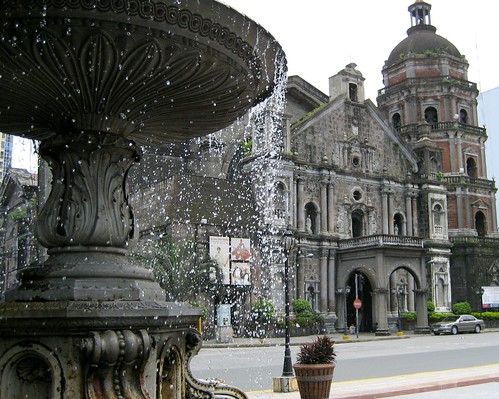
Located at Plaza Calderon de la Barca, Binondo Church, also known as Minor Basilica of Saint Lorenzo, was founded by the Dominican Friars in 1596. It has sustained considerable damage over the centuries from earthquakes and other natural disasters, as well as from fierce bombings during World War II. It wasn’t until 1972 that it was restored, but the octagonal bell tower and some foundations remain of the original 16th century structure, which is typical of colonial Spanish architecture. Today, its maintenance is largely funded by the members of the Catholic Chinese community; most reside and operate business establishments in the area.
Binondo, an hacienda once like Makati, is an island between two estuaries or esteros — Estero de la Reina and Estero de Binondo. The village of Binondo sprang in the banks of the Pasig River, and was once called Ysla de Binondo. It was already a hub of Chinese commerce even before Martin de Goiti and his men forcibly took over Manila in 1570 from its Muslim kings.
Two years before this church was built, in 1594, the Spaniards gave the land to the Catholic Chinese tax-free and Binondo was established with limited self-governing privileges. This was to encourage their loyalty to Spain while keeping them culturally at a distance. Nonetheless, just across the Pasig River, from the gated walls of Intramuros, the Spaniards aimed the range of their cannons at this Chinese enclave in case of an uprising.
The Galleon Trade ensued thereafter which sailed between Manila and Acapulco and linked the Chinese junk trading system to Mexico and to the rest of Europe. For 250 years, galleons sailed 9000 nautical miles. When the Spaniards settled in the country, more Chinese came. And as the population of the Chinese grew in Manila, the mutual feeling of fear and distrust between them and the Spaniards rose as well. Consequently, such mutual suspicions manifested persecution and harassment including large-scale massacres.
In 1581, Governor General Gonzalo Ronquillo Peñalosa's heightened fear of the Chinese led him to issue a directive to round up the scattered communities of early Chinese migrants and forced them to settle at the Settlement of San Gabriel. They were also subjected to forced labor in building the Walls of Intramuros. Travel to the island was through the Duente de Spaña Bridge built by the Spanish authorities in 1632 (where it was replaced by Jones Bridge). At that time, by law, all Chinese were forced to reside in the areas of Ysla de Binondo, San Nicolas and Sta. Cruz.
The Spaniards separated the Chinese in quarters called Parian. By 1596, led by their padrinos, most citizens of Parian, were baptized as Catholics, thus creating the Chino cristianos. By virtue of their new faith, they were granted more freedom than the unconverted Chinese and could marry the natives. In 1790, when the last Parian was destroyed, the Chinese were allowed to join the baptized Chinese in Binondo and Santa Cruz. Sangley, the term used by the Spaniards for the Chinese, comes from the word siong-tay, literally "often comes" in Hokkien. The Sangleys came as merchants, laborers, and artisans. Due to massacres or fires, the Spaniards changed the location of the Parian nine times.
The first major Chinese revolt against the Spaniards occurred on October 25, 1593. It was led by Pua Ho Go (P’an Ho Wu in Mandarin) who, along with 250 Chinese, was enlisted compulsorily as boat rower for a military expedition to Moluc¬ca Islands in Indonesia, led by Governor-General Gomez Perez Dasmariñas.
It was a series of failed expeditions — in 1582, he had to go home after two-thirds of the expedition were downed by epidemic; 1584, no luck, either. Finally, in 1593, Dasmariñas had with him in his galley 80 Spaniards and 250 Chinese galley slaves. The vessel was put into port near Batangas for shelter due to contrary winds. In the silence of the night, when the Spaniards were asleep, the galley slaves led by Pua Ho Go killed them all, except for a Franciscan friar and secretary. Dasmariñas was the only Spanish governor-general and the highest ranking Spanish official in the Philippines ever killed by the insurgents.
On October 3, 1603, the Spanish colonial regime carried out the first massacre of the Chinese in the Philippines, in which more than 23,000 died. It was also the first Chinese pogrom that occurred in Southeast Asia. There was a total of six Chinese massacres in the Philippines in which approximately 100,000 lives were sacrificed. The Chinese, along with the Filipinos, experienced untold sufferings from the brutality of the Spanish rule.
There are now about 1 million ethnic Chinese in the Philippines; a large concentration live in the cities of Manila and Cebu. HIstorically, the relationship between the Chinese and Filipinos has alternated between alienation and acceptance from the pre-Spanish era. However, through intermarriages and the more common use of Tagalog, many Chinese (or Tsinoys) are now active participants in all aspects of Philippine society.

Labels: Binondo, Early Chinese, Manila history
posted by Señor Enrique at 7:40 AM
| 38 comments
Tuesday, September 26, 2006
DON CARLOS PALANCA TAN QUIEN-SIEN
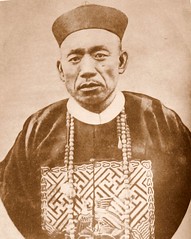 His life was a classic rags-to-riches story: Born of a poor family in T’ung-an hsien, he migrated to the Philippines in 1844. Although starting out in a measly position in the textile business, through hard work, tenacity, and acquired connections, he prospered.
Only about twenty years after arriving in Manila, he had risen as a powerful leader in the Chinese community. His wealth stemmed from importing enterprises, which included sugar and rice. He was also involved in coolie brokerage. Besides the businesses that he presided over, there were many commercial ventures in which his investments raked in enormous profits.
When he converted to Catholicism, his baptismal sponsor was Colonel Carlos Palanca Y Gutierrez — a Spanish forces leader in the Franco-Spanish intervention of 1858-62 in Cohin, China. He then assumed the name of his godfather (padrino); changing it from Tan Quien-sien to Carlos Palanca Tan Quien-sien. He eventually became widely known as Don Carlos Palanca.
He attained the position of gobernadorcillo from 1875-77, and again some years later; serving as the interim gobernadorcillo in 1885 and 1889. And when not in office, he continued to move behind the scenes with undisputed power; an effective arbitrator of disputes as well. For his services as gobernadorcillo, Spain granted him the Medal of Civil Merit and the Grand Cross of Isabel the Catholic.
He was always active in community affairs and philanthropy; raising funds for the community hospital and even provided a building for it himself in 1891. His generous donations extended outside of the Chinese community. There were many exemplary accomplishments attached to his name — the abolishment of vice in the community, the end of police extortions of the Chinese; the abolition of the death penalty for crimes committed by Chinese; and through powerful connections in Spain, softened Spanish legislation on the Chinese
He played a major role in the community’s efforts to obtain a Chinese consulate in Manila during the 1880s and 1890s. When the Americans took control of the country in 1898, he provided the American troops with temporary lodging arrangements, as well as furnished them with coolies to build their barracks. Subsequently, he urged the Ch’ing government to negotiate with the United States for a Chinese consulate in Manila. When the consulate was established in 1899, the Ch’ing government appointed his son, Ignacio Palanca Tan Chueco, to the position of first consul.
When the Philippine Revolution broke out he chose to keep distance; not committing to either side. When the Spanish government charged a number of mestizos with conspiracy, he argued in behalf of some of them and helped secure their release, though his attitude toward the Chinese mestizos was one of contempt. Not a believer of inter-racial marriage, he sent his son to a school in China to thwart his filipinization.
The Spanish and Filipinos, on the other hand, regarded Don Carlos Palanca with mixed sentiments. Their pervasive perception of him was that of a master corrupter; one who would resort to extreme measures just to get what he wanted.
He was thought of as a man obsessed with becoming the Chinese consul. He did assume the interim role of which when his son’s return from China was delayed for several months; unable to immediately fulfill his appointment as consul.
There were speculations among the Filipino intellectuals that Jose Rizal modeled after Don Carlos Palanca his character of Chinaman Quiroga in El Filibusterismo. Jose Alejandrino, a friend of Rizal, confirmed that it was indeed the case. Alejandrino further claimed that Don Carlos Palanca approached Aguinaldo — when he was forming his revolutionary government — about the possibility of creating an opium monopoly.
Despite such controversies, he was, undoubtedly, a powerful force in the Chinese community during the late nineteenth century. When he died in 1901, a statue was erected in the Chinese cemetery as a tribute to his community service and philanthropy.
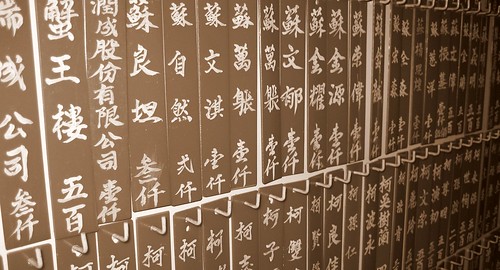
The Chinese in Philippine Life 1850-1898
By Edgar Wickberg
Ateneo de Manila University Press
Fei-lu-pin Min-li-la Chung-hua Shang-hui san-shi chou-nien k’an ed. Huang Hsiao-ts’ang
(Manila, 1936)
Labels: Binondo, Early Chinese, Manila history
posted by Señor Enrique at 6:45 AM
| 46 comments
Friday, September 15, 2006
SOLO TRIP TO CHINATOWN

For the very first time in ages, I was able to gallivant on my own in Manila’s Chinatown and felt completely confident. Joining Ivan’s Big Binondo Food Wok tour certainly got me reacquainted with this area’s narrow streets, which I was once very familiar with as a kid.
Some of the things that piqued my interest as I enjoyed my solo flight walk were the foodstuffs being sold out in the streets such as the roasted chestnuts, which I used to enjoy especially during Christmastime in New York. I even had a friend who showed me how to roast them in a microwave oven.

There was also the tubo or sugar cane which brought back fond memories. As little kids, my friends and I would buy a long cane and have it cut into several pieces for us to share. They were always a sweet and refreshing treat, especially during the hot summer afternoons; however, it was rather challenging for the jaw. Also, you’d better have a good set of teeth to really enjoy them.

The atis was another delight – sweet and delicious, but a lot of work to eat because of its many seeds. This is my brother Taba’s favorite (he was the sixth sibling and aptly nicknamed Taba because he was chubby when young.) I remember him patiently peeling off the skin until there were only those at the bottom left. He would then slowly enjoy eating it, with ecstasy etched on his face. I would get more of a kick by watching him eat one instead of having one for myself.

These red things look fierce. They’re called dragon fruit. Never had one of these intriguing fruits before, but told they’re good. Considering they’re found more in Chinatown than in any other Manila neighborhoods, I’m afraid that if I had one I’d be off hallucinating for days and finding nirvana. However, the vendor assured me this fruit, though red, is not of the Papaver somniferum kind.

In the end, I settled for one of these — tikoy!
I'll be back in Chinatown more often with or without anyone in tow. Now that I know my way around, I will be enjoying this neighborhood as I used to when I was a kid.
I very much appreciate my articles and photos appearing on fellow bloggers' sites, popular broadsheets, and local broadcast news segments, but I would appreciate even more a request for permission first.
Thank you!
*
Labels: Binondo, Featured food, life in Manila, Manila Chinatown
posted by Señor Enrique at 8:13 AM
| 32 comments
Monday, August 28, 2006
FOOD BINGEING AT CHINATOWN BINONDO
 Besides the daily grind of commerce, food is one of the main attractions of Chinatown.
 I heard about some of its good restaurants such as the Lido along Alonzo Street; the original Lingnam Restaurant known for its fresh noodles; and the eateries along the estero such as Grand House that people rave about.
And for some quick meals Chinatown offers the original Mey Lin along Carvajal Street, Shin Tong Yon on Benavidez Street, and Ha Yuan Restaurant on Masangkay Street.
 Although my father took me to Chinatown to eat at least once a week while growing up, I had been away for so long that when I came back, everything looks strange; foreign, in fact.
 So many things had changed during my absence. And since coming back, The President was the only restaurant I would go to whenever I find myself in Chinatown. As much as I love the foods served at this fine restaurant, I was craving for other places. I guess it wasn’t just the food; I was trying to get that old feeling back -- the time when my father and I used to walk on these streets.
My old friends and relatives weren't of any help. They don’t feel inspired to venture into Binondo’s narrow streets anymore. Besides, a lot of fine Chinese restaurants had opened all over Metro Manila that offer lots of parking to boot. But I wanted to reacquaint myself with the authentic Binondo eateries. And this inner desire led me to sign up for Ivan Mandy’s Big Binondo Food Wok — an afternoon of history lessons and several authentic Chinese food stops.
I had a wonderful time! Ivan is really good at what he does. Let me put it this way, everyone in this particular tour group was having such a good time that the intermittent showers throughout the entire afternoon didn’t even bother any one of us.
There were other bloggers who joined this particular tour and whom I had the pleasure of meeting. I will leave it up to them to share with the readers the full extent of the tour. What I plan to do instead is go back to those places that Ivan Mandy introduced us to, order a couple of entrees from their menu, and then blog about it.

Labels: Binondo, eateries, Featured food
posted by Señor Enrique at 4:46 PM
| 32 comments
Sunday, August 27, 2006
TWO WEDDINGS AND A FOOD TRIP

Imagine this: In a single day, I had gone to four houses of worship, witnessed two weddings, attended a centering prayer meeting, walked through Rizal Park, rested my weary feet at the lobby of Manila Hotel, enjoyed a walking tour of Manila’s Chinatown, and met fellow bloggers for the first time.
It all started at Malate Church. I had misread Beth’s of KaleidosThoughts SMS message to meet her at Ermita Church to attend their centering prayer meeting; I ended up at Malate Church instead. However, rather than rush over to Ermita Church where she was, I watched a grand wedding being held at Malate church. With the area teeming with luxury cars, private chauffeurs and security personnel, I could only surmise many important people were in attendance.
Beth’s centering prayer workshop was a whole day affair, but only stayed for about half an hour; twenty minutes of which were learning and participating in meditation — definitely soothing for both mind and body. Immediately afterward was a ten-minute break, and then I had to say goodbye to her.
 Originally, I invited Beth to join me in this Chinatown food tour, but she had another church-related activity to attend to. She did, however, promise to act as my guide for an evening walking tour of Plaza Lawton later this year when most lights at government buildings will be turned on for the holiday season.
Before heading over to Binondo to join up with Ivan’s Big Binondo Food Wok, I stayed around to witness another wedding, but this time at Ermita Church. It was much simpler than the wedding earlier at Malate Church, but nonetheless, everyone seemed just as excited and jubilant.
I still had some time to kill before heading to Chinatown so I headed towards Kalaw Avenue and then to Rizal Park. Although a cloudy day, I took a picture of the hero’s monument. There were many tourists (Koreans) having their pictures taken in front of the monument; therefore, I wasn't able to take a shot from dead center; had to do it from the side.
 Only a block away is one of Manila's grand hotel. Last time I was in the area, I only had enough time to take a picture of its façade, though the guard advised it was all right to take pictures of the hotel’s beautiful lobby as well. At that time, I was running late for Carlos Celdran's Intramuros tour and didn't have enough time to do it.
 However, I had more time this Saturday to take some pictures of its interior, as well as lounge for a little while to appreciate its hunongous but warm ambience. Take note of the wooden ceiling and the capiz shell shades of the huge brass chandeliers. Also had an opportunity to chat briefly with one of the hotel's security managers who has been working there for ten years. He mentioned that as the years passed, there were less high profile personalities to be seen in the premises or checking in as guests. Perhaps, the Mandarin Hotel in Makati has taken over as the city's most prestigious and luxury hotel.
 From Manila Hotel, unable to find a calesa to take me to Binondo Church; decided to cab it instead. I rarely take cabs these days so I also took this opportunity to strike up a conversation with the driver to sort of ask for some driving tips.
Incidentally, before I started driving in the city, I asked a number of taxi drivers for their advice. I was rewarded with valuable information which prevented me from getting overwhelmed or aggravated by the city's trafic jams.. Be that as it may, to this day, I don't particularly enjoy driving over at Makati mainly because of its strict and ever-changing traffic schemes.
There was a mass going on at Binondo Church when I arrived so I decided to attend it. Right afterwards, I noticed some people taking pictures; thought they must be part of the same walking tour that I had signed-up for. I was right.
It was past twelve by that time and I was beginning to feel hungry. I knew that eating at some of Chinatown's retaurants was the highlight of this tour so, just to appease my grumbling stomach, I crossed Ongpin Street to get some hopia at Eng Bee Tin.
Ivan soon showed up and our walking tour started. Much to my pleasant surprise, a visit to one of the older Chinese temples in the heart of Chinatown was an added treat, for I have never been inside one.
It was indeed a pleasure to have finally met Sidney Snoeck of My Sari-Sari Store, who for more than the past six months — along with Irene aka Niceheart of Journey to Honeyville — has been most generous with his support and encouragement in honing my blog writing skills.
It was also quite exciting to have met other bloggers on this food trip such as Ejay and his girlfriend, Pi; a wonderful couple, I must admit. As for Irene, I have a hunch we'll get a chance to meet when I attend her son Reggie’s concert either in New York City or at Newport, Rhode Island for its famed summer jazz festival.
This has been one of the most hectic Saturdays I’ve ever had in quite some time, but absolutely enjoyed every minute of it.
I will post a separate entry about the food trip; for now, feast your eyes on these Chinese delights!

Labels: Binondo, Featured food, walking tour
posted by Señor Enrique at 6:16 AM
| 40 comments
Wednesday, August 16, 2006
CHINATOWN aka BINONDO
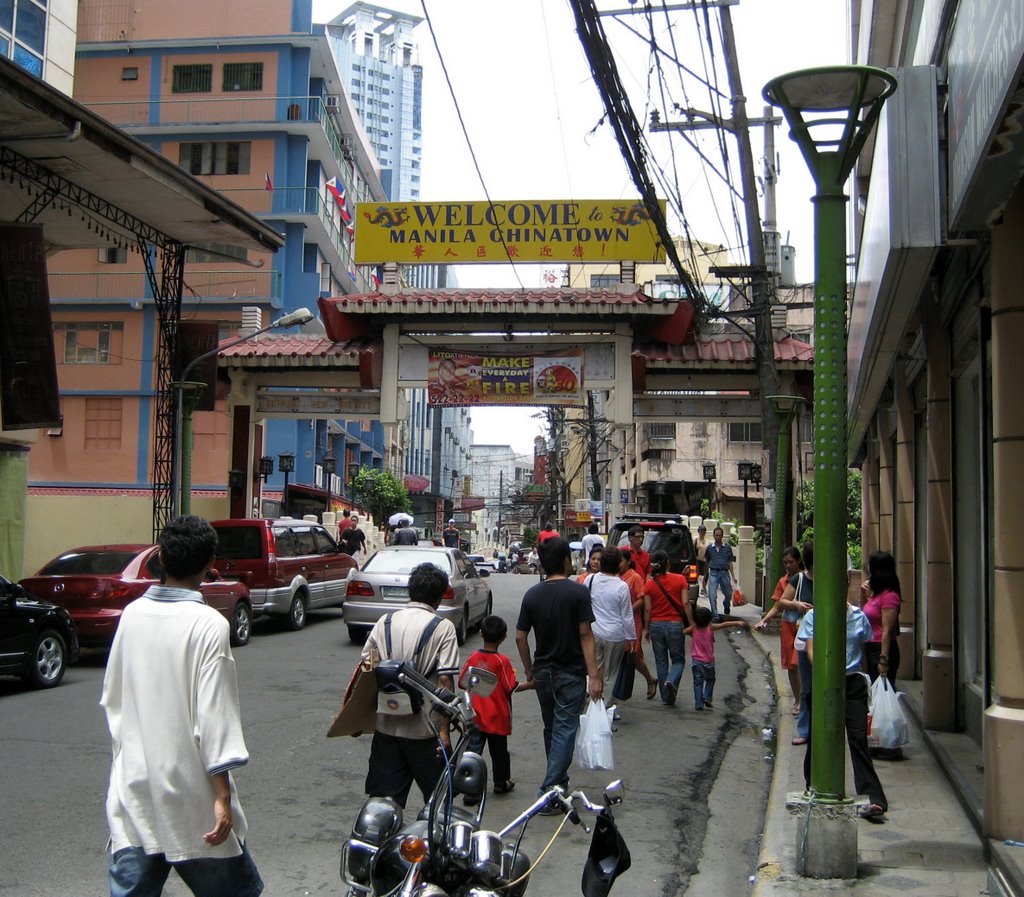 This was the largest town during the 1800s outside of Intramuros.
 It was the center of commerce for the Chinese and Filipino businessmen even before the Spaniards arrived and it continues to be a thriving commercial hub to this day.
More than 70% of the goods sold in the provinces are estimated to be directly sourced from wholesalers along Chinatown’s dozens of narrow streets. This area also boasts numerous eateries which attract many people from all over Metro Manila, especially on weekends.
My father, though born in Subic, Zambales, studied in Manila from elementary to college and lived at my grandfather’s cousin’s house in Binondo; only to return to Subic during vacation. After graduating from college, along with his cousin as partner, they set up a business at Florentino Torres Street near C.M. Recto Avenue.
From the time I was old enough to go to the bathroom by myself, my father started taking me along to his office on Saturdays when he worked only until lunchtime. I was a quiet, cooperative child and could be left on a chair near him as long as I have a favorite toy in my hand to keep me occupied. But when I turned eight or nine, there were times boredom would spur me to sneak out of the office and gallivant on my own around Chinatown. Confident with my basic know-how of the various twists and turns of some of its narrow streets, I would usually end up at my favorite place -- the pet shop that my father and I always passed by on our way to eat lunch.
It had a gigantic aquarium filled with exotic salt water fish. The nice Chinese proprietress would lend me a stool to sit in front of it. And while I ate a bag of buchi or mini hopia I bought from the nearby street vendors, I would make believe I was an underwater diver. This would go on for quite a lengthy period until I would get a tap on my shoulder from that nice Chinese lady as she pointed to the wall clock nearing 12. I would then thank her and run back to my father’s office.
At lunchtime, as we passed by the pet shop on our way to a restaurant, the nice Chinese lady would wink at me as if to celebrate our little secret. This escapade went on for quite some time until my father noticed my disappearing act and had his messenger, Tito, trail me. Once settled on the stool to watch the newly-arrived batch of intensely colorful salt water fish, Tito rushed back to the office and told my father my exact whereabouts. My father decided to leave for the day an hour earlier than usual and came to fetch me at the pet shop.
I was too engrossed by the activities inside the fish tank to sense my father standing behind me until I noticed his figure reflected on the tank’s glass. My eyes widened with fright but before he could utter a single word, the nice Chinese lady stepped out of her counter where the cash register was to greet my father. And from their initial exchange, they appeared to know one another. My father had always been a man of few words but quite articulate when necessary; however, on this particular occassion, he was obviously fumbling for his words.
And before I knew it, my father was buying me a five-gallon fish tank and some of its paraphernalia. The nice Chinese lady then told me to come back and buy the fish another day when the tank had been fully set up; with its water conducive enough for the fish to inhabit. Before saying goodbye to her, my father asked if he could use their telephone to ask Tito to pick up our purchase and bring it home.
We headed for lunch and then to a movie right afterwards. While my father dozed off as usual — lulled by the comfortable cushioned seat and the air-conditioned theater — I sat there fidgeting on my seat. My mind was fixated on my unexpected good fortune earlier. Although I was thrilled to have received a fish tank, I couldn’t figure out why my father got me one even though I was sneaking out without his permission.
I thought perhaps, the nice Chinese lady must have convinced my father to buy me one, but my father wasn’t one to be easily swayed by a sales pitch. Besides, I didn’t hear anything about getting me an aquarium in their conversation; they were merely updating each other about respective family life. I then suspected something else — but even at a very young age, I knew better than to pry so I left well enough alone. These intermittent thoughts, in the end, distracted me enough from enjoying a John Wayne western projected up on the silver screen.
I returned to the pet shop many times since then — now with my father’s permission — because the nice Chinese lady had started to teach me how to breed fresh water Zebra fish, which I later traded for marbles and bubblegum cards with some of the neighborhood kids.
 And it wasn't until in high school that I realized I was wrong in assuming that my father and that nice Chinese lady might have shared a romantic liaison in the past (considering they both grew up only a block away from each other). The truth was, the many other surprise gifts and treats that I later received from him revealed the clue: they were mostly things my father never had as a child. And that every time he got something for me to enjoy, it was also as if he were getting it for himself.
Labels: Binondo, Growing up memoirs
posted by Señor Enrique at 6:13 PM
| 32 comments