Sunday, August 13, 2006
STA. CRUZ CHURCH - MANILA
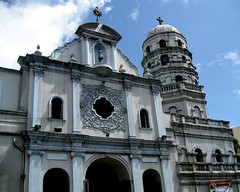
It was built by the Jesuits in 1608 as a parish church for the growing Chinese immigrants in Manila, many of whom had converted to the Catholic faith. When the Jesuits were expelled from the Philippines, the church became Dominican.
The original structure of Sta. Cruz Church was twice damaged by earthquakes; it was completely destroyed during the Battle of Manila in 1945, which totally devastated the entire city and ended the almost three-year Japanese occupation of the Philippines.
When Manila was declared the capital of the Philippine archipelago on June 24, 1571 by the head of the Spanish expedition, Miguel Lopez de Legaspi, the city soon became a replica of a European medieval city with churches, palaces and city halls built in the Spanish baroque style. The present building of the church, completed in 1957, was designed to reflect the architecture of that period. The church’s tower, however, is comprised of a series of sections whose girth decreases as they climb upwards. Their shape and dimensions are reminiscent of the composition of other Asiatic styles of architecture.
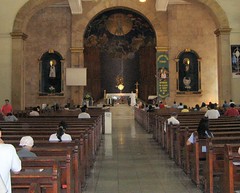
As for its altar, it may seem understated at first glance, but its dramatic lighting is quite awesome, actually.
The church is located at Plaza Lacson (formerly Plaza Goite) in Santa Cruz. It is fronted by Plaza de Sta. Cruz and the famous Carriedo Water Fountain is just directly across the street.
Labels: Manila history, Santa Cruz Church
posted by Señor Enrique at 2:08 AM
| 20 comments