Sunday, November 16, 2008
WRONGS OF PASSAGE

One of the more common sights in Manila are those of our young students beaming with youthful vitality, pride and promise; rightly so, for ahead of them are the best and exciting years of their life, with some seeking work/live opportunities in various distant lands. Indeed, a gripping future awaits these young folks.
However, there remains to this day, a dark aspect of student life that despite the perils involved -- its hazing rituals, primarily -- many are enticed to sign up due to the sense of community and belonging that such groups offer, including the promise of a vast network of peers who could help one another professionally after graduation. And despite the Philippine Hazing Law, violent inititation rites continue to be condoned and practiced by many local Greek letter societies or fraternities.
Cris Anthony Mendez died on August 27, 2007, following severe beatings by members of the Sigma Rho Fraternity at the University of the Philippines, Diliman. The beatings to his legs and chest were so severe that the 20-year-old was left with bruised lungs and huge bruises all over his body, according to the autopsy report.
Ramon Magsaysay Awardee and former Senate President Jovito Salonga has resigned as member of the Sigma Rho fraternity because of this incident. In a statement sent to the Inquirer, Salonga, one of the most prominent Sigma Rhoans, said that he was resigning “because of recent events in which Sigma Rho has been involved.”
Sigma Rho has been accused of two other fraternity-related violence: In December 1994, Dennis Venturina, a Sigma Rhoan, died in a riot between Scintilla Juris and Sigma Rho; whereas, on February 19, 1999, Niño Calinao, a senior journalism major was shot dead by suspected Sigma Rho members. He was mistaken for a member of the rival fraternity Scintilla Juris, which clashed with Sigma Rho members in a riot a week before the killing. Both incidents happened inside the University of the Philippines Diliman campus.
Prior to these incidents at UP Diliman, there was also the tragic fraternity-related case of 22-year-old first-year law student Leonard Villa of the Ateneo University back in 1991.
In joining the Aquila Legis Fraternity, Leonard Villa was allegedly subjected to a savage initiation rite in which he was kicked, mauled and beaten to death. His mother, Gerarda Villa, recalled the struggles her family went through just to prove that her son's killing was murder and not homicide.
Yet to date, she cannot get the judicial system to mete out punishment to those found guilty of having participated in her son's killing. Villa said they won the case in the lower court against 26 members of the Aquila Legis but it was overturned by the Court of Appeals. The case is now with the Supreme Court.
Through six decades, Aquila Legis fraternity has inducted over 1500 members, 90% of whom are members of the Philippine Bar and include Cabinet Secretaries, Congressmen, Justices, and Ambassadors. Its name comes from the Latin phrase meaning "Legal Eagle."
Since the death of her son, her late husband, Romulo Villa, a lawyer and once a BIR Commissioner during the Marcos era, founded Crusade Against Violence (CAV) in which she is now the current president. During her interview with the Inquirer, Villa said that they expected cover-up attempts in the Cris Mendez case.
It should be noted that although not everyone who goes through such ritualistic tests endures debilitating physical injuries, other forms of hazing, though subtler, can cause lingering emotional or psychological trauma -- such as being subjected to constant verbal abuse or sleep deprivations. In other cases, new members or rookies are ordered to wear humiliating attire, deprived of a regular schedule to maintain personal hygiene, or required to provide personal services to senior members (e.g. cooking, cleaning, carrying books, errands, etc.).
Hazing is often used as a method to promote group loyalty and camaraderie through shared suffering (male bonding in fraternities), either with fellow participants, past participants or both. A tentative explanation from evolutionary psychology is that grave hazing can condition the habituation and internalization of the psychological trait known as Stockholm syndrome in humans.
Stockholm Syndrome argues that blatantly brutal hazing can, in fact, produce negative results; making the units more prone to break, desert or mutiny than those without hazing traditions. This was observed in the Russian army in Chechnya, where units with the strongest traditions of dedovschina were the first to break and desert under enemy fire.
Regrettably, hazing has transcended the walls of our universities and some local high schools. It has become a societal problem, a way of life in certain elitist organizations and professions. Incidents of which occur in the military, police forces, athletic teams, marching bands, religious cults, professional schools and various clubs.
* * *
Please note:
I very much appreciate my articles and photos appearing on fellow bloggers' sites, popular broadsheets, and local broadcast news segments, but I would appreciate even more a request for permission first.
Thank you!
I very much appreciate my articles and photos appearing on fellow bloggers' sites, popular broadsheets, and local broadcast news segments, but I would appreciate even more a request for permission first.
Thank you!
Labels: academe, fraternity, life in Manila
posted by Señor Enrique at 3:54 PM
| 23 comments


Tuesday, November 04, 2008
THE SCHOOLS OF MENDIOLA

At the core of Manila's University Belt area is Mendiola Street, named after a man dedicated to schools and teaching methods -- Enrique Mendiola (May 3, 1859 - Mar. 30, 1914), a Filipino and one-time member of the Manila Municipal Board. He founded the newspaper El Arboleda.
It is a short thoroughfare located in Manila's San Miguel district: starting from the intersection of Legarda Street and Claro M. Recto Avenue, ending just outside one of the gates of the Malacañang Palace Compound. The Mendiola Bridge, near the intersection, was renamed after Chino Roces -- publisher of The Manila Times, who had become a major thorn to the Marcos dictatorship.
A convening venue of choice for activists, massive crowds of protest marchers would clog the bridge and the nearby intersection; causing major disruption of businesses in the area, including the suspension of classes at San Beda College, Centro Escolar University, Holy Spirit, St. Jude, San Sebastian College, University of the East, Far Eastern University and many others. In the past, these schools provided the “warm bodies” for the rallies but nowadays, many marchers include the so-called rallyists-for-hire from Metro Manila's indigent communities.
Nonetheless, when not disrupted by a political rally, Mendiola is a quiet and beautiful tree-lined street; an ideal setting for learning. The schools located here are:
Centro Escolar University
San Beda College
College of the Holy Spirit
La Consolacion College
Victorino Mapa High School


* * *
Please note:
I very much appreciate my articles and photos appearing on fellow bloggers' sites, popular broadsheets, and local broadcast news segments, but I would appreciate even more a request for permission first.
Thank you!
I very much appreciate my articles and photos appearing on fellow bloggers' sites, popular broadsheets, and local broadcast news segments, but I would appreciate even more a request for permission first.
Thank you!
Labels: academe, life in Manila
posted by Señor Enrique at 8:04 AM
| 18 comments
Monday, June 16, 2008
PAMANTASAN NG LUNGSOD NG MAYNILA

Its main campus is composed of 13 undergraduate schools, two professional schools, and eight graduate schools. It offers a wide range of curricular programs in Medicine, Law, Nursing, Engineering, Computer Science and Information Technology, Business, Architecture, Education, Mass Communication, Physical Therapy, Tourism, Government, Arts, the Social Sciences, and the Pure and Applied Sciences.
Several thousand faculty serve a diverse student body of different ages in different academic divisions, from undergraduate to postgraduate levels.
Continue reading here.


The Pamantasan ng Lungsod ng Maynila (University of the City of Manila in English, commonly abbreviated as PLM, or simply Pamantasan), is the largest city government-funded, tuition-free, university in the Philippines.
It also holds the distinction of being the first Philippine institution of higher learning to have its official name in Filipino. The Philippines' Commission on Higher Education (CHEd) has considered PLM as a model for public institutions across the Philippines.
Furthermore, it has cited several PLM programs and departments as Centers of Excellence. A study using cumulative data from 1999 to 2003 showed that during the said period PLM was among the top five schools in the Philippines in terms of board exam passing rate. In the same study, it was one among three public universities in the top ten category.
Continue reading here.
* * *
Please note:
I very much appreciate my articles and photos appearing on fellow bloggers' sites, popular broadsheets, and local broadcast news segments, but I would appreciate even more a request for permission first.
Thank you!
*
I very much appreciate my articles and photos appearing on fellow bloggers' sites, popular broadsheets, and local broadcast news segments, but I would appreciate even more a request for permission first.
Thank you!
*
posted by Señor Enrique at 8:42 AM
| 13 comments
Saturday, January 27, 2007
HIDALGO EAST OF QUEZON BOULEVARD
 Inspired by the words of the great Manuel Luis Quezon, former President of the Philippine Commonwealth -- "education is the right of all citizens and that educated people is needed to ensure the upliftment of the masses and the creation of wealth for all" -- several prominent lawyers and justices founded Manuel L. Quezon University School of Law in 1947.
Its two campuses (the Administration Building and the Monzon Hall) still stand today on Hidalgo Street in Quiapo, Manila. These two structures, along with San Sebastian Church to the west, are the commanding landmarks of this enclave of Manila's Quiapo district.
I have been going to Hidalgo Street quite regularly since late year when it was transformed as a photographers haven. However, that is the Hidalgo Street between Plaza Miranda at Quiapo Church and Padre Gomez Street. The area of Hidalgo Street where the campuses of MLQ University are located, is at the other side of Quiapo Church, across Quezon Boulevard, leading towards San Sebastian Church.
Besides the buildings of MLQ University and the Catholic high school of Saint Nazarene, along this stretch of Hidalgo Street are some vintage two-storey houses, though most appear hardly maintained and decripit. One can only imagine the grandeur they once projected during their heyday. Most notable of these old grand houses is the Bahay Nakpil-Bautista, which is now a musem and stands right off Hidalgo Street at N. Bautista Street. But there is one particular old house that captivated me. I plan to go back there with my dSLR and seek permission from its owner to allow me to take some photographs of its interior.


* * *
Please note:
I very much appreciate my articles and photos appearing on fellow bloggers' sites, popular broadsheets, and local broadcast news segments, but I would appreciate even more a request for permission first.
Thank you!
*
I very much appreciate my articles and photos appearing on fellow bloggers' sites, popular broadsheets, and local broadcast news segments, but I would appreciate even more a request for permission first.
Thank you!
*
Labels: academe, Hidalgo Street, life in Manila, Quiapo
posted by Señor Enrique at 7:25 AM
| 19 comments
Friday, September 01, 2006
MANILA HIGH SCHOOL - BUWAN NG WIKA

Wikang Pilipino sa Pambansang Kalayaan at Pagkakaisa
by Pat Villafuerte
by Pat Villafuerte
Sa bawat panahon
Sa bawat kasaysayan
Sa bawat henerasyon
May palawakan ng isip
May palitan ng paniniwala
May tagisan ng matwid
Maging ito’y magbunga ng tuwa, ng lungkot, ng galit
Sila-sila’y nagtatagpo, kayu-kayo’y nagpapangkat
Sa bawat kasaysayan
Sa bawat henerasyon
May palawakan ng isip
May palitan ng paniniwala
May tagisan ng matwid
Maging ito’y magbunga ng tuwa, ng lungkot, ng galit
Sila-sila’y nagtatagpo, kayu-kayo’y nagpapangkat

Isang diwa ang nagpasya, isang wika ang ginamit
Wikang Pilipino! Wikang maka-Diyos, makabayan, makatao
Wikang naglalagos sa isipang makabansa
Wikang nanunuot sa damdaming makalupa
At paisa-isang dila, parami-raming labi, sama-samang tinig
Bumubulong, sumasatsat, humihiyaw, nagngangalit
Hinihingi’y kalayaan! Katarungan! Kalayaan! Katarungan!
Wikang Pilipino! Wikang maka-Diyos, makabayan, makatao
Wikang naglalagos sa isipang makabansa
Wikang nanunuot sa damdaming makalupa
At paisa-isang dila, parami-raming labi, sama-samang tinig
Bumubulong, sumasatsat, humihiyaw, nagngangalit
Hinihingi’y kalayaan! Katarungan! Kalayaan! Katarungan!

Hanggang saan susukatin?
Hanggang kalian bubuhayin?
Hanggang kalian maaangkin?
Layang mangausap, layang sumulat
Layang mamuhay, layang manalig
Layang humahalakhak, layang mangarap,
Layang maghimagsik
Maghimagsik! Maghimagsik! Maghimagsik!
Hanggang kalian bubuhayin?
Hanggang kalian maaangkin?
Layang mangausap, layang sumulat
Layang mamuhay, layang manalig
Layang humahalakhak, layang mangarap,
Layang maghimagsik
Maghimagsik! Maghimagsik! Maghimagsik!

A, parang isang pangarap, parang isang panaginip
Kasaysayan pala’y mababago isang saglit
Sa dakong silangan … doon sa silangan
Ang sikat ng araw … sumilip, sumikat, uminit
Sari-saring mukha, magkakabalat, magkakadugo, magkakapatid
Sama-samng gumising, magkakapit-bisig, nag-alsa’t tumindig
Lakas ng tao! Lakas ng bayan! Lakas ng daigdig!
Laban sa tirano, sa gahaman, sa mapanupil, sa mapan-lupig
Kasaysayan pala’y mababago isang saglit
Sa dakong silangan … doon sa silangan
Ang sikat ng araw … sumilip, sumikat, uminit
Sari-saring mukha, magkakabalat, magkakadugo, magkakapatid
Sama-samng gumising, magkakapit-bisig, nag-alsa’t tumindig
Lakas ng tao! Lakas ng bayan! Lakas ng daigdig!
Laban sa tirano, sa gahaman, sa mapanupil, sa mapan-lupig

Bata’t matanda, propesyonal at di propesyonal
Manggagawa, kawani, guro, mangangalakal
Mangigisda’t magbubukid, pari, madre, iskolar
Sundalo, pulis, drayber, estudyante, istambay
A, lahat-lahat na
Sa sama-samang tinig, sa sama-samang lakas
Nagkakaisa, nagkasama
Nagkasama, nagkaisa
Mga bagon bayani ng Bagong Republika
Manggagawa, kawani, guro, mangangalakal
Mangigisda’t magbubukid, pari, madre, iskolar
Sundalo, pulis, drayber, estudyante, istambay
A, lahat-lahat na
Sa sama-samang tinig, sa sama-samang lakas
Nagkakaisa, nagkasama
Nagkasama, nagkaisa
Mga bagon bayani ng Bagong Republika

At …
Wala nang dapihapon
Wala nang takipsilim
Wala nang lungkot, takot, luha, dusa’t hinagpis
Wala nang tanda, ng dusting pagkalupig
Bagwis ng ibong dati’y pinuyian sa tinid ng galit
Ngayo’y nakalipad na … umaawit, humuhuni, umaawit
Dahil malaya
Dahil sa wika
Dahil sa lakas
Wala nang dapihapon
Wala nang takipsilim
Wala nang lungkot, takot, luha, dusa’t hinagpis
Wala nang tanda, ng dusting pagkalupig
Bagwis ng ibong dati’y pinuyian sa tinid ng galit
Ngayo’y nakalipad na … umaawit, humuhuni, umaawit
Dahil malaya
Dahil sa wika
Dahil sa lakas

Bagong kalayaa’y naririto ngayon
At nakamit natin nang buong hinahon
Ni walaang digmaa’t pinapanginoon
May mabuting nasang taga sa panahon
At nakamit natin nang buong hinahon
Ni walaang digmaa’t pinapanginoon
May mabuting nasang taga sa panahon

At kung sakaling magbalik muli
Ang kasaysayang hininog ng isang madilim na kahapon
Muli, ang paisa-isang dila, ang parami-raming labi
Ang sama-samang tinig
Ang sari-saring mukha, magkakabalat, magkakadugo’t magkakapatid
Sama-samang gigising, magkakapit bisig aalsa’t titindig
Lakas ng tao! Lakas ng bayan! Lakas ng daigdig!
Ang kasaysayang hininog ng isang madilim na kahapon
Muli, ang paisa-isang dila, ang parami-raming labi
Ang sama-samang tinig
Ang sari-saring mukha, magkakabalat, magkakadugo’t magkakapatid
Sama-samang gigising, magkakapit bisig aalsa’t titindig
Lakas ng tao! Lakas ng bayan! Lakas ng daigdig!

* * *
Please note:
I very much appreciate my articles and photos appearing on fellow bloggers' sites, popular broadsheets, and local broadcast news segments, but I would appreciate even more a request for permission first.
Thank you!
*
I very much appreciate my articles and photos appearing on fellow bloggers' sites, popular broadsheets, and local broadcast news segments, but I would appreciate even more a request for permission first.
Thank you!
*
Labels: academe
posted by Señor Enrique at 7:59 PM
| 16 comments
Friday, August 04, 2006
UNIVERSITY OF SANTO TOMAS
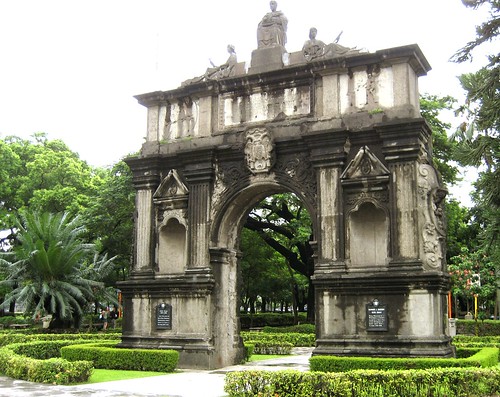 Notably the oldest university in Asia (even older than Harvard), although it is disputed by the University of San Carlos in Cebu, which was founded in 1595 but became a university only in 1948.
The foundation of the University of Santo Tomas is attributed to Miguel de Benavides, third Archbishop of Manila. He arrived in the Philippines in 1587 along with the first Dominican mission and was promoted archbishop of Manila in 1601. Upon his death in 1605, he bequeathed his library and personal fortune worth 1,500 pesos to be used as seed money for establishing a school of higher learning to prepare young men for the priesthood.
Fr. Bernardo de Santa Catalina carried out his wishes and was able to secure a building near the Dominican church and convent in Intramuros for this school. It was first called Colegio de Nuestra Señora del Santisimo Rosario and later renamed Colegio de Santo Tomas in memory of the foremost Dominican Theologian, Saint Thomas Aquinas.
It was granted permission by King Philip II to open as a college in 1611. In 1624, it was authorized to confer academic degrees in Theology, Philosophy, and Arts. Pope Innocent X elevated the College to the rank of a university in 1645 and in 1680, placed under royal patronage. In 1785, King Charles III granted it the title of “Royal University”. Pope Leo XIII made the University of Santo Tomas a “Pontifical University” in 1902. In 1927, with the continuing increase in enrollment, the University moved from Intramuros to its present site which covers an area of 21.5 hectares in the district of Sampaloc. In 1947, Pope Pius XII bestowed upon it the title “The Catholic University of the Philippines”.
During World War II, the Japanese converted the campus into a concentration camp for civilians, foreigners and POWs. After the war, the university resumed its mission and continues to be one of the more prestigious universities in the country.
Its official title is now The Royal and Pontifical University of Santo Tomas, The Catholic University of the Philippines. It has approximately 35,000 students consisting of 30,000 undergraduate students and 5,000 students in Medicine, Law, Conservatory of Music and the Graduate School. It also boasts a 460-bed full-pledged hospital for charity and clinical patients.
Labels: academe, Philippine history, UST
posted by Señor Enrique at 6:12 AM
| 26 comments