Monday, April 03, 2006
CRASHING PREJUDICE

Finally saw the movie, Crash, over the weekend. It definitely deserves its Oscar.
I was under the impression that the Movie of the Year upset was a backlash to the much-anticipated win of Brokeback Mountain, but seeing this provocative film made me realize why Crash won. It was storytelling at its finest; delving into the complexities of racial prejudice and at the same time challenges the viewers to question their own fears and bigotry.
Spike Lee had ventured into this arena of racial strife in most of his films, but they were unlike the way Paul Haggis wrote and directed Crash. He depicted racial prejudice from the various perspectives of his multi-ethnic characters as they weaved in and out of each other’s lives through coincidences and chance meetings. It was superb storytelling in the same vein as Paul Thomas Anderson’s Magnolia and Robert Altman’s The Player.
Mel Brook’s character in his 1968 movie, The Producers, said, “Without the Jews, Gays, and Gypsies, there’d be no theater.” Perhaps, this statement rings true of Hollywood as well; that unlike middle America, this moviemaking enclave has long enjoyed its own culture in which same sex love as poignant as in Brokeback Mountain has long been accepted a usual part of it. But, the post-9/11 volatile racial tension as portrayed in Crash was too disturbing to ignore; permeating the consciousness of most Academy members.
Racial prejudice in America is indeed a major issue that needs to be addressed. But then again, prejudice thrives among those suffering from deep-seated fear and anger, which are precipitated by one’s own inadequacies and feelings of powerlessness as portrayed by the characters in Crash.
Picture credit: eddx.com
Labels: films
posted by Señor Enrique at 8:19 AM
| 6 comments


Friday, March 24, 2006
Master Filmmaker: AKIRA KUROSAWA
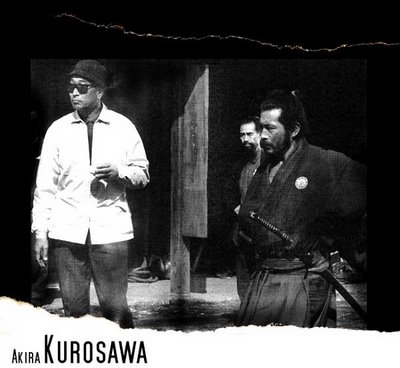
I was happy for Ang Lee when he won this year’s Oscar for Best Director. Hopefully, he will open the door for other Asian filmmakers — including Filipino directors and cinematographers — to get major projects in Hollywood much like what Sidney Poitier has done for African-American actors.
Nonetheless, before Ang Lee, in the realm of Asian filmmakers, there was the acclaimed Akira Kurosawa whose films — such as Rashomon (1950), Ikiru (1952), Seven Samurai (1954), The Throne of Blood (1957), Kagemusha (1980), and Ran (1985) — greatly influenced major filmmakers worldwide from Sergio Leone to George Lucas.
Kurosawa went to art school and favored Western style painting. Although a recipient of many important art awards, he gave up the brush to pursue filmmaking. Starting in 1936 until 1943, he worked as an assistant director for Yamamoto Kajiro, one of Japan’s major directors of war propaganda films. Kurosawa initially gained fame as an excellent scenarist, but some of his best scenarios were never preserved on celluloid; only published in journals. Just the same, they were recognized and awarded notable prizes for their freshness of representation. In 1943, Kurosawa was promoted to director and made his first feature film, Sanshiro Sugata. That was the beginning of his illustrious career as a major and influential film director.
An entry about Kurosawa in Encyclopedia Britannica Online mentions that Kurosawa’s films “represent a unique combination of elements of Japanese art—in the subtlety of their feeling and philosophy, the brilliance of their visual composition, and their treatment of samurai and other historic Japanese themes—with a distinctly Western feeling for action and drama and a frequent use of stories from Western sources, both literary classics and popular thrillers.”
Other than for his excellence in filmmaking, Kurosawa also gained notoriety for sparing no expense when it came to providing excessive quantities of high quality gourmet food and exotic delicacies on the set for his entire cast and crew.
Labels: Featured artist, films
posted by Señor Enrique at 7:43 AM
| 8 comments
Friday, March 17, 2006
ROLLING, ACTION!
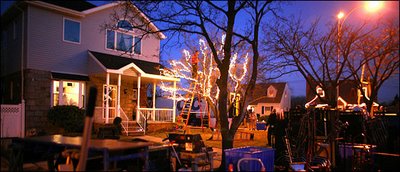
The above picture by Chang W. Lee of a house in Queens being prepared for a movie scene was the accompanying photo of a New York Times article about the recent surge of TV and movie productions in New York City. It goes on to say that the film and television industry has become the fastest-growing source of employment, putting almost 10,000 New Yorkers to work over the past year alone. The reason is the 15 percent credit that production companies receive to shoot in New York.
I think that’s just swell. Really. But, however glamorous and lucrative this whole thing is, there’s the often unreported downside as well. That is, the inconvenience experienced by some residents during filming.
Like one early Sunday morning around 7:00 am, I was awakened by the annoying sound of a hovering helicopter. This may be common in South Central, Los Angeles, but definitely odd in my New York neighborhood. As it turned out, they were shooting a scene for another sequel of Bruce Willis’ Die Hard movie.
When I went out with my dog to buy the Sunday paper and some groceries to make breakfast, we had to wait almost half an hour before the production assistants allowed us to cross the street; same on our way back. It took them an entire day to shoot a scene which appeared less than a minute onscreen. Friends and other residents of Manhattan's Upper West Side faced an arduous task of commuting to work when the same film crew took over the 72nd Street subway station and its vicinity for more than two weeks. Bruce Willis, at that point, was losing the love of New Yorkers.
In another incident, my friend’s elderly parents were livid when they had to be told when they could leave and enter their apartment building when Woody Allen was shooting in their lobby and front steps for several days. Another friend was annoyed when Spike Lee was shooting a scene right in front of her Brooklyn ground floor apartment. She wasn’t allowed to open her windows or even peek out.
On tougher neighborhoods, residents would pump up the volume of their stereos and TV sets as soon as they hear the director’s cue for action. Others would purposely open their windows and stick their heads out, especially if they’re within camera range. This would make the producers shell out some cash to buy the residents’ cooperation.
In New York, at least, if someone (not a cast member) appeared quite prominently on camera and the production staff was unable to secure his or her signature on a release form, that person can sue the studio for using his/her image without permission and financial compensation. However, if it was a news item, the law does not apply. I found out about this accidentally and in a very embarrassing way.
It was a beautiful early spring day with the temperature hovering in the 60s. By 3:00 pm I faked illness; told my boss I wasn’t feeling well and needed to take off early to sleep it off. Concern was etched on his face and even suggested that I take a cab home while he pulled out some singles from his pocket to make sure I have change. I told him I have it.
My real intention was to enjoy the rest of that warm early spring afternoon outdoors. I walked up Fifth Avenue to 57th Street and then turned west to meet some friends at a neighborhood Italian bistro for some drinks and dinner. It was a lovely walk with most New Yorkers in a good mood.
Later on in the evening, at the bistro, everyone was having a wonderful time until my friend grabbed my shoulder and pointed at the TV monitor at the bar. On the screen was the local news’ weather report. For its backdrop, they used an earlier video of Fifth Avenue with me walking up nonchalantly from half a block away towards the camera. By the end of the report, my figure filled the entire monitor as I passed by the camera.
Unfortunately, my boss saw it also. After all, it was a segment of New York’s most popular local evening news. The next day, he walked over to my desk and in muted tone said that it was too bad I wouldn’t get any remuneration for my TV appearance. It was considered a news item. He sensed my discomfort and walked away without waiting for my response.
Later on that day, he didn’t come back from lunch. His secretary claimed he called from the restaurant to say he had gone home; sickened by the oysters he had for lunch. I knew better. It was spring fever like what I suffered from the previous day. Besides, they were filming a movie in his neighborhood with his favorite actress Kim Bassinger. It was a chance to see her in person and even get her autograph; if he were lucky enough.
Labels: films, Life in New York
posted by Señor Enrique at 11:00 AM
| 8 comments
Saturday, March 11, 2006
TV Rewind: ROME
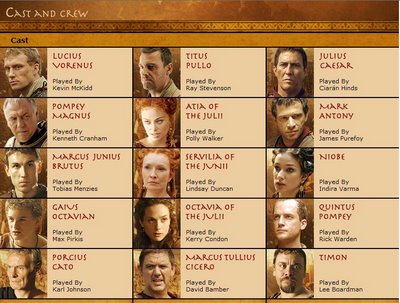
I just finished viewing the DVD box set of the TV series Rome; a collaborative effort by HBO and The BBC. It’s an incredible 12-episode depiction of the Roman Empire from the perspective of two Roman soldiers, Titus Pullo and Lucius Vorenus.
However, regardless of its historical background, parents are hereby forewarned: it contains many scenes not suitable for children (violence, bloodshed, nudity and vulgar language, as well as sub-plots dealing with incest and inter-generational lesbian relationship). Neither does watching this DVD boxset, if one had not already seen its original airing, would be a good way to relax and seek respite from our country's political fiasco; considering that backstabbing, betrayal, lusts for power and election frauds are quite prevalent in the more than ten hours of Rome.
Be that as it may, this is one riveting drama worthy of being included in one's DVD collection.
Series Outline: After eight years of war, Gaius Julius Caesar has completed his masterful conquest of Gaul, and is returning to Rome. He brings with him legions of battle-hardened, loyal men, unimaginable riches in slaves, gold and plunder, and a populist agenda for radical social change. The aristocracy is terrified, and threatens to prosecute him for war crimes if he enters Rome. The delicate balance of power lies in the Senate with Caesar's old friend, partner and mentor, Pompey Magnus.
The year is 52 B.C. Four hundred years after the founding of the Republic, Rome is the wealthiest city in the world, a cosmopolitan metropolis of one million people, epicenter of a sprawling empire. The Republic was founded on principles of shared power and fierce personal competition, never allowing one man to seize absolute control. But now, those foundations are crumbling, eaten away by corruption and excess. The ruling class has become extravagantly wealthy, with a precipitous decline in the old values of Spartan discipline and social unity. There is now a great chasm between the classes. Legal and political systems have weakened, and power has increasingly shifted to the military. Such is the situation when two soldiers of Caesar's 13th Legion, Lucius Vorenus and Titus Pullo, are ordered into the wilds of Gaul to retrieve their legion's stolen standard, the unifying symbol of Caesar's legion, setting off a chain of circumstances that will entwine them in pivotal events of ancient Rome. An intimate drama of love and betrayal, masters and slaves, and husbands and wives, ROME chronicles epic times that saw the fall of a Republic and the creation of an empire.
Labels: films
posted by Señor Enrique at 10:38 AM
| 5 comments
Tuesday, March 07, 2006
MORNING AFTER THE OSCARS

Mayor Lito Atenzia has transformed this stretch of Avenida Rizal from Carriedo Street to Claro M. Recto Avenue in Manila's Santa Cruz district into a pedestrian mall. When I was a kid, this was a bustling commercial strip; boasting a row of several movie theaters — Odeon, Galaxy, State, Ideal and Avenue to name a few. At nightfall, the signs of these theaters and various bazaars exhibited an exciting array of neon lights. It was fabulous!
Regrettably, since the aboveground tracks of the light rail transit was built along Avenida Rizal, most enterprises in the area began to lose their charm and glitter. People started to shop and spend their leisure times at the newer air-conditioned malls being built all over Metro Manila.
My father’s office was located at Florentino Torres. He would always take me along on Saturdays when he worked only until noon. After having our lunch in one of the Chinese restaurants in Ongpin, we would then see a movie in Avenida Rizal. This was how I developed a keen fondness for Hollywood movies and its annual Oscar Award festivities. Not that I’ve become a movie and Oscar geek, but watching the Oscars becomes even more exciting when you’ve seen most of the nominated films.
Ironically, in this year’s Oscars, I didn’t see the winner of the Best Movie category, Crash, which practically surprised a lot of people, including its entire cast. I was convinced Brokeback Mountain would snatch the award without a hitch. I was wrong .
I was happy for Philip Seymour Hoffman for having won the Best Actor award, but disappointed he didn’t bark his acceptance speech. Nonetheless, my hunch tells me the members of the Academy voted for him, not only for his incredibly believable portrayal of Truman Capote, but as an overall acknowledgement of his excellence as a character actor in the many films he had done in the past. He reminds me of Geoffrey Rush — not so pretty to look at, but one hell of a great actor.
I should have continued to follow my intuition and root for George Clooney to win the Best Actor award for his portrayal of a CIA operative in Syriana, but allowed the buzz to influence my choosing Matt Dillon in Crash. Lesson learned here: Don't believe the hype!
I’m sure the Internet is teeming with coverage of the Oscar awards ceremony, so I don’t intend to delve much into it; however, I just want to point out another buzz; that is, behind Felicity Huffman’s supposedly astonishing portrayal of a pre-operative male-to-female transsexual (she was among the nominees for Best Actress). I saw Transamerica and throughout the movie, a particular thought kept gnawing at me: Why didn’t the producers opt for a male actor for the role? I thought it was a definite casting blunder; unless, of course, the film was intended as a mere showcase for Ms. Huffman.
This makes me wonder how the 1999 movie, Boys Don’t Cry, would have turned out if the role of Teena Brandon (who was in the throes of sexual identity and preferred to pursue life in her male identity as Brandon Teena) was played by a male actor instead. It would somehow lose its credibility, I’m sure. Therefore, regardless of Felicity Huffman's overly-hyped performance, Transamerica would have fared better, I'm sure, had the transgender role was given to a male actor instead. Hollywood has enough talented make-up artists to handle the visual transformation.
Incidentally, Hilary Swank won the Oscar for Best Actress for her portrayal of Teena Brandon in which she was paid a measly $75 a day for a total of $3,000 for doing Boys Don’t Cry. She won another Oscar for Best Actress — acting opposite Morgan Freeman and Clint Eastwood in the 2004 movie, Million Dollar Baby. She played Maggie Fitzgerald, a 30-something, down-on-her-luck waitress who dreams of becoming a professional boxer.
Labels: films
posted by Señor Enrique at 8:41 AM
| 14 comments
Monday, February 27, 2006
TV & MOVIE BINGEING
Although my laptop has been fixed, PLDT remains clueless as to why my landline was assigned to another customer; thus, I have been unable to access the Internet for almost a week now. The situation remains unresolved.
Instead of allowing this mess to get the best of me, I’ve opted to vent out my frustration by immersing myself in some TV shows and movies. This way, I’ll also get to enjoy even more the upcoming Oscar Awards telecast.
Here’s some of what I saw recently:
Films:
Munich
Walk the Line
Capote
An Unfinished Life
Syriana
Lord of War
Brokeback Mountain
Cinderella Man
Memories of a Geisha
Jarhead
Goodnight, and Good Luck
Hustle & Flow
Transamerica
Charlie and the Chocolate Factory
Films I’m yet to see:
A History of Violence
Pride & Prejudice
A Constant Gardener
Crash
Mrs. Henderson Presents
The New World
North Country
March of the Penguins
TV shows:
Lost (first and second season box sets)
House (first season – currently watching)
TV shows whose DVD box sets I eagerly await:
Grey’s Anatomy
Prison Break
Surface
photo credit: forum-video.com
*
Labels: films, life in Manila
posted by Señor Enrique at 7:42 AM
| 6 comments
Friday, February 24, 2006
Philip Seymour Hoffman as CAPOTE

A highly-esteemed literary figure, especially among baby boomers, Truman Capote was best known for his Breakfast in Tiffany’s and In Cold Blood (both works have been turned into films).
He was undoubtedly a prolific writer; a regular contributor to The New Yorker and other publications, as well as having been rumored to have ghost-written the entire book, To Kill a Mockingbird (his friend, author Harper Lee's novel). However, right after the publication of In Cold Blood, he went dry. His effort in writing this book, which eventually became an international best-seller, was the singular event of his life featured in the film, Capote.
The movie appears limited in scope. Its basic premise deals with the main character, Capote, developing friendship with the convicted murderers with the intention of writing an accurate explanation of their heinous crime — the murder of a family of four in rural Holcomb, Kansas. The murderers, on the other hand, welcomed his friendship; they were hoping to gain absolution through this book he was writing, as well as through the author’s purported intimate friendship with certain influential people, win their appeal for a lighter sentence. Hence the bizarre bond between Capote and one of the murderers, Perry Smith, became the highlight of this movie.
Philip Seymour Hoffman’s superb portrayal of Truman Capote as a flamboyant literary figure of New York's cafe society with a high-pitched lisping voice tinged with a Southern drawl was absolutely worthy of a Best Actor Oscar nomination. The film’s screenwriter, Dan Futterman, was also nominated by the Academy.
What others may not know is that Philip Seymour Hoffman, Dan Futterman, and Bennett Miller, Capote’s director, have been friends since their teenage years. And while at NYU, they’ve made a drunken pact that whoever wins an Oscar later on in life, would bark their acceptance speech; that is, not bark only for a couple of seconds, but throughout his entire allotted time until pulled out from the microphone. Hoffman revealed this pact publicly while a guest of David Letterman recently.
For this year’s Academy Award, I am rooting for either Philip Seymour Hoffman (Capote)or Joaquin Phoenix (Walk the Line) to grab the Best Actor award. However, after knowing about this drunken pact, I’m now exclusively rooting for Hoffman simply because I’d like to see if he’d actually make good on his agreement to bark his entire acceptance speech.
Labels: Featured Writer, films
posted by Señor Enrique at 10:21 AM
| 2 comments