Monday, August 21, 2006
BONIFACIO AND THE CRY OF BALINTAWAK
It has been said that we Filipinos have no sense of history. However, according to Ambeth Ocampo, it isn’t so much as indifference or amnesia, but rather our uncertainty as to what or whom to believe. Thus, the easy way out is to simply ignore the past.
Take for instance Andres Bonifacio); how much do we really know about him, as well as his group, KKK (Kataastaasan Kagalanggalangang na Katipunan ng mga Anak ng Bayan)?
To avoid an exhausting historical treatise, Ocampo suggested that we simply look at the world of local art and study how Bonifacio is represented by Filipino artists in the last eighty years in their drawings, paintings, music, and sculpture. He argued that the stereotyped image of Bonifacio as represented in their works goes against historical documentation. Hence, we have two Bonifacios in our national consciousness — one mythical, the other real — and that the myth has become more popular than reality. And therein lies our problem.
As an example, Ocampo pointed out when a sculptor submitted studies for a proposed Bonifacio monument to the National Historical Institute. From his awkward drawings revealed the popular Bonifacio stereotype: one wearing an open camisa de chino to display a muscled chest and pants rolled up to reveal bare feet. On his left hand waved the Katipunan flag, while his right raised a menacing bolo. To highlight this difficult pose, the artist gave Bonifacio fiery eyes and a silent but suggested rebel yell.
To the masses, there is nothing wrong with this image of Bonifacio. It can be seen in full color in the Carlos V. Francisco mural at the Manila City Hall, or in the various cement versions in schoolyards and municipal plazas all over the archipelago. Everything seemingly comes from the same mould or idea.
Ocampo traced the origin of this image to a drawing by Jorge Pineda reproduced on the cover of Renacimiento Filipino of July 14, 1911. From this drawing was born the monument by the sculptor Ramon Martinez, which was unveiled on September 3, 1911, in Balintawak (it has since been transferred and now stands in front of Vinzon Hall in U.P. Diliman).
Thus, that has been how most remembered Bonifacio until it was challenged by the late National Artist for Sculpture Guillermo Tolentino.
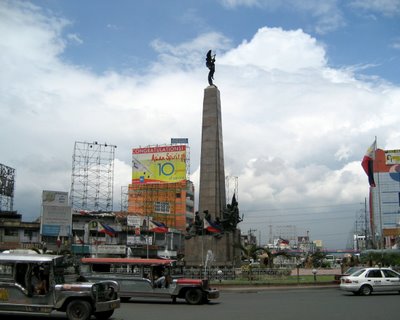
After painstaking research and interviews with people who had actually known Bonifacio, Tolentino created a masterpiece in bronze in Caloocan that has become a landmark now known as “Monumento.”
In this monument, as Ocampo illustrated, the artist represented a different image of Bonifacio: one in a closed barong tagalog, with a handkerchief tied on his neck, and wearing shoes! He stands calm but defiant with a bolo in one hand and a gun on the other. Behind him are Emilio Jacinto and a standard bearer with the Katipunan flag.
When the protests poured in, Tolentino countered his critics with his research. The likeness was based not only on a photograph of Bonifacio, but on the bone structure of his sister Espiridiona as well. Interviews with surviving members of the Katipunan gave an idea of his attire and revealed that, contrary to common belief, Bonifacio favored his gun over his bolo in battles. Tolentino even consulted espiritistas (psychics) to discern the true likeness and character of Bonifacio.
Ocampo also cited Bonifacio’s likeness to be elusive, for there is only one faded studio photograph of him in existence as compared to Jose Rizal’s numerous pictures. The irony of it all is that despite the common image of Bonifacio as the barefoot Great Plebian in his camisa de chino and rolled up pants, our sole photograph of him shows him wearing, of all things, a coat!
Aside from Bonifacio’s image, there was also the confusion as to the authenticity of the Grito de Balintawak tradition. Since the turn of the century, it has been widely believed that the first cry of the revolution took place in Balintawak, Caloocan. Then along came Teodoro Agoncillo, our nationalist historian, who gave the exact date for the cry as August 23, 1896, and the exact place to be Pugadlawin, not Balintawak. Despite these becoming textbook facts, according to Ocampo, the Balintawak tradition continues to thrive. And that even Nick Joaquin wrote in support of Balintawak.
This controversy remains unresolved except in our textbooks, but as Ocampo pointed out, depending on the book one should read, there were five dates for the Cry — August 20, 23, 24, 25, and 26 — and five different venues: Balintawak, Pugadlawin, Kangkong, Bahay Toro, and Pasong Tamo. Ocampo, to this day, remains confused and stumped himself.
Source: Bonifacio’s Bolo by Ambeth R. Ocampo
Labels: Featured artist, historical figure, Philippine history
posted by Señor Enrique at 8:27 AM
| 17 comments