Monday, September 29, 2008
ON WRITING AND BLOGGING

"Quiapo deserves a thorough visit from every writer worth his or her salt. I'd begin with a jeepney ride (no cars or taxis, please) from Quezon City of Makati, getting off at Quiapo Church (where you might get your fortune told or have someone pray on your behalf, for a small fee), then walking to Avenida Rizal via R. Hidalgo, Carriedo, or Raon then on to Plaza Sta. Cruz, Escolta, and Chinatown, emerging on C. M. Recto (Azcarraga, when I first set foot on it). Spend some time at Arranque Market, a stationary caravan featuring plump exotic chickens, riotous parakeets, and flea-bitten Persian kittens (and, father up the street, everyone's stolen cell phone, typically if understandably sold without their chargers). Somewhare along the way, eat - preferably in some nondescript but jumpacked hole-in-the-wall with ceiling fans to cool the hototay.
As you walk around, practice sizing up situations and asking yourself 'Where's the story?' or 'What's the story here?' At worst, you'll end up with a bag of details, a literary pack rat's delight, that you can dip into on those still, dry days. At best, you'll come up with a story suggested by the scene at hand."


Source:
THE KNOWING IS IN THE WRITING
Notes on the Pratice of Fiction
The University of the Philippines Press
© 2006 Joey Y. Dalisay, Jr.
I very much appreciate my articles and photos appearing on fellow bloggers' sites, popular broadsheets, and local broadcast news segments, but I would appreciate even more a request for permission first.
Thank you!
*
Labels: blogging, Featured book, Featured Writer, photography, writing
posted by Señor Enrique at 1:07 AM
| 16 comments


Saturday, August 30, 2008
12 LITTLE THINGS EVERY FILIPINO CAN DO
 No. 1 - Follow traffic rules. Follow the law.
 No. 2 - Whenever you buy or pay for anything, always ask for an official receipt.
 No. 3 - Don't buy smuggled goods. Buy local. Buy Filipino.
 No. 4 - When you talk to others, especially foreigners, speak positively
about us and our country.
 No. 5 - Respect your traffic officer, policeman and soldier.
 No. 6 - Do not litter. Dispose your garbage properly.
Segregate. Recycle. Conserve.
 No. 7 - Support your church.
 No. 8 - During elections, do your solemn duty.
 No. 9 - Pay your employees well.
 No. 10 - Pay your taxes.
 No. 11 - Adopt a scholar or a poor child.
 No. 12 - Be a good parent. Teach your kids to follow the law
and love our country.
I bet you're wondering what this is all about.
It's about a little book, "12 Little Things Every Filipino Can Do To Help Our Country," 105 pages, written by Alexander Lacson, 40, a lawyer by profession, a UP graduate, College of Law Class 1996, with postgraduate studies at Harvard Law School in Cambridge, Massachusetts.
Four years ago, he and his wife Pia had a serious discussion about migrating to the US or Canada because the Philippines appeared hopeless as it only got worse year after year. They asked themselves this question: “Will the Philippines progress in the next 20 years?” If the answer was yes, they’d stay. If no, they would leave and relocate.
After a long discussion, they could not give a definite answer to the question, until they realized that the answer to that question is actually in them. They also realized that the answer is in us as a people, that hope is in us as a people.
Since then, Alexander and Pia decided to do more for their country. Thus, this book — one way of their ways of doing more for the country.
I won't go into details here, for these 12 basic steps are self-explanatory but the author's arguments are valid and his recommendations, feasible. Get a copy. It's a quick read and besides, you may be inspired to become a part of the solution to alleviate our country's ills.

And If you agree with what this book says as doable, buy one for a friend, and then request that friend to give a copy as well to another friend. Come to think of it, our balikbayan friends and relatives should buy some copies to bring back as pasalubong to our compatriots abroad.
To buy copies, you may call at these telephone numbers: 840-0338 to 41.
You may also contact the author via email: alacsonph@yahoo.com
I very much appreciate my articles and photos appearing on fellow bloggers' sites, popular broadsheets, and local broadcast news segments, but I would appreciate even more a request for permission first.
Thank you!
*
Labels: Featured book, Featured Writer
posted by Señor Enrique at 10:45 AM
| 71 comments
Friday, August 01, 2008
SEARCHING FOR A HOME, A MEMOIR
This book is about Jennifer Fay Field, her famous friends, travels and life as a royal.
I very much appreciate my articles and photos appearing on fellow bloggers' sites, popular broadsheets, and local broadcast news segments, but I would appreciate even more a request for permission first.
Thank you!
*
Labels: Featured book
posted by Señor Enrique at 10:01 AM
| 13 comments
Monday, July 21, 2008
REMEMBERING DON RAFAEL IBARRA

Don Rafael Ibarra, the largest landowner and richest man in San Diego. And even though many people loved and respected him, there were others who seethed with envy; thus, hated him with a passion.
And so one day when he came across a vehicle tax collector who was blinded with anger -- beating and stomping a downed man who earlier made fun of him as being illiterate -- Don Rafael, indignant that no one else had the courage to intervene, came to the rescue. He grabbed the tax collector to prevent him from inflicting further harm to the man lying bloodied on the ground.
There were witnesses who claimed that Don Rafael hit the tax collector, others that he only pushed him. In any event, the Spanish ex-artilleryman who had been thrown out of the ranks for being loutish and stupid, and eventually handed a job as a vehicle tax collector -- so he wouldn’t make a living doing menial labor which would only embarrass the army -- stumbled a few steps backwards and fell, hitting his head on a rock. Blood spurted out of his mouth. He died soon afterwards.
Consequently, Don Rafael was arrested and imprisoned. Everyone deserted him, including those who once thrived in his kindness and generosity.
There was, however, one person who chose to stand by him -- a Spanish lieutenant, an old friend, who went through the appeals process on his behalf. But it was all to no avail. Languishing in jail, Don Rafael suffered much unpleasantness; the cruelty that abound undermined his iron will that he eventually fell ill with a disease. Death seemed to be the only cure.
And just when he was about to be exonerated, to be absolved of the accusation of having murdered the tax collector, he died in jail alone. His body was relegated to the Chinese Cemetery for burial only to be later exhumed and thrown into the water.
Hence, the life of Rizal’s Noli Me Tangere character, Don Rafael Ibarra, the father of Crisostomo Ibarra.
* * * *
Local Photographer Sues Manila Bulletin for Copyright Infringement
Petition To Mayor Lim - Save Quiapo
I very much appreciate my articles and photos appearing on fellow bloggers' sites, popular broadsheets, and local broadcast news segments, but I would appreciate even more a request for permission first.
Thank you!
*
Labels: Featured book
posted by Señor Enrique at 9:58 AM
| 44 comments
Thursday, September 07, 2006
FREAKANOMICS ON CRIME AND ABORTION

This picture of an almost empty commuter bus reminds me of a particular chapter in the book I’m reading, Freakanomics. It's about the sudden drop in crime rate in America which completely baffled many social scientists and law enforcement officials. That is, until an unconventional-thinking economist came up with a mind-boggling theory. In fact, the Wall Street Journal dubbed this man, Steven Levitt, the Indiana Jones of economics.
A most recent winner of the John Bates Clark award for the best economist under the age of 40, Levitt‘s success as ascribed by this financial broadsheet, as having a lot more to do with his wit, pluck and disregard for conventional wisdom; not as a specialist of technical information for the select few.
“His genius is to take a seemingly meaningless set of numbers, ferret out the telltale pattern and recognize what it means,” according to this Wall Street Journal article. Through such method, Levitt outlined the cause which resulted to the drastic drop in crime in the United States.
During the 1990s, the Clinton administration along with many criminologists and socio-political scientists unanimously issued a dismal forecast that the entire country was facing a future steep in crime. Accumulated data was so compelling that odd makers were putting their money on the criminals.
“We know we’ve got about six years to turn this juvenile crime thing around, or our country is going to be living with chaos,” President Clinton declared. However, contrary to the common prediction by these learned men, the crime rate fell instead.
The reversal was indeed astounding — the teenage murder rate alone, expected to surge at 100 percent, dropped more than 50 percent within five years. By 2000 the overall murder rate in the United States had dropped to its lowest level in thirty-five years, including the rate of just about every other sort of crime, from assault to car theft. The stumped criminologists, relying upon conventional wisdom, grappled to explain this unexpected shift; only to come up with highly inaccurate and erroneous conclusions.
And then came Steven Levitt who pinpointed this drastic decrease in crime to a woman in Dallas who was then a 21-year-old uneducated destitute; an alcoholic and drug addict who had given up for adoption her two children. Her name was Norma McCorvey.
In 1970, she found herself pregnant again; all she wanted was an abortion. Without intending to, she also dramatically altered the course of events that affected the entire United States of America.
Abortion was illegal in Texas where Norma McCorvey resided, as well as in the entire United States during that time. There were, however, powerful people who adopted her cause and made her lead plaintiff to a class-action lawsuit seeking to legalize abortion. They named the Dallas County district attorney, Henry Wade, as defendant. To protect her privacy, her name was disguised as Jane Roe.
The case ultimately found its way all the way to the U.S. Supreme Court; hence Roe versus Wade.
On June 22, 1973, the Supreme Court ruled in favor of Ms. Roe, paving the way for legalized abortion throughout the country. Ironically, too late to get an abortion when the ruling came out, Norma McCorvey gave birth, but put the child up for adoption. In the succeeding years, she would renounce her allegiance to legalized abortion crusade and become a pro-life activist.
Millions of American women most likely to resort to abortion in the wake of the Roe vs. Wade were indigent, uneducated, unmarried teenage mothers whose children, if born, would have been more likely than average to become criminals. But due to Roe vs. Wade, these children weren’t being born.
According to Levitt’s theory, “this powerful cause would have a drastic, distant effect: years later, just as these unborn children would have entered their criminal primes, the rate of crime began to plummet.”
Again, Levitt based his findings on numbers and data, but what the link between abortion and crime tells him is this: “when the government gives a woman the opportunity to make her own decision about abortion, she generally does a good job of figuring out if she is in a position to raise the baby well. If she decides she can’t, she often chooses the abortion.” On the other hand, should a woman decide to have the baby, a pressing question arises: “what are parents supposed to do once a child is born?”
This entry was created to briefly illustrate the unorthodox manner in which this famed economist, Steven Levitt, goes about drawing his conclusions. It wasn’t intended to allude to a personal perspective on the subject of abortion.
Freakanomics is a good read which I recommend to those who appreciate articulate, though a roguish style of deductive reasoning.
*Many thanks again to Minotte’s Notes for offering to get me a copy of this book in San Francisco when I thought none was available locally. I did, however, found it at a local National Bookstore.
I very much appreciate my articles and photos appearing on fellow bloggers' sites, popular broadsheets, and local broadcast news segments, but I would appreciate even more a request for permission first.
Thank you!
*
Labels: current affairs, Featured book
posted by Señor Enrique at 6:10 PM
| 21 comments
Friday, August 11, 2006
ON BOOKS AND WRITERS

For all blogmates game enough to have done the six weirdness meme a week or so ago — and may now be having regrets for revealing their uniquely strange characteristics — I say don’t sweat it. Check out instead the following five accomplished writers and their peculiar habits*:
- Henrik Ibsen hung a picture of August Strindberg, his mortal enemy, near his writing desk.
- Friedrich von Schiller couldn’t write unless his bare feet were immersed in cold water.
- Jack Kerouac wrote only by candlelight.
- John Steinbeck suffered from the fear of putting down the first line.
- John Cheever used to put on a business suit, leave his apartment, and go to his basement where he would hang his suit on a hanger and proceed to write in his underwear.
We may laugh at them now, but guess who in the end laughed all the way to the bank?
Speaking of writers, recently, I was tagged by a newfound blogmate, Ipanema of Lands End. Her meme is all about books. This, I must admit, has got to be the toughest meme yet only because I’ve read quite a few and to choose one title as the singular response to each of the following questions is absolutely tough. There were instances where I was convinced I was done, but only to go back to make some changes. At one point, it seemed like I was going through one of those neuroses common amongst New Yorkers.
Finally, I just had to say to myself, “Stop it! No more changes. Post the damn thing!”
So here are my responses:
One book that changed your life:
The Science of Mind by Ernest Holmes -- absolutely the finest book on anger management.
One book you have read more than once:
The Alchemist by Paulo Coelho – though small and a quick read, it is truly a feel good book.
One book you would want on a desert island:
U.S. Army Survival Manual – I’ve got to eat eventually.
One book that made you laugh:
356 Daily Instructions for Hysterical Living by Benrik – a celebration of one’s innate desire to be silly and frivolous, but too ashamed to admit it.
One book that made you cry:
Sophie’s Choice by William Styron – the challenge alone of reading it from start to finish can make any grown men cry.
One book you wish had been written:
The Deliriously Blissful Life, A Manual -- to be awarded at birth right after you get slapped on the butt by a masked, white-gowned stranger.
One book you wish had never been written:
The Communist Manifesto by Marx and Engels – it doesn’t work mainly because it lacks an understanding of/consideration for human psyche. Not their fault – when the book was published in 1848, Sigmund Freud (1856-1939) wasn't even born and Wilhelm Wundt (1832-1920) was still a high school student.
One book you are currently reading:
The Passover Plot by Hugh Schonfield – more appropriately, a book I’m currently trying to finish reading
One book you have been meaning to read:
Freakonomics by S. Levitt and S. Dubner – if I could only find a copy here in Manila
Now tag five people:
Since it was a newfound blogmate that tagged me, thought it’d be fitting for me to tag other newfound blogmates as well for this meme. So here you are:
Aurea — Boxing, Grad School, Life…
Bugsybee — Blogging Bugs
Houseband00 — My Life With D (The Houseband Chronicles)
Ladybug — Of Law and Badminton
Wil — Miskina Ano Na Isip
Jhay - Pinoy Explorer
You may post your response on my comment box if you do not wish to post a separate entry of it on your site. Others who may wish to join in the fun can post your responses also on my comment box.
Have fun, y'all!
*Source: Art and Soul, 156 Ways to Free Your Creative Spirit by Pam Grout
Labels: Featured book, Featured Writer, meme
posted by Señor Enrique at 9:07 PM
| 30 comments
Sunday, January 29, 2006
Featured Aphorism by BALTASAR GRACIAN

Deal solely with men of honor; may such only may you be involved, and such only may you involve. What they have done is best pledge of what they will do, even in the business of shuffling the cards, for they deal above board, and so it avails more to lose with men of honor, than to win with men of dishonor, for there is no profit in crookedness, because it is unbeholden to honesty; on this account there is no true friendship among thieves; nor are their protestations of friendship true, even when they seem it, for they are not made in good faith, and those without such should ever be abnominated of men, for they do not cherish honor, do not cherish virtue, and honor is the throne of virtue. - Baltasar Gracian
A collection of aphorisms from the works of BALTASAR GRACIAN
Translated by Martin Fischer
Published by Barnes & Noble Books, 1993
Art Credit
Title: The Fortune Teller
Artist: Jehan-Georges Vibert
Labels: Featured book, Featured Writer
posted by Señor Enrique at 6:33 AM
| 0 comments
Sunday, December 18, 2005
WHY GOD WON'T GO AWAY
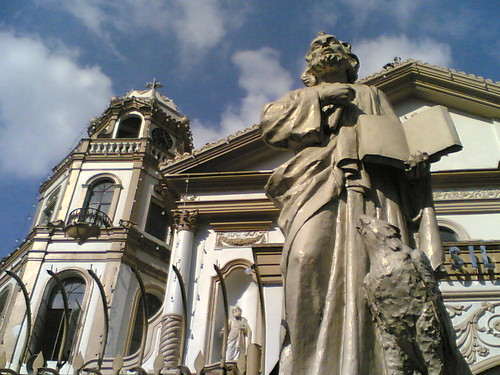
I must admit that Lorimar usually comes up with incredible online finds which he posts on his site, The New (Online) Confessions. Most recent of which is his God is Hired-Wired into the Human Brain about Andrew Newberg’s article published by Quantum Biocommunication Technology.
The following is an excerpt of Is Religion Rooted in the Human Brain?
Most secular thinkers believe that religion is an entirely psychological invention—born out of confusion and fear—to help us cope with the struggles of living and comforts us in the face of the terrible certainty that we will die. But researchers Andrew Newberg and Eugene d’Aquili offer a new explanation, at once profoundly simple and scientifically precise: the religious impulse is rooted in the biology of the human brain.
Newberg and d’Aquili base this revolutionary conclusion on a long-term investigation of brain function and behavior as well as studies they conducted using high-tech imaging techniques to peer into the brains of meditating Buddhists and Franciscan nuns at prayer. What they discovered was that intensely focused spiritual contemplation triggers an alteration in the activity of the brain that leads one to perceive transcendent religious experiences as solid, tangible reality. In other words, the sensation that Buddhists call "oneness with the universe" and the Franciscans attribute to the palpable presence of God is not a delusion, or subjective psychology, or simple wishful thinking. Rather, it is triggered by a chain of distinct neurological events that can be objectively observed, recorded, and actually photographed.
Read complete article…
Why God Won't Go Away: Brain Science and the Biology of Belief (Paperback)
By Andrew Newberg, Eugene d’Aquili and Vince Rause
Labels: Featured book
posted by Señor Enrique at 9:55 AM
| 0 comments
Sunday, December 11, 2005
FEEL THE FEAR AND DO IT ANYWAY

Whenever I passed by some of Manila’s impoverished areas, I would find myself wondering at times if fear had a lot to do with their inability to advance in their lives. I would also wonder if theirs are so overwhelming that succumbing has become a more common practice than confronting their fears. And for those who strive to better their lot, what support system or information resources have they got? Where do they go for inspiration? Encouragement?
I once saw the book, Feel the Fear and Do it Anyway, by Susan Jeffers displayed in the window of a bookstore, and its title intrigued me. I later found out the book “offers readers a clear-cut plan for action that, when followed, should help them unlearn their misconceptions about fear and replace them with attitudes of strength and conviction.”
I was rushing to get home that evening and had no time to get a copy for myself. I wish I had because there were many times I felt fear—applying for a much more challenging job, traveling alone to a foreign country, undertaking a new task, replacing a team member with someone else, and so on and so forth. There were also times I was so anxious over something that I’ve lost sleep over it. Yet, in spite of those surmounting apprehensions, I managed to survive or achieve what I set out to do.
I soon realized I was responsible for adding on to the hindrances by giving additional power to my fears—by indulging in them and wasting a lot of energy in the process. From that time on, I’ve learned to focus on proactive solutions, as well as acquire the necessary skills to resolve a dilemma or achieve the desired results. As with most things in life, it took some time but well worth the effort; I was learning to empower myself rather than my fears.
Indeed, the unresolved fears we carry around with us can cause paralyzing anxieties—fear of getting hurt, fear of failure, fear of rejection, fear of being laughed at, and worst of all, fear of losing what we never had to begin with; whatever that may be.
According to Ron Kurtus’ Overcoming Unnecessary Fears, “You can overcome fears by gaining confidence in your ability to do such a task. That is usually done by doing something difficult and seeing that the consequences of failure are not so bad or that the chances of failure are not so great.”
He then concludes, “People fear physical harm or ridicule. Sometimes the danger is not as bad as it seems. Taking a little step in overcoming the fear can go a long way in increasing your confidence and erasing other fears.”
I was once told by a mentor that the pain of failure is not as bad as the pain of someday saying to your self, “I should have.” I had since made that a personal mantra as I prepared to pursue a bigger challenge in life. Certainly, I failed on numerous occasions, but those failures only honed my skills to better manifest my visions, as well as attain some wisdom to guide my future journeys.
And knowing we only pass by once in this lifetime, heck, why not feel the fear and do it anyway, right? And as incentive, we ought to add another line to Bertrand Russell’s quote above — “And wisdom begets prosperity.”
But one question remains: How do we share this information with those living in impoverished areas of our cities?
Labels: Featured book, Words of wisdom
posted by Señor Enrique at 6:07 AM
| 12 comments
Tuesday, November 29, 2005
THE BEATLES: The Biography
 At nearly 1,000 pages long, including more than 100 pages of footnotes, bibliography, discography and other end matter, "The Beatles," by Bob Spitz, is as big as a Bible. But as we hefted this literary cinder block and contemplated reading it, we had to wonder what could possibly be left to say about the musical foursome whom John Lennon once declared more popular than Jesus.
Ten pages in, we were hooked. Bob Spitz's beautifully written chronicle breathes new life into the familiar story of the Liverpool boys who conquered the world and became, according to a recent Variety poll, the most influential entertainers of the past century. The author's passion for his subject, and for every nuance of every scene, electrifies even the most familiar moments in the legend. Spitz cast his net wide, gathering little-known information from contemporary radio interviews, fanzines, Brian Epstein's personal diaries, and such arcana as the architectural renderings for John and Cynthia Lennon's home and a pamphlet called "A Short History of the Liverpool Cotton Market." The scene-by-scene particulars are fascinating; for example, the description of Ringo meticulously rolling up towels to seal the threshold under the door of a room at the Delmonico Hotel in New York the night in 1964 when they met Bob Dylan and Dylan introduced them to marijuana. "An unusually gregarious Dylan was delighted by the Beatles' curiosity and readiness to experiment," Spitz writes. "They got right in the groove, which relaxed the recalcitrant bard, who lit joint after joint, fanning the fateful flame." The chapter ends: "Nothing would ever be the same again."
Read more: You Know You Should Be Glad, a review by Jane and Michael Stern (The New York Times)
The Beatles: The Biography, by Bob Spitz
Published: November 27, 2005
Labels: Featured book
posted by Señor Enrique at 2:49 PM
| 0 comments
Sunday, November 27, 2005
Featured Book: REAL MAGIC
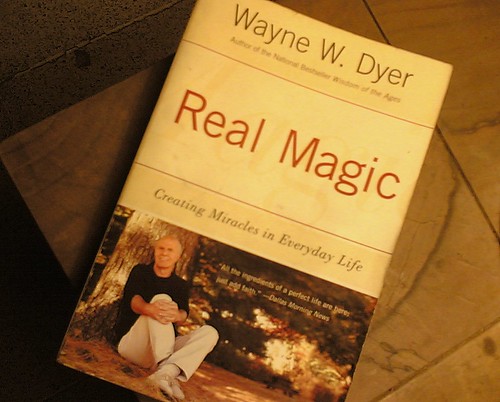
By Wayne W. Dyer
Quill, an imprint of HarperCollins Publishers
I was blessed with having mentors in my life. Had it not been for their time and patience I never would have known the value of creating options for myself, as well as seeking alternative paths in the pursuit of a more fulfilling career and personal life. And so, when I had acquired some years and wisdom, in reciprocity, I engaged in mentoring.
For the most part, I would stress the importance of spirituality in one’s life; not so much religiosity, but rather an inner knowing of one’s connectivity with others and the universe. I did this by recommending a study of a martial art and the book, Zen in the Art of Archery. Learning martial arts, by the way, also hones one’s ability to focus in spite of tumultuous factors that may surround him.
Almost in all cases, the topic of cultivating financial security from one’s career would arise. New York has a glut of financial wiz and planners who offer guidance, as well as a number of respectable graduate schools to acquire appropriate credentials from in order to enhance one’s resume and earning power. Either one should be able to address the issue.
However, there are other more affordable alternatives such as Dr. Wayne Dyer’s book, Real Magic, and another I had previously featured, As a Man Thinket by James Allen.
In Real Magic, Dr. Dyer basically points out that everything we need to acquire prosperity has always been within us, but we must first eliminate the hindrance—the scarcity consciousness—which prevents us from experiencing abundance in our life. He illustrates this principle with the following story:
A man who was ragged and appeared to be without anything in a physical sense came upon a road boss and said, “Can you help me? I need work.”
The road boss said, “Fine, take that large boulder over there and roll it up and down the hill. If you need work that will fulfill your need.”
The man said, “You don’t understand, what I really need is money.
The boss replied, “Oh, if it is only money that you need, here is fifty dollars. But you cannot spend it.”
Again, the man was perplexed. “You don’t understand, what I really need is food and fuel and clothing, not just money.”
The boss again replied, “If you are sure that this is really what you need, then spend the money for food, fuel and clothing, but don’t eat the food, or burn the fuel or wear the clothing.”
The man was finally forced to look at what he really needed, which was a sense of security, peace and inner satisfaction. All totally invisible, all within the mind. All divine sustenance.
The author further claims, “What you need, you already have, and when you know it, and go within and create it in your mind, the divine sustenance you seek in the form of material things or money will be manifested in whatever amounts needed.”
That whenever we say to ourselves, “I don’t have enough money,” “The economy is bad these days,” “I don’t have the appropriate educational background,” or, “I didn’t come from the right family and therefore, will never get the promotion and earn the money I want,” we are operating in our mental world from a position of lack or the underprivileged. Therefore, we deprive our own self the opportunity of going into the world of real magic; hence unable to experience a life of prosperity and abundance.
Dr. Dwayne Dyer also mentions of the time he was accused of having a cavalier attitude toward the poor by a radio talk show host when he was a guest on his program. Dr. Dyer’s contention was that being broke is a temporary state of affairs that afflicts everyone at some point in life, but being poor is an attitude, a set of beliefs that gets reinforced when we shift to blaming life circumstances for the condition of poverty.
One of the incoming calls in response to this radio conversation was from a physician in Washington, D.C., who had grown up in a family of thirteen children in appalling poverty in Jamaica. He disagreed with the host, saying:
I lived in dirt-poor conditions all of my life. I mean hungry, starving poverty. But I always had a vision of myself as a doctor. I could not lose that vision, and I would always tell my grandmother about that picture in my head. She was raising all of us on practically no income, and she always told me to never, but never, let the picture become blurred. She told me about the value of that inner picture, and that I always kept it, and believed in it, I would only have that picture to act upon.
As I got older and finished high school, I applied to several schools in premed curricula, and I was rejected over and over again, but I could not shake that picture that my grandmother helped me to have as a ragtag little boy playing with the chickens in our little hut in Jamaica. Finally I was given a conditional opportunity to enroll in a premed program in Europe, and I worked my way there and through school.
Today I am a physician with a thriving practice. Without that vision, without that invisible picture in mind, I could never have escaped the life of poverty that continues today for most of my brothers and sisters and all of my friends there. They live in poverty and believe that life dealt them a stacked deck, and that I was lucky. But I know better. I am living the life I pictured for myself.
And Dr. Dyer, don’t you ever let anyone dissuade you from telling the truths that you know, because you are doing much more to help those in horrible circumstances than those who buy the big lie that their lives are beyond their own control.
Dr. Dyer asks his readers to suspend any erroneous beliefs that these truths apply exclusively to him, the doctor in Washington, D.C. and to a chosen few, but has nothing to do with any of us. In actuality, it has everything to do with all of us.
He argues that these truths transcend individual lives because it involves universal laws and principles that were here long before we all showed up in our physical form. He’s simply reporting on what he knows to be true for his own self and many others. That if you want to experience prosperity in a miraculous level, he suggests that you must leave behind your old ways of thinking and develop a new way of imagining what is possible for you to experience in your life.
The old tried and true adage supports Dr. Wayne Dyer's principle: Thoughts manifest themselves.
Ask and you shall receive, applies as well.
Labels: Featured book
posted by Señor Enrique at 7:23 AM
| 0 comments
Friday, November 25, 2005
A STATEMENT ON LOVE

Love is union under the condition of preserving one’s integrity, one’s individuality. Love is an active power in man; a power which breaks through the walls which separate man from his fellow men, which unites him with others; love makes him overcome the sense of isolation and separateness, yet it permits him to be himself, to retain his integrity. In love the paradox occurs that two beings become one and yet remain two.
Labels: Featured book
posted by Señor Enrique at 3:57 AM
| 2 comments
Thursday, November 24, 2005
Featured Book: SITTING IN DARKNESS
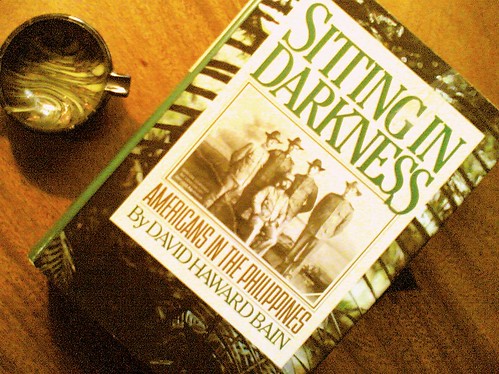
My best friend in New York gave me a copy of this book as a birthday gift 10 years ago. The following is a review of it by T. Bailey of The Washington Post (February 25, 1985):
IN WHICH WAR was the term "Gook" invented? When did American soldiers conduct their first body count and pioneer the use of the "water cure" to persuade Asian guerrillas to betray their comrades?
After which battle did a young rifleman write home to the folks in Kingston, New York, "I am in my glory when I can sight my gun on some dark skin and pull the trigger"?
Modern as it all sounds, the answer is not Vietnam, or even Korea or World War II. The American conquest of the Philippines barely rates a mention in school history books, usually as a cryptic footnote to the short war which President William McKinley and publisher William Randolph Hearst waged on Spain in 1898 for the independence of Cuba and the circulation of Hearst's newspapers. Yet 126,458 Americans fought in the Philippines between 1898 and 1902, of whom 4,234 died, while 16,000 Filipinos died in battle and another 200,000 in "reconcentration camp." There were in addition massacres of civilians in reprisal for guerrilla attacks and similar sideshows all too familiar in subsequent Asian wars.
The story of how, and why America liberated the Philippines from Spain and then took the islands back from their inhabitants two weeks later is a complicated one, already well told in one of the classics of American historiography, Leon Wolff's Little Brown Brother, published in 1960. But the writing of history is never finished, and David Haward Bain has managed another fine book on the subject, not disagreeing with Wolff's conclusions, but making them fresh and vivid for a generation which has seen yet another Asian war.
This is not, however, simply another tale of savagery in the rice paddies. Almost as if he could read tomorrow's newspapers, Bain has brought his account up to the minute, with perceptive entries, for instance, indexed under Aquino Benigno and Ver, General Fabian (the latter currently on trial for complicity in the former's assassination). This energetic young historian has thus pulled off that rarest of publishing coups, a scholarly historical work of bang-on topicality. He has, what's more, found a most original way of bringing his story to life.
From this distance, and even at the time, the American conquest of the Philippines has always been difficult to fathom. But, then and now, two figures jump forth from a cast of thousands: Emilio Aguinaldo, not quite 30, brave and passionately patriotic, the president of the republic of the Philippines proclaimed as the beaten Spaniards departed (and the first republic in Asia) and Colonel Frederick Funston, six years older, who drove the last nail into the republic's coffin by capturing Aguinaldo on March 23, 1901, after a long and daring hunt through the jungles and mountains of northern Luzon.
Aguinaldo, who looked remarkably like his current successor, Ferdinand Marcos, survived his capture and lived a long life, long enough to welcome the arrival of the Japanese in 1942 (understandably, perhaps; the new invaders also promised liberation), to march in the Manila independence parade of 1946, carrying the flag he first raised against Spain in 1896, and to see a new American war just getting under way in Asia in 1964, the year of his death. A largely forgotten figure now, even in the Philippines, Aguinaldo emerges from Bain's book an authentic hero and his republic a tragically missed chance for the United States to have been the protector of Asia's first genuine democracy.
His captor, the adventurous son of a Kansas politician known as "Foghorn Funston, the farmers' friend" was plainly just as archetypal a figure. "I am afraid that some people at home will lie awake nights worrying about the ethics of this war, thinking that our enemy is fighting for the right of self-government" he told a New York Times correspondent. "The word independent, which these people roll over their tongues so glibly, is to them a word, and not much more . . . . they are, as a rule, an illiterate, semisavage people, who are waging war, not against tyranny, but against Anglo-Saxon order and decency." Funston's feat, a mixture of reckless daring and ingenious double-cross, or what used to be known in Vietnam as a "John Wayne stunt," was the stuff of movies, and would have made a splendid vehicle for James Cagney (Funston was 5 feet 4 inches tall and touchy about it) if Hollywood had blossomed before American imperialism went out of fashion.
BUT, LIKE MANY a veteran from the East, Funston could not settle down to life back home, took to the bottle and died at 51 in 1917, when he was being seriously considered for command of the American Expeditionary Force that went to France that year. But for his heart attack, in fact, we would very likely now be debating the merits of the Funston rocket instead of the one named for his deputy, General John Pershing, who got the job instead.
Here, unmistakably, we have the Green Beret, or cowboy turned romantic military stuntman. In fact, Funston's boss, General Arthur MacArthur, father of the even more famous Douglas, was an old Indian fighter, and so were many of his buddies in the 20th Kansas infantry he led to the Philippines. The fact that the Far East is West of the Wild West has profoundly shaped America's wars there, a point made in the insightful and absurd movie The Deer Hunter.
It is hard to quarrel with Bain's conclusion that the years of American rule did little or nothing to solve the basic political problem of the Philippines. After three centuries of Spanish colonial government, the islands had none of the institutions of self-rule and no experience of it. All the new rulers achieved was a superficial Americanization of the illustrades, the Hispanicized native upper class, leaving the masses in pious poverty and the way open for a native-born dictatorship to follow the authoritarian rule of slippery Spaniards and decent Anglo-Saxons. People learn self-government by governing themselves and making their own mistakes, and America put off the Philippines' fateful day for 50 years, failing, in the end, even to supply the military protection that is the only justification for empire.
But Americans are still well thought of in the Philippines, as Bain and a group of friends, including his photographer-brother Christopher, discovered when they repeated Funston's epic trek through the Luzon jungle in 1982, talking to the same locals, fording the same streams, and being bitten by descendants of the same mosquitoes which bit the pint-sized adventurer and his party 80 years earlier. Melding past and present, and interweaving the historical background with present politics brings vividly home the long shadows still cast by America's first adventure in Asia. This is an important story, honestly researched and well told -- a second classic, in fact, on a fascinating subject.
Review by T. BAILEY
The Washington Post, February 24, 1985
Sitting in Darkness, Americans in the Philippines
By David Haward Bain
1984, Houghton Mifflin Company
Related link: Same As It Ever Was
Labels: Featured book
posted by Señor Enrique at 4:32 AM
| 4 comments
Thursday, November 03, 2005
Featured Book: AS A MAN THINKETH
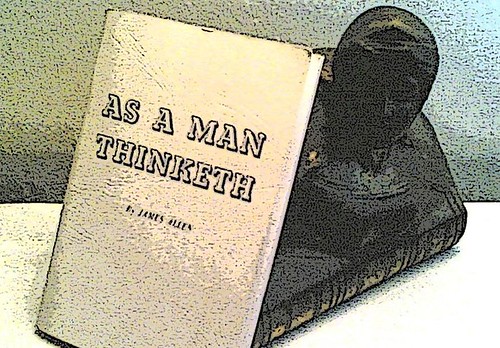
By James Allen
What makes life difficult throughout the history of mankind is that we are born without a manual. As we struggle to follow our bliss; to fulfill our inner longings that will consequently define our life, we find ourselves at a certain crossroad: whether or not to transcend our comfort zone – family and culture – that once nurtured us. Thus, begins what Joseph Campbell would refer to as the hero’s journey.
From teenage angst to mid-life reevaluations, for the most part, we cope with personal issues alone. Regardless of our basic support system comprised of family and friends; despite of their well-meaning intentions, suggestions and recommendations, we often base our decisions on the set of thoughts and core beliefs that we alone ascertain for ourselves.
As a Man Thinketh tells us that although we are powerless to change any person or condition that comes our way, we do, however, have the power to provide its meaning, as well as how and to what extent we will allow this person or condition to affect us. But then again, this book argues, most people and conditions that we attract into our life are equivalent experiences of the thoughts we harbor in our mind.
Long before the publication of this tiny book, many had already attested to the power of thoughts to manifest themselves; that our every uttered word and every action taken was preceded by our having thought about it first. Everything around us – from our cellphones (or mobiles, as they are now beginning to be referred to these days) to the cars we drive — all came from thought.
Marcus Aurelius Antoninus, Emperor of Rome, A.D. 161-180, said, “The happiness of your life depends upon the quality of your thoughts, therefore guard accordingly; and take care that you entertain no notions unsuitable to virtue, and reasonable nature.”
James Allen, in this tiny book, also underscores our innate power to fill our mind with thoughts of what we want to experience in our life, as well as our power to filter out those we do not wish to experience.
He claims, “Of all the beautiful truths pertaining to the soul which have been restored and brought to light in this age, none is more gladdening or fruitful of divine promise and confidence than this – that man is the master of thought, the moulder of character, and the maker and shaper of condition, environment, and destiny.”
In essence, we actively participate in creating our destiny through the thoughts we often find ourselves thinking a lot about.
This is a wonderful book that reminds us about a simple truth: we are what we think.
Labels: Featured book
posted by Señor Enrique at 6:19 AM
| 2 comments
Friday, October 07, 2005
Featured Book: THE ALCHEMIST

By Paulo Coelho
Harper Collins Publishers
I first read it during a long flight from Kennedy to Narita. It was a gift from a dear friend. Although a small book and a quick read, its insight had me contemplating every now and then. This book is about the pursuit of a dream in magical ways; an absolute must read for artists, visionaries, entrepreneurs, and dreamers.
Amazon.com books
http://www.amazon.com/exec/obidos/tg/detail/-/0062502182/103-1910990-5171015?v=glance
National Book Store (Philippines)
http://www.nationalbookstore.com.ph/details.asp?sku=6054388
Labels: Featured book
posted by Señor Enrique at 5:20 PM