Friday, November 28, 2008
THE KIDS ARE ALRIGHT

All those hours that teenagers spend socializing on the Internet may not be such a bad thing after all. America’s youth are actually developing important social and technical skills online – often in ways adults do not understand or value. These findings were the result of the most extensive U.S. study on teens and their use of digital media, commissioned by the MacArthur Foundation.
Mizuko Ito, lead researcher on the study, Living and Learning With New Media, said that although it may look as though kids are wasting a lot of time hanging out online, whether it’s on MySpace or sending instant messages, their participation, however, is giving them the technological skills and literacy they need to succeed in the contemporary world. And more important, these young people are learning how to get along with others, how to manage a public identity, how to create a home page.
Moreover, Ms. Ito, a research scientist in the department of informatics at the University of California, Irvine, said that some parental concern about the dangers of Internet socializing might result from a misperception.
“Those concerns about predators and stranger danger have been overblown,” she said. “There’s been some confusion about what kids are actually doing online. Mostly, they’re socializing with their friends, people they’ve met at school or camp or sports.”
The study, part of a $50 million project on digital and media learning, used several teams of researchers to interview more than 800 young people and their parents and to observe teenagers online for more than 5,000 hours. Because of the adult sense that socializing on the Internet is a waste of time, the study said, teenagers reported many rules and restrictions on their electronic hanging out, but most found ways to work around such barriers that let them stay in touch with their friends steadily throughout the day.
“Teens usually have a ‘full-time intimate community’ with whom they communicate in an always-on mode via mobile phones and instant messaging,” the study said.
The researchers also identified two distinctive categories of teen engagement with digital media: friendship-driven and interest-driven. While friendship-driven participation centered on “hanging out” with existing friends, interest-driven participation involved accessing online information and communities that may not be present in the local peer group.
Significant findings include:
* There is a generation gap in how youth and adults view the value of online activity.
* Adults tend to be in the dark about what youth are doing online, and often view online activity as risky or an unproductive distraction.
* Youth understand the social value of online activity and are generally highly motivated to participate.
* Youth are navigating complex social and technical worlds by participating online.
* Young people are learning basic social and technical skills that they need to fully participate in contemporary society.
* The social worlds that youth are negotiating have new kinds of dynamics, as online socializing is permanent, public, involves managing elaborate networks of friends and acquaintances, and is always on.
* Young people are motivated to learn from their peers online.
* The Internet provides new kinds of public spaces for youth to interact and receive feedback from one another.
* Young people respect each other’s authority online and are more motivated to learn from each other than from adults.
* Most youth are not taking full advantage of the learning opportunities of the Internet.
* Most youth use the Internet socially, but other learning opportunities exist.
* Youth can connect with people in different locations and of different ages who share their interests, making it possible to pursue interests that might not be popular or valued with their local peer groups.
* “Geeked-out” learning opportunities are abundant – subjects like astronomy, creative writing, and foreign languages.
“This study creates a baseline for our understanding of how young people are participating with digital media and what that means for their learning,” said Connie Yowell, Ph.D., Director of Education at the MacArthur Foundation. “It concludes that learning today is becoming increasingly peer-based and networked, and this is important to consider as we begin to re-imagine education in the 21st century.”
The John D and Catherine T. MacArthur Foundation, with assets of $7 billion, supports creative people and effective institutions committed to building a more just, verdant, and peaceful world. In addition to selecting the MacArthur Fellows, the foundation work to defend human rights, advance global conservation and security, make cities better places, and understand how technology is affecting children and society.
To learn more about the MacArthur Foundation and the work of their grantees, visit their annual report online.
John D. MacArthur (1897-1978) developed and owned Bankers Life and Casualty Company and other businesses, as well as considerable property in Florida and New York. His wife Catherine (1909-1981) held positions in many of these companies and served as a director of the Foundation.
I very much appreciate my articles and photos appearing on fellow bloggers' sites, popular broadsheets, and local broadcast news segments, but I would appreciate even more a request for permission first.
Thank you!
Labels: current affairs, technology
posted by Señor Enrique at 8:12 AM
| 2 comments


Tuesday, September 30, 2008
MARITIME PIRACY AND ECONOMIC CHAOS IN OLD MANILA

According to the International Maritime Bureau's piracy reporting center, there has been an alarming surge in pirate attacks worldwide. Africa remains the world's top piracy hotspot, with 24 reported attacks in Somalia and 18 in Nigeria this year.
Recently, Somali pirates seized the cargo ship Faina off the coast of Somalia on Thursday as it headed to Kenya. The Ukrainian-operated ship is carrying ordnance ordered by the Kenyan government, which ncludes 33 Russian-built T-72 tanks and a substantial amount of ammunition and spare parts.
The pirates are demanding a $20 million ransom to release the Faina and its crew. Although the Kenyan government stands firm in its policy not to negotiate with pirates or terrorists, what's on board deeply concerns five nations — Ukraine, Somalia, Russia, the United States and Britain — and have been sharing information to try to secure the swift release of the ship and its 21-member crew.
Meanwhile, in America, in its attempt to thwart a shattering financial crisis with major global repercussion, the Bush administration and congressional leaders agreed on a deal to authorize the biggest banking rescue in U.S. history — the $700 billion bail out program.
According to the Wall Street Journal, at its core is Treasury Secretary Henry Paulson's concept of buying impaired mortgage-related assets from financial firms — giving them cash to replace the toxic debts that have put them in danger or dissuaded them from lending. The plan is to help the firms restore their capital bases as well as the trust that enables them to borrow and lend at reasonable terms. Without this, officials worry that the credit markets, the lifeblood of the U.S. economy, would grind to a halt.
An extraordinary week of talks unfolded after Paulson and Ben Bernanke, the Federal Reserve chairman, went to Congress 10 days ago with ominous warnings about a full-blown economic meltdown if lawmakers did not act quickly to infuse huge amounts of government money into a financial sector buckling under the weight of toxic debt.
These two crises — maritime piracy and economic turmoil — in one fell swoop, at one point during the 16th century, similarly roiled in and shocked Manila.
In the early morning of November 4, 1587, in the bay of Augua Segura or Puerto Seguro, now named San Jose del Cabo somewhere in the tip of Baja California, the English pirates led by Thomas Cavendish sighted the galleon ship Santa Ana, on her way to Cabo San Lucas at the tip of Lower California to make a landfall and check her course prior to continuing on to Acapulco.
Cavendish's ships, the Desire and Content gave chase with all sail. It was afternoon when they came up broadside with the Santa Ana — tagged as the "great rich ship" — under the command of Tomas de Alzola. It left the port of Cavite the last week of June, some four-and-a-half months earlier.
The English ships attacked the Santa Ana with full force, killing and maiming many of its men who fought valiantly and refused to surrender. After about six hours of intense resistance and having suffered heavy loses — with the hull of Santa Ana also sustaining a canon blast at the waterline — Captain Tomas de Alzola finally hung out a flag of surrender.
In spite of the the disparity in size of the ships — the Santa Ana had a tonnage of 700, while the Desire and the Content were of 120 and 60 tons, respectively — the odds of the battle was overwhelmingly in favor of the British. The Santa Ana lacked the necessary artillery and fire power. Cavendish's Desire alone mounted eighteen guns, while the Content had ten.
In a report to the king from Manila, Governor de Vera wrote that the capture of the Santa Ana came as a surprise since the galleon routes were kept a secret and no other but Spanish ships had been sighted on the these galleon routes for years.
Cavendish and his men were all praise, however, for the courage of Captain Alzola and his crew, which included Filipinos, for fighting up to the end.
The Santa Ana carried 122,000 pieces of gold and a cargo of fine pearls, silks, satins, damasks, musks, and other merchandise of the East Indies, as well as ample supply of all kinds of foods and wines. The royal treasurer in Manila provided a more detailed report: the Santa Ana carried 2,300 marks of gold, equivalent to 84.2 pounds avoirdupois; not to mention a large amount of gold that had not been registered. The total sale value of the Santa Ana's cargo in Mexico would have been over two million pesos, which represented an original investment in Manila of more than one million pesos.
The Spaniards in Manila were further infuriated upon fully realizing the extent of Cavendish's depredation, which consequently, created a severe economic meltdown in Manila. Bankruptcy, poverty and severe despondency were experienced by many members of the city's trading community, including a substantial number of inhabitants and soldiers.
Besides the daring piracy that Cavendish conducted in the waters considered by the Spanish as the exclusive domain of their king, it was his youth (barely in his twenties) along with an inferior sea vessel manned no more than fifty men — who trespassed their domain and got away with it — that ultimately left the Spaniards in Manila feeling unbearably weak and inadequate.
During the 250 years of the galleon trade, the sea claimed dozens of ships, thousands of men and many millions in treasures. As the richest ships in all the oceans, the galleons were the most coveted prize of pirates and privateers. Four were taken by the English — the Santa Ana in 1587, the Encarnacion in 1709, the Covadonga in 1743, and the Santisima Trinidad (the largest ship in her time) in 1762.
The first to fall was the Santa Ana, a prize catch that went to the Englishman Thomas Cavendish. His brazen act of maritime piracy eventually precipitated an economic turmoil that startled the Spanish regime in old Manila.
The Filipino Seamanship
Image EXIF:
MAMANG MANDARAGAT
© 2008 Señor Enrique
Aperture: F9
Shutter: 10/130 sec
Focal Length: 30mm
ISO: 400
I very much appreciate my articles and photos appearing on fellow bloggers' sites, popular broadsheets, and local broadcast news segments, but I would appreciate even more a request for permission first.
Thank you!
*
Labels: business, current affairs, galleon trade, Manila history, Philippine history
posted by Señor Enrique at 4:13 AM
| 6 comments
Sunday, September 28, 2008
THE FOUNDATION AND GRANT WRITING

real opportunity to help advance equity around the world to
help make sure that, no matterwhere a person is born, he or
she has the chance to live a healthy, productive life."
- Melinda Gates
The Bill & Melinda Gates Foundation (B&MGF) is the largest transparently operated private foundation in the world, founded by Bill and Melinda Gates in 2000 and doubled in size by Warren Buffett in 2006.
The primary aims of the foundation are, globally, to enhance health care and reduce extreme poverty, and, in the United States, to expand educational opportunities and access to information technology.
The foundation, based in Seattle, Washington, is controlled by its three trustees: Bill Gates, Melinda Gates, and Warren Buffett. Other principal officers include Co-Chair William H. Gates, Sr. and Chief Executive Officer Jeff Raikes. It has an endowment of US$38.7 billion as of December 31, 2007.
The scale of the foundation and the way it seeks to apply business techniques to giving makes it one of the leaders in the philanthrocapitalism revolution in global philanthropy.
Read more here.
The Grant Writing Workshop by John Silva
My revamped grant writing workshop fits with the new demands of funders influenced by the Gates Foundation.
Funders today want proposals that are brief, that can tell a story, that avoids silly development language (like empowerment) and can convince funders that your goal is to be part of the elimination of the problem. The last point is important. With the Gates Foundation and other large foundations now giving larger amounts and on a multi-year basis, they’d like to see more proposals that not just alleviate or lessen the problem. They’re talking eradication, elimination and making the problem history.
Are you equipped to talk in that language? Given the sort of development orientation we’ve had and not having been challenged to write a proposal to eradicate a problem, we are at a disadvantage.
Well, with thirty years of grant writing experience and having been with the best of NGO’s and foundations in the world, I’ll show you how to write a powerful and winning proposal that will be seriously considered for a grant.
I’m not into theory. I’m teaching three decades of working experience with the likes of Oxfam America, the Ford Foundation, the American Cancer Society and so many others. I wrote proposals and got them funded.
Read more here.
THE GATE
© 2008 Señor Enrique
Aperture: F11
Shutter: 10/250 sec
Focal Length: 36mm
ISO: 200
I very much appreciate my articles and photos appearing on fellow bloggers' sites, popular broadsheets, and local broadcast news segments, but I would appreciate even more a request for permission first.

*
Labels: current affairs, learning workshop, opportunity, photography
posted by Señor Enrique at 12:57 AM
| 0 comments
Saturday, September 27, 2008
THE SUDDENLY BARREN PLAZA ROMA

Mayor Alfredo S. Lim was astonished and alarmed when he passed by Intramuros to see the trees which included six narra and two mahogany trees at the IA-regulated Plaza Roma opposite Manila Cathedral had been cut.
How could Mrs. Bambi Harper, the Intramuros Administration chief, do such a thing? -- he must have thought. Mrs. Harper was not answering her cell phone so the mayor called the police station nearest to the scene of this environmental chainsaw massacre.
It was later discovered that Mrs. Harper was planning to plant about 22 fire trees at the plaza so she had ten narra and three mahogany trees – all endangered species, as well as 17 fruit bearing trees (neem, mango, langka and atis) cut and transferred elsewhere. However, her failure to announce her intention to do some tree-cutting astounded and irked many powers that be.
Executive director Corazon Davis of the Department of Environment and Natural Resource’s National Capital Region office wasted no time to file charges against Mrs. Harper -- for violation of Presidential Decree 953, Republic Act 3019 (Anti-Graft and Corrupt Practices Act) and Republic Act 9175 -- before the Office of the Ombudsman.
PD 953 penalizes the unauthorized cutting, destruction, damage and injury of trees, plants and vegetation. RA 9175, on the other hand, regulates the ownership, possession, sale and use of chainsaws. RA 3019, well, astounded and irked many of Mrs. Harper's allies.
However, Mayor Lim, a lawyer, read the legal ramifications of this environmental misdeed correctly and cleared Mrs. Harper, ordering City Hall’s legal department to charge instead the contractor, Fernando Simborio of the Batangas based Green Philippine Nursery Plant, with five counts of violation of PD 953.
Rene Martel, in a Manila Times opinion column claims, "We didn’t hear any verbal thundering from from Davis when DENR Secretary Lito Atienza, in his previous role as Mayor of Manila, ordered (despite an uproar by the caring environmental community) well over two hundred trees to be chopped down at the two historic sites of Mehan Garden and Arroceros Forest Park. And ironically, Harper’s voice was one of the loudest to rail against Atienza at that time."
Be that as it may, poor Mr. Simborio the contractor. He was, after all, simply following what he was ordered and paid to do.
View photo of the shady Plaza Roma here before its ten-decade old trees were chainsawed.
THE BARREN PLAZA
© 2008 Señor Enrique
Aperture: F3.5
Shutter: 10/200 sec
Focal Length: 27mm
ISO: 100
I very much appreciate my articles and photos appearing on fellow bloggers' sites, popular broadsheets, and local broadcast news segments, but I would appreciate even more a request for permission first.
*
Labels: current affairs, Intramuros, life in Manila, politics
posted by Señor Enrique at 2:32 AM
| 28 comments
Thursday, September 11, 2008
IMMINENTLY THE WORST TERRORIST ACT ON EARTH?

These past couple of days, as I gallivant around Manila -- absorbed in some street photography and lost in thought about yet another rise in price of pandesal, as well as the local oil companies' lack of enthusiasm to roll back the price of gas to reflect the decrease in price of crude oil in the global market -- the thought about this Large Hadron Collider (LHC) project also manages to creep into an already busy mind.
It isn't my intention to spread any more negative vibes on this project than it's already attracting; only hoping that by posting an entry about it, some folks out there who are familiar with this awesome scientific project will share their insight and thereby quell our inchoate fear.
Incidentally, my concern was excacerbated after reading an excerpt from an affidavit submitted on March 21 by Luis Sancho to the U.S. District Court of Honolulu in support of a lawsuit against the Department of Energy, Fermi National Accelerator Laboratory, the National Science Foundation, and the European Organization for Nuclear Research (CERN).
Sancho, a cosmologist who specializes in time theory, is among the plaintiffs seeking an injunction to halt further work on the Large Hadron Collider. The following is the excerpt from his affidavit:
Quote
I was initially in favor of funding the Large Hadron Collider—the biggest, most technologically advanced machine ever built. It is a superconductive, superfluid ring in which bundles of heavy atoms are to be accelerated to almost the speed of light and smashed together to replicate the awesome energies of the Big Bang and to create showers of heavy-mass particles found only in those first seconds when the universe was destroyed and re-created. Unfortunately, theoretical calculations show that the LHC could produce two kinds of dark matter—black holes and strange, ultradense quark matter—that are extremely dangerous, as both have been theoretically proven to swallow in a chain reaction the entirety of Earth. Thus, a cosmological bomb billions of times more powerful than the atomic bomb might be created at the European Organization for Nuclear Research.
The exact probability of a runaway reaction that converts Earth into dark matter is unknown. The minimal risk as calculated by CERN allows for a 1 to 10 percent chance of extinguishing Earth. In the insurance business, a potential catastrophe’s “death toll” is calculated by multiplying the number of possible victims by the probability that the event will occur. A similar calculation (6,000,000,000 x 1–10%) shows that the LHC experiment would be, technically, the largest holocaust in history. It would also be the biggest environmental crime in history, far more harmful than global warming, as it would mean the destruction of all life-forms on the planet. Since the production of dark matter is neither necessary for the advancement of science nor safe for mankind, the LHC should be forbidden to operate. As we close Chernobyl-like plants for security reasons and forbid the reproduction of the Ebola virus in an open environment (though some specialized virologists would like to study it for research purposes), so should we forbid the reproduction of free, uncontrolled dark matter, even if its theorists would like to study it at CERN. The production of dark matter will not be a “new discovery,” nor will it advance the study of physics. Furthermore, CERN’s researchers will not be awarded a Nobel Prize—the ultimate goal of all experimentalists—if Earth is consumed.
From a psychological point of view, physicists are a curious group. We are responsible for creating scientific explanations for the nature of God and the universe, and we sometimes act with an arrogant fundamentalism. It is not strange that fundamentalist scientists behave like fundamentalist religious people. Both groups believe in their dogmas with such force that they can justify acts of collective murder all over the world. The callousness of physicists is proverbial among scientists. It should not be surprising, then, that CERN would commit a terrorist act by switching on the LHC. In layman’s terms, CERN is asking all of mankind to play a game of Russian roulette. This they propose to do in order to foster the career goals of a few thousand specialists. No group has the right to put at significant risk the life of a single human being without his express consent and knowledge, let alone the entire population of the planet. CERN’s efforts must be judged as acts of criminal negligence and irresponsibility that could harm billions of human beings, or worse, as a potential terrorist act. The director of CERN has said, “The LHC will be the closest we will ever be to God,” as the Big Bang is the violent beginning and end of the universe. I hope he is wrong.
Unquote
I am one in constant awe of the achievements of our scientific community, but this project, worth billions of dollars, leaves me thinking: Is it truly necessary? And is it safe?

This is one of the photographs from CERN that show the various stages of completion of the LHC and several of its larger experiments (some over seven stories tall), over the past several years. View all 27 photos here.
But here's some good news: the first Large Hadron Collider (LHC) experiment went off yesterday without a hitch, paving the way toward the recreation of post-big bang conditions.
"Things can go wrong at any time, but luckily this morning everything went smoothly," said Lyn Evans of the European Organization for Nuclear Research (CERN) who oversaw the building of the accelerator.
Read the complete National Geographic article here.
I very much appreciate my articles and photos appearing on fellow bloggers' sites, popular broadsheets, and local broadcast news segments, but I would appreciate even more a request for permission first.
Thank you!
*
Labels: current affairs
posted by Señor Enrique at 5:28 AM
| 31 comments
Tuesday, September 09, 2008
BRASSIERE DOSSIER

Even though the following two incidents did not occur here in Manila, local women especially those who often travel abroad, including those who hang their laundry outdoors to dry may find these news bits interesting:
A large-breasted woman flying from Oakland to Boston was accosted by the Transportation Safety Administration (TSA) agents when the underwire in her bra set off the magnetometer.
She ended up in a standoff with TSA officials over her bra and left with a choice: allow her breasts to be fondled or give up on flying. Instead, she raised a stink.
Kates asked to see a supervisor and then the supervisor's supervisor. She was told that underwire bras were the leading item that set off the metal detectors. However, she argued that the equipment must be overly sensitive. And if the TSA is engaging in extra brassiere scrutiny, then other women are suffering similar humiliation, Kates thought.
The Constitution bars unreasonable searches and seizures, Kates reminded the TSA supervisor, and scrutinizing a woman's brassiere is surely unreasonable, she said.
The supervisor stood firm on the choice offered to Kates: submit to a pat-down in a private room or not fly at all. Kates could only offer a third alternative, to take off her bra and try again, which the TSA supervisor accepted.
Arbitrary, no-exceptions "security" rules unduly punish innocents -- people with surgical pins in their bodies are now subject to discriminatory treatment when they fly, as are those whose names are similar to aliases used by suspected terrorists, and they're now joined by women with large breasts.
Read complete article here.
Meanwhile, on the other side of the Atlantic, Abbie Hawkins, 19, got dressed at 7:30 one morning and arrived for work at the Holiday Inn Norwich North, near the international airport without noticing that a baby bat was hiding inside the bra she was wearing.
She felt only a slight vibration when driving to work. "I thought it was just my mobile phone in my jacket pocket," she said.
It was not until her lunch break, at midday when she felt a more noticeable, strange movement inside her bra, which had been hanging on her washing line the previous night.
She plucked up the courage to investigate and pulled out a little baby bat which was tucked away in the padded pocket of her underwear. "I just lost my breath when I saw it and I did not know what it was at first. I keep thinking how could I have not known it was there?" Miss Hawkins said. "I will certainly be checking my bras every morning from now on."
The teenager's general manager freed the bat in the hotel garden.
Read entire story here.
I very much appreciate my articles and photos appearing on fellow bloggers' sites, popular broadsheets, and local broadcast news segments, but I would appreciate even more a request for permission first.
Thank you!
*
Labels: current affairs
posted by Señor Enrique at 7:59 AM
| 22 comments
Thursday, September 04, 2008
AFFAIRS OF THE HEART

In Japan, there are companies that will help you get rid of an unwanted spouse, retrieve a straying one, get back with an ex or even get together with someone you’ve seen but don’t yet know. With all the technology and expertise in human psychology at their disposal, these companies, for a fee, will do it for you.
It used to be when a divorced woman was shunned by the Japanese society, doomed unlikely to remarry; thus, Japanese wives put up with any amount of infidelity and abuse.. Not anymore. Tomiya was one of those who founded such companies. "People want to be happy,” he said, and this desire has resulted to an enormous increase in divorces and in companies such as GNC that Tomiya founded 16 years ago. It now has branches across Japan.
Tomiya's staff perform all sorts of services, from trailing a straying spouse or looking into the background of a marriage or job candidate, to dealing with stalkers, domestic violence, sexual harassment, even hackers. But his main job is sorting relationship problems. In the past year alone he has dealt with 2,000 cases.
Some of the cases handled by Tomiya's company entails the use of professional seducers to help unhappy wives build a case for divorcing their husbands. Take this one case, for instance:
3.30pm. Mr A is outside a bank in a busy part of Ikebukuro, a faintly seedy area of Tokyo, waiting for his date. He beams as she teeters across the road on high heels. Kyoko, 20, is half his age. She has a mane of black hair, sloe eyes, a fetching smile and a cute giggle. Her blouse is open to reveal her cleavage and she has on a short skirt and sheer black tights. Mr A is a bald 40-year-old salesman in a crumpled grey suit and glasses.
Mr A met Kyoko by chance in the street; the first time she asked him for directions, then they bumped into each other again, and since then they have been exchanging flirtatious texts.
They stop off at a cigarette machine, then go to a cheap basement restaurant for spaghetti. He has bought her moisturiser and cleanser. She giggles coyly: “Next time, why don’t you give me a ring?” At 4.30 they’re outside a pawnbroker’s, looking at rings. Their shoulders touch, then they reach for each other’s hands.
Click here to read the rest.
Here in Manila, even though divorced or legally separated women are not ostracized, there are those who, due to unknown reasons, opt to remain living with their abusive, alcoholic, or unfaithful husbands. One of whom is someone I know, Matilda (not her real name) who has been married to a relative of mine, Juancho (not his real name, either) for 35 years. Juancho has been maintaining another family.
Manila, being a small city, word got around from the onset. Juancho didn't deny it when confronted; however, he refused to let go of his other family in which he has two sons, while she refused to heed the advice of everyone: to leave him and move on with her life. Their four children are now done with college and enjoying their adulthood; two are married.
And although the situation brings her insurmountable grief, Matilda, has somehow convinced herself that she could change her husband and eventually win him back completely. It has been ten years.
Juancho divides his time between living with Matilda in Manila and with the other younger woman in the province where he maintains a business. A few months ago, Matilda had a terrible accident that caused severe injury to her spinal column. She was prescribed a regular dose of pain killers to assuage the excruciating back pain, as well as a series of physical therapy to help her walk again.
Despite being upset about this cruel twist of fate that befell Matilda, Juancho continues to divide his time between Matilda and the other younger woman -- much to Matilda's disappointment. She was hoping that this accident would awaken his senses to leave his other family. Regrettably, it didn't turn out that way.
Last I ran into him and asked about her condition, Juancho said that she is now walking but on very limited stretches. And then he muttered, "She should have just let me go instead of harboring all that anger for the other one all through these years." I was dumbfounded. But the earnestness in his eyes conveyed the love for the other woman far outweighs the love he has for his legal wife Matilda.
In Nigeria, religious leader Mohammadu Bello Abubakar, who is 84, accepted an Islamic decree that would force him to divorce 82, or 95 percent, of his 86 wives; allowing him to keep only four.
According to a BBC report, one of Nigeria's top Islamic bodies, the Jamatu Nasril Islam, sentenced Abubakar to death last week. The sentence was lifted but he was threatened with eviction from his home. Mr Abubakar had earlier challenged Islamic scholars, saying there was no punishment stated in the Koran for having more than four wives.
"I have not contravened any established law that would warrant my being banished from the land... There is no law that says one must not marry more than four wives," the AFP news agency reported him as saying.
I very much appreciate my articles and photos appearing on fellow bloggers' sites, popular broadsheets, and local broadcast news segments, but I would appreciate even more a request for permission first.
Thank you!
*
Labels: current affairs, life in Manila, Local culture
posted by Señor Enrique at 5:28 AM
| 32 comments
Tuesday, May 27, 2008
SOLDIERS AND TEACHERS

With the government's plan to broadcast satellite-based education to children in the rural and remote areas of the Philippines having been cancelled (see timeline of ZTE-NBN deal), newly-appointed Armed Forces chief Gen Alexander Yano has received a directive from President Arroyo to send soldiers to teach.
The president argues that many members of the military forces are college graduates; thus, qualified to bring education to children in the country's remote villages. In essence, our soldiers will now be tasked to protect our children's mind as well.
According to a nephew who was once with the Philippine Air Force, local employment opportunities have been so bleak for many recent college graduates that they have started opting for a career in the military. He was one of them.
And with such influx, recruitment officials have raised the bar; favoring those with college diplomas over mere high school graduates. I met some of my nephew's military colleagues; they all seemed to be fine young people who are capable of teaching our children.
Nonetheless, however wonderful this soldier-teacher program appears to be, I couldn't help but be concerned for their safety as they are sent to far-flung communities.
"Titser" by Conrado de Quiros
* * *
I very much appreciate my articles and photos appearing on fellow bloggers' sites, popular broadsheets, and local broadcast news segments, but I would appreciate even more a request for permission first.
Thank you!
*
Labels: current affairs
posted by Señor Enrique at 8:51 AM
| 16 comments
Monday, May 26, 2008
SAME AS IT EVER WAS

The photo above was originally published in the Omaha World-Herald in May, 1900 with a letter by a U.S. soldier, A.F. Miller, of the 32nd Volunteer Infantry Regiment. It told of how Miller's unit would subject captured Filipino insurgents to what the U.S. forces called the "water cure" in order to uncover information from their prisoners.
“Now, this is the way we give them the water cure,” Miller explained. “Lay them on their backs, a man standing on each hand and each foot, then put a round stick in the mouth and pour a pail of water in the mouth and nose, and if they don’t give up pour in another pail. They swell up like toads. I’ll tell you it is a terrible torture.”
During the first year of the Filipino-American war, eyewitness accounts of atrocities committed by U.S. forces — the senseless torching of villages, unmerciful killing of prisoners — began to appear in American newspapers. Although the U.S. military tried to censor outgoing cables quite successfully, stories crossed the Pacific through the mail, which wasn’t censored.
American soldiers, in their letters home, wrote about "extreme violence against Filipinos, alongside complaints about the weather, the food, and their officers." Some of these letters were published in home-town newspapers.
Many Americans were indeed puzzled by the news that U.S. soldiers were viciously torturing Filipinos with water, considering that the United States -- since emerging as a global superpower -- has always been a staunch proponent of liberation, rescue, and freedom.
More than a hundred years later, many Americans were just as puzzled by the news that U.S. soldiers were subjecting Iraqi insurgents and terror suspects to "borderline torture" tactics at Abu Ghraib prisons.
The "water cure," however, is no longer the preferred method. It has been replaced with snarling dogs, short shackles, and mocking of the Quran. Some were subjected to extreme humiliation by being forced to "perform dog tricks," "be nude in front of a female," wear "women's underwear on their heads," and kept awake for continuous 20-hour daily interrogations.
Interestingly, in both the Philippines and Iraq, the U.S. soldiers themselves -- with photos taken by their own cameras and letters sent home -- created the clearest evidence of atrocity against their captives.
Debating torture and counterinsurgency—a century ago by Paul Kramer - The New Yorker
Report: CIA Pushed Torture Envelope - CBS News
Featured Book: "Sitting In Darkness"
When Tears Fall
Photo courtesy of The New Yorker
I very much appreciate my articles and photos appearing on fellow bloggers' sites, popular broadsheets, and local broadcast news segments, but I would appreciate even more a request for permission first.
Thank you!
*
Labels: current affairs
posted by Señor Enrique at 1:51 AM
| 18 comments
Thursday, September 07, 2006
FREAKANOMICS ON CRIME AND ABORTION

This picture of an almost empty commuter bus reminds me of a particular chapter in the book I’m reading, Freakanomics. It's about the sudden drop in crime rate in America which completely baffled many social scientists and law enforcement officials. That is, until an unconventional-thinking economist came up with a mind-boggling theory. In fact, the Wall Street Journal dubbed this man, Steven Levitt, the Indiana Jones of economics.
A most recent winner of the John Bates Clark award for the best economist under the age of 40, Levitt‘s success as ascribed by this financial broadsheet, as having a lot more to do with his wit, pluck and disregard for conventional wisdom; not as a specialist of technical information for the select few.
“His genius is to take a seemingly meaningless set of numbers, ferret out the telltale pattern and recognize what it means,” according to this Wall Street Journal article. Through such method, Levitt outlined the cause which resulted to the drastic drop in crime in the United States.
During the 1990s, the Clinton administration along with many criminologists and socio-political scientists unanimously issued a dismal forecast that the entire country was facing a future steep in crime. Accumulated data was so compelling that odd makers were putting their money on the criminals.
“We know we’ve got about six years to turn this juvenile crime thing around, or our country is going to be living with chaos,” President Clinton declared. However, contrary to the common prediction by these learned men, the crime rate fell instead.
The reversal was indeed astounding — the teenage murder rate alone, expected to surge at 100 percent, dropped more than 50 percent within five years. By 2000 the overall murder rate in the United States had dropped to its lowest level in thirty-five years, including the rate of just about every other sort of crime, from assault to car theft. The stumped criminologists, relying upon conventional wisdom, grappled to explain this unexpected shift; only to come up with highly inaccurate and erroneous conclusions.
And then came Steven Levitt who pinpointed this drastic decrease in crime to a woman in Dallas who was then a 21-year-old uneducated destitute; an alcoholic and drug addict who had given up for adoption her two children. Her name was Norma McCorvey.
In 1970, she found herself pregnant again; all she wanted was an abortion. Without intending to, she also dramatically altered the course of events that affected the entire United States of America.
Abortion was illegal in Texas where Norma McCorvey resided, as well as in the entire United States during that time. There were, however, powerful people who adopted her cause and made her lead plaintiff to a class-action lawsuit seeking to legalize abortion. They named the Dallas County district attorney, Henry Wade, as defendant. To protect her privacy, her name was disguised as Jane Roe.
The case ultimately found its way all the way to the U.S. Supreme Court; hence Roe versus Wade.
On June 22, 1973, the Supreme Court ruled in favor of Ms. Roe, paving the way for legalized abortion throughout the country. Ironically, too late to get an abortion when the ruling came out, Norma McCorvey gave birth, but put the child up for adoption. In the succeeding years, she would renounce her allegiance to legalized abortion crusade and become a pro-life activist.
Millions of American women most likely to resort to abortion in the wake of the Roe vs. Wade were indigent, uneducated, unmarried teenage mothers whose children, if born, would have been more likely than average to become criminals. But due to Roe vs. Wade, these children weren’t being born.
According to Levitt’s theory, “this powerful cause would have a drastic, distant effect: years later, just as these unborn children would have entered their criminal primes, the rate of crime began to plummet.”
Again, Levitt based his findings on numbers and data, but what the link between abortion and crime tells him is this: “when the government gives a woman the opportunity to make her own decision about abortion, she generally does a good job of figuring out if she is in a position to raise the baby well. If she decides she can’t, she often chooses the abortion.” On the other hand, should a woman decide to have the baby, a pressing question arises: “what are parents supposed to do once a child is born?”
This entry was created to briefly illustrate the unorthodox manner in which this famed economist, Steven Levitt, goes about drawing his conclusions. It wasn’t intended to allude to a personal perspective on the subject of abortion.
Freakanomics is a good read which I recommend to those who appreciate articulate, though a roguish style of deductive reasoning.
*Many thanks again to Minotte’s Notes for offering to get me a copy of this book in San Francisco when I thought none was available locally. I did, however, found it at a local National Bookstore.
I very much appreciate my articles and photos appearing on fellow bloggers' sites, popular broadsheets, and local broadcast news segments, but I would appreciate even more a request for permission first.
Thank you!
*
Labels: current affairs, Featured book
posted by Señor Enrique at 6:10 PM
| 21 comments
Wednesday, July 05, 2006
PRE-WAR GAMES
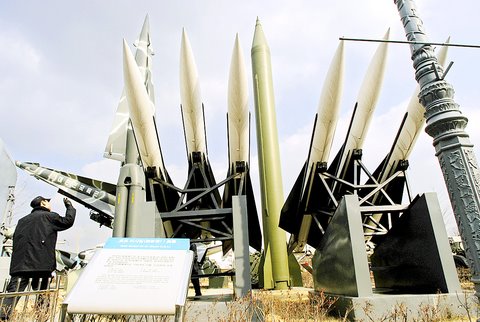 I read the news today, oh boy! North Korea test-fired several missiles on Wednesday.
 A statement released by the State Department in Washington confirmed that it apparently included a Taepodong 2, the long-range missile at the heart of diplomatic tensions with the U.S. and its allies.
Only last week, President Bush echoed earlier U.S. threats of a harsh response if North Korea went ahead with such a launch. Japan, on the other hand, stated it would "apply various pressures" but declined to give details. In response, on Monday, Pyongyang vowed to retaliate with an "annihilating" nuclear strike if attacked pre-emptively by the United States.
On Wednesday, North Korea did go ahead with its launch of several long-range missiles.
This incident only makes me think more about the London Free Press editorial, Let's Keep Our Earth Alive, which I found out through Lorimer's recent blog post. It’s about Stephen Hawking’s recommendation that we aggressively devise plans to colonize space for the survival of the human species.
Here’s the editorial in its entirety:
In case you missed it, the oddest scrap of news last week came from Stephen Hawking, the renowned English physicist who communicates with a letter-board-rigged computer because he's paralyzed by ALS.
Hawking said human beings are making such a botch of things, they had better colonize space, and fast, if they want to survive as a species.
"It is important for the human race to spread out into space for the survival of the species," he said. "Life on Earth is at the ever-increasing risk of being wiped out by a disaster, such as sudden global warming, nuclear war, a genetically engineered virus or other dangers we have not yet thought of."
Hawking, who was greeted like a rock star on a visit to Hong Kong, urged putting a permanent base on the moon in 20 years and one on Mars in 40.
Great. All we have to do is figure out how to grow carrots on Mars. The idea is science fiction; ludicrous.
But the idea behind the idea is not.
The world is in just as bad shape as Hawking says. The dangers are real. They're immense: - Global warming is already being felt. Young people of today will live to see a world unimaginably transformed -- for the worse. - Just because there hasn't been a nuclear bombing since Nagasaki doesn't mean there won't be another. As former Prime Minister Kim Campbell pointed out in Ottawa last week, more than 20,000 nuclear warheads remain poised at hair-trigger around the world.
There could be one big Armageddon. Or a "little" nuclear war -- or several, any one of which would make 9/11 pale in comparison.
The priorities of this world are pathetically, perilously cock-eyed. The "war on terror" is all the rage, while polar caps shrink, arms bristle and the population explosion runs unchecked. Oxfam reported last week that 14 billion bullets are produced annually -- two for every person.
Hawking's right. This planet is in big trouble. Real dangers do loom on the horizon. We may be living in the century that sees the end of planet Earth as an inhabitable space.
But the answer isn't to go to the moon. It's to find solutions; to fight, and not go down without a struggle.
Where's the activism that once surrounded civil rights, environmentalism, peace? It's the people who must choose -- choose to do what must be done to keep this planet alive.
Coming from Sir Stephen Hawking, this is definitely no Cassandra-speak.
Nevertheless, those guys in Pyongyang better get their act together and stop playing this silly quien es mas macho game.
Image Credit: Taipei Times
Labels: current affairs
posted by Señor Enrique at 7:40 AM
| 6 comments