Saturday, November 15, 2008
REMEMBERING YOU

A few years back, a nephew couldn't wait to finish high school so he could go on to college; not to pursue a particular degree to set him up for a worthwhile career, but to be in the environment full of kolehiyalas. But alas! When he finally entered college life this year, he proved more of a torpe than a swain. As for the cause of his changed demeanor, he bragged about a goal to focus on his studies, of course; earning for himself in the process multiple pogi points from his approving parents.
Based on discussions with fellow Pinoys both here and abroad, I can safely assume that a great majority has a kolehiyala playing a prominent role in their fond memories of college life -- either as a girlfriend or someone idolized from afar. Same goes for the coed: I bet they had a particular college guy (kolehiyelo?) in mind as a suitor; that is, if they weren't already entangled with one.
Be that as it may, I came across an old tune by Michael Franks which may be a perfect soundtrack during such moments of reminiscing:
That the names of those we love
Are written on our hearts
And we'll search 'til we find
In this jungle of confusion
Something that reminds us
How we love each other
Then I think I've found the clue
Because I'm certain I remember you
Through my window I see
How the seasons change like notes
Within some harmony
But the love in our eyes
Is an endless summer
Is a joy that magnifies
Each time we touch each other
And it feels like deja vu
As my heart reveals
How I remember you
Day after day I'm amazed
How our love intensifies
In every way it resembles forever
Abandons us never
Like the sunlight that shines
Like the fragrance of the rose
No single word defines
We are tuned to the sound
That displays creation
That our lives revolve around
And searching for each other
From a million hearts we choose
You remember me and I remember you
A chorus of sparrows in summer
Is how I remember you
The fire of maple in autumn
Is how I remember you
The silence of snowfall in winter
Is how I remember you
I very much appreciate my articles and photos appearing on fellow bloggers' sites, popular broadsheets, and local broadcast news segments, but I would appreciate even more a request for permission first.
Thank you!
Labels: Growing up memoirs, music
posted by Señor Enrique at 6:53 AM
| 21 comments


Saturday, October 11, 2008
A VISIT NOT SO FABULOUS FOR THE FAB FOUR

Out of all the photographs I had taken of the Manila Yacht Club, this has got to be my favorite. It was once selected as Photo of the Week by the editors of Manila Bulletin's Picture Perfect section.
I have never in my life gone inside the Manila Yacht Club, but there's one striking memory I treasure from when I was a kid in which it played a prominent role. This happened one Saturday, the 3rd of July, 1966, when the Beatles arrived in Manila.
Their handlers' plan was to fly them by helicopter from Manila International Airport to a waiting yacht owned by Manolo Elizalde docked at Manila Bay. However, should the crowd of fans were to be less-frenzied and manageable, as compared to those in other cities which the Beatles had visited, a likely option called for a typical motorcade, as afforded to visiting heads of state. This way, many local folks would get a glimpse of the Fab Four as they headed from the airport to their awaiting yacht. I intensely prayed for the latter.
Besides the anticipated presence of riotous and hysterical fans that usually crowded the Beatles' live performances, the cost of buying tickets for the entire family to see their concert at Rizal Stadium proved prohibitive for my father. Neither did he have the heart to merely pick and choose only a couple to see the concert, for everyone was stricken with Beatlemania, including the household help. So the decision was for everyone to stay home. And that was that.
After many years of growing up in a household with a soundtrack from other family members' record collections -- a repertoire that consisted of a steady stream from my father's favored jazz artists and big bands to my older siblings' mushy and rocking hits of the '50s -- the Beatles' music I claimed as truly my very own. Darn, even my vocal range, pitch and enunciation matched perfectly that of Lennon's and McCartney's. Spurred by childhood dreams of grandeur, I was truly under the impression that I could be a potential fifth Beatle. Hence, under such compelling illusion, no one could possibly thwart my determination to see the Beatles in person, in one way or another.
Prior to their weekend arrival, a Manila Times article highlighted the upcoming visit replete with a map of their motorcade route from the airport to the Manila Yacht Club. Needless to say, that article inspired me to hatch a plan unbeknownst to all, except for my sister Inday and four more childhood friends who range in age from 11 to 15 (I was to celebrate my fourteenth birthday the following week).
On that momentous Saturday, the 3rd of July, 1966, all dressed up as if headed to a children's party, we got on a cab on Avenida Rizal that took us to Dewey Boulevard and Quirino Avenue. According to the motorcade route as illustrated by the Manila Times article, this was where the cars heading north from the airport would have to make a u-turn if they wanted to go to the yacht club. Hunch told me the motorcade had to slow down to a crawl in order to accomplish such maneuver; thus, this would be the ideal ground for us to claim.
There was a lot of traffic on that Saturday afternoon and when we finally reached our destination -- at the service road that paralleled the boulevard near corner Quirino -- the motorcade with the white Cadillac limousine (obviously with the Beatles in it) were fast approaching; only a hundred or so meters from the u-turn. After silently offering a prayer of appreciation -- that the Beatles weren't flown by a helicopter instead -- we all jumped out of that taxi like a bunch of thoroughbreds bolting out of the starting gate; racing over to the boulevard as if our lives depended on it. Years of playing 'tag' and tumbang preso certainly gave our legs the much needed sprinting power.
And as it in lockstep, as we neared that particular u-turn junction, the white Cadillac also began to decelerate. For a few precious seconds, Ringo, John, Paul and George were all within our arms' reach. As evidenced by the wide smiles on theirs faces, they were all apparently enthralled by the sight of our group of nicely-dressed kids running alongside their limousine while screaming out their names.
John Lennon removed the shades that covered his eyes, and his seemingly heartfelt smile and enthusiastic waving hand made my knees and legs suddenly felt rubbery. As the white limousine completed it's u-turn on its way to the yacht club, we headed for the grassy ground along the boulevard where I fell, tripping everyone else behind me in the process. We remained laying on the grass for a few minutes before we slowly got up to brush ourselves off and get back to the taxi waiting for us. The cab driver patted our backs; very much delighted that we all had seen the Beatles in person and up close.
We had the cab driver drop us off at the same spot where he had picked us up -- on Avenida Rizal, a safe and far enough distance from our house. I paid him with the money that I've managed to save the past few months. We then headed to Manong's sari-sari store where I treated everyone to a bottle of Cosmos sarsaparilla and hopiang hapon. Afterwards, Mang Fermin came by and we all enjoyed a cone of dirty ice cream as well. Everyone was rather giddy while discussing in hushed tones what we had experienced earlier that afternoon. Everyone promised to keep it as our very own secret.
When we all went home, my sister Inday and I found our father alone in the downstairs living room reading the newspaper. After pressing his hand on our foreheads, my sister raced upstairs while I sat next to my father. He asked how the birthday party was. I told him the truth: I said it was my upcoming birthday that we celebrated. And that we took a cab to Dewey Boulevard to see the Beatles' motorcade. I was prepared to accept whatever punishment he thought appropriate for such roguish act. Instead he just calmly told me not to mention what we had done to anyone else, especially to my mother. Unlike my sister who had immediately gone upstairs when we got home, I chose to remain sitting on the sofa next to my father, lost in thought. For some strange reason, I was feeling that my childhood, my age of wonder, was finally coming to an end.
I was aroused from my pensive mood only when my brother Pepsi came down and turned on the radio. The top ten program he tuned into was playing the Beatles' Paperback Writer. After the song was finished, I went upstairs to change my clothes.
The Beatles' concert performances in Manila during that weekend set a record-breaking phenomenon in terms of attendance. Some estimates placed the figure as high as 50,000 for each performance. Regrettably, what could have been a historic musical event soon got marred by 'political' controversy.
Supposedly, a miscommunication between their local promoters and manager, Brian Epstein, resulted to Imelda and her friends getting insulted by the Beatles' nonappearance at a Palace reception. Consequently, incited by the Marcos' media machine, Beatlemania turned into Beatlephobia. Hence, the Beatles, including their entire entourage, were roughed up at the airport as they were leaving Manila. Undoubtedly, it was a concert tour that proved less than fabulous for the famed Fab Four.
Nevertheless, what I deemed more unfortunate for the Beatles was the missed opportunity to enjoy a glorious Manila Bay sunset. At that time, since they may have already been experimenting with mind-altering substances such as LSD, God only knows what words and music might have come from Lennon and McCartney after enjoying a spectacular Manila Bay sunset. A more psychedelic tune than Lucy In The Sky With Diamonds, I bet.
I very much appreciate my articles and photos appearing on fellow bloggers' sites, popular broadsheets, and local broadcast news segments, but I would appreciate even more a request for permission first.
Thank you!
Labels: Beatles in Manila, Growing up memoirs, music
posted by Señor Enrique at 9:31 AM
| 50 comments
Sunday, September 21, 2008
HOUSE BEAUTIFUL

No, this is not the house of my childhood years. Ours was not grand or opulent, though the memory of which I will treasure dearly.
However, in retrospect, the one thing I wish we had in our house back then was subdued or recessed lighting as in this photograph of the Legardas' home in San Miguel, Manila. The ceiling lights that my father favored cast functional illumination, indeed, but fluorescent lighting just doesn't exude warmth.
One of the jobs I had during my early years in New York was as a stock clerk at W & J Sloane's Lamp Department wherein I learned the art of interior lighting. W & J Sloane was then the premiere furniture store in America that catered to the wealthy. Its window displays alone incited much excitement especially during October's furniture industry market week.
Because of the wonderful mix of co-workers who made it feel like one big family, this store became a second home to me, so to speak, for almost four years. The bunch of fellow students who were also working there made it even more fun; one was Billy, an Irish kid from the Bronx who was our department's technician. A few months prior to his graduation from the New York School of Visual Arts, he taught me the craft of assembling and wiring those crystal chandeliers from Italy and Chekoslovakia. When he quit, I took over his position.
At least two days of the week I was over at the customers' apartments assembling chandeliers. Their Manhattan apartments -- from Park Avenue to Fifth Avenue and from East End Avenue to Central Park West -- were a sight to behold. These were the celebrated abodes of Manhattan's old money and the noveau riche (mostly Wall Street's star traders). For the most part, it was like walking into a movie set or right into the pages of Architectural Digest.
One memorable experience was when I had to assemble two humongous crystal chandeliers at this four-level penthouse apartment of El Dorado's north tower on Central Park West. I was there for almost five days. The lady of the house was a handsome blonde woman of no more than forty who resembled Kim Basinger. She was a kind lady who would chat with me for a couple of minutes before she went out around eleven. And just before stepping out, I would always hear her asking the housekeeper to prepare a nice lunch for me, which I would enjoy at the terrace overlooking Central Park.
On the day I had completely finished the job, after calling the store's electricians to let them know that the chandeliers were ready to be installed, I decided to walk out the terrace to enjoy the spectacular view of Central Park for the final time -- from above this penthouse apartment on the 30th floor.
I was startled from my entranced state when the lady of the house walked out to the terrace to join me, holding two glasses of what appeared to be orange juice; turned out it was screw driver. Within a few minutes, I was just as animated as she -- pointing towards the tennis courts inside Central Park where my friends and I played, including the spot we called Frisbee Hill. She, on the other hand, told me about Fredrick Law Olmstead, the man who designed Central Park.
"You must see the park when lit at night'" she said. "Ah, that would be a treat, indeed" I replied. And before I knew it, I found myself embarrassingly declining her offer to stay for dinner. But the second glass of screw driver weakened my resistance; hence, the lady of the house, the housekeeper and I relished a light dinner of tossed salad and pasta out in the terrace, while enjoying the view of Central Park after dark. It was enchanting.
As I was leaving the apartment, she handed me a check which I refused. But she jolted me with a remark, "Young man, in life, you must learn to appreciate and accept praises that come your way." With that I accepted the check as I bid her and the housekeeper a fond farewell. The check was for a hundred dollars!
By the way, the El Dorado at 300 Central Park West is an Art Deco-style luxury cooperative apartment building, which overlooks the Jacquelyn Kennedy Onassis Reservoir in Central Park. It has been associated with entertainment figures such as Marilyn Monroe, Faye Dunaway, Groucho Marx, Tuesday Weld, Bono and Michael J. Fox, who have had apartments there. In 2007, Moby, the singer, put his penthouse in the south tower on the market with a price of about $7.5 million.
Barbra Streisand, Jerry Seinfeld and Calvin Klein also owned apartments in the nearby buildings along Central Park West.
And while working at W & J Sloane's Lamp Department, I had met in person Frank Sinatra, Sidney Poitier, Katherine Hepburn, Beverly Sills, Neil Simon, Jerry Orbach, Truman Capote, and many other members of New York glitterati. Greta Garbo (otherwise known as the the "I vant to be alone" actress of the silent film era) also used to walk in to browse around but never bought anything. We left her alone.
The W & J Sloane Corporation, which operated a chain of 33 furniture stores in eight states, filed for bankruptcy in September of 1985; blaming over-expansion for its cash problems. The flagship store building on Fifth Avenue and 38th Street where I worked has been converted to a commercial and luxury residential building.
LEGARDA MANSION
San Miguel, Manila
Focal Length: 18 mm
Shutter Speed: 1/13 sec
Aperture: F/3.5
ISO: 100
I very much appreciate my articles and photos appearing on fellow bloggers' sites, popular broadsheets, and local broadcast news segments, but I would appreciate even more a request for permission first.
Thank you!
*
Labels: Growing up memoirs, Life in New York
posted by Señor Enrique at 6:22 AM
| 14 comments
Saturday, September 20, 2008
ON WAR GAMES AND MAKING MOVIES

Playing war games as a kid, the Japanese troops were the enemy of choice due to the glut of films and TV shows that romanticized World War II at that time. Cowboys and Indians were played sometimes, but Filipino guerillas versus the Japanese troops proved more popular among the neighborhood kids.
These games, however, were more fun when played in Subic because of my aunt's backyard with hills and mountains as backdrop. And most of all, there was the kamalig that we'd use as the Japanese garrison, which was to be invaded at all costs. The ruckus we'd make incensed my aunt and terrified her flock of geese and the chickens in the poultry that we'd get occasionally banned from playing out in her backyard.
Anyway, one morning in Subic for the weekend with my father, an uncle picked us up in his black Ford sedan that looked like an oversized Volkswagen beetle. Actually, I didn't want to go because I'd rather stay with an older cousin who was making a slingshot for me. But then my uncle said something that made me changed my mind: "We're going to where they're shooting a war movie." And suddenly, I forgot all about the slingshot.
This uncle owned some properties in Subic that had become popular to the location scouts of local and foreign movie production studios, including "Apocalypse Now." Once, he took me and my cousins to where Charito Solis had just finished doing an attempted rape scene with Max Alvarado or was it Bino Garcia? Perhaps, Martin Marfil. Anyway, her clothes were torn and frayed, while her face and entire body showed some bruises. She looked dirty as if dragged all over the rice field, but they were just make up. She smelled so nice; the mesmerizing scent lingered long after she'd passed us by. Whatever it was, it smelled better than the perfume worn by my eldest sister Fraulein and her friends. I didn't know the name of that movie. Neither did I see it in the theater.
However, on this particular Saturday, it was a more special experience, for I got to meet the film's stars, most especially its enchanting leading lady. For that alone, I was not to forget its title: "No Man Is An Island."
When we arrived, the entire cast was lounging around waiting for the camera and lights to be positioned just right. The cast looked at us as we approached the set and the director cordially greeted my uncle. He then introduced us to Barbara Perez and Jeffrey Hunter.
We didn't stay too long because they eventually resumed shooting. The entire ambience -- the set and all those actors in their guerilla outfits and Japanese army uniforms -- were to become the characters and images of my imagination whenever playing war games with my friends or with my toy soldiers.
My eldest sister Fraulein and her friends were most impressed that I got to meet Barbara Perez in person, while my brothers were somewhat indifferent. I guess, they were jealous for not having the chance to meet her. Later on as a teenager, after seeing Audrey Hepburn in "Wait Until Dark," I walked out of Avenue Theater thinking she reminded me of Barbara Perez who was just as alluring a movie star as she.
The Eraserheads' might have immortalized Paraluman in their "Huling El Bimbo", or at least, introduced her to their young fans (the children of Pinoy baby boomers), but nowadays I wonder if many people remember Barbara Perez.
Incidentally, Simon of Video48 had posted a wonderful article on Barbara Perez and the offers of Hollywood that she refused, including some tidbits on the movie "No Man Is An Island. Click here to enjoy it.

Please note:
I very much appreciate my articles and photos appearing on fellow bloggers' sites, popular broadsheets, and local broadcast news segments, but I would appreciate even more a request for permission first.
Thank you!
*
Labels: Growing up memoirs, movies
posted by Señor Enrique at 7:59 AM
| 8 comments
Wednesday, September 10, 2008
DEAR TIYA DELY

Among my fondest childhood memories were the afternoons with my mother as she attended to some mundane chores, while I played with my toy cars. Almost always, our soundtrack was provided by the Sony transistor radio tuned in to a program hosted by Tiya Dely Magpayo, the veritable on-air counselor of the love-struck and lovelorn.
It was only today I learned from Carla that Tiya Dely had just passed away after suffering a stroke. Moreover, according to an article by Bayani San Diego Jr. and Cyril Bonabente of the Philippine Daily Inquirer, Tiya Dely was working in the radio booth of dzRH when she had the stroke on Saturday at 11:30 p.m., while hosting the program “Serenata Kolektibista”, which features one of her many longtime passions, kundiman and rondalla music.
Tiya Dely hosted radio shows for nearly seven decades, earning her the title "First Lady of Philippine Radio." Even in her 80s, she maintained a full schedule at the radio station, hosting a nightly show, “Ang Inyong Tiya Dely,” apart from the weekend program.
She had received many awards for her contributions to the Philippine broadcast industry. Among which were the Pama-As Gintong Bai award from the National Commission for Culture and the Arts, Gawad Plaridel from the University of the Philippines College of Mass Communication and a Lifetime Achievement Award from the Kapisanan ng mga Brodkaster ng Pilipinas.
Tiya Dely was among the radio personalities at that time that inspired me to start writing short stories. With the guidance of my grade six teacher at Bonifacio Elementary School, Mrs. Soriano, I became the after recess entertainment on Friday afternoons. She had me read in front of the class the short story I had written for that week. And since she gave me free reign on whatever subject I wanted, I came up with amusing anecdotes based on family scenarios. Those stories never failed to give my classmates a good laugh, including our kindly teacher, Mrs. Soriano.
Thank you and so long, Tiya Dely!
Mother and Child - Kamagong
by Joselito S. Patigado, DS
ContreraSculptures@updiliman.com
Camera: Nikon D80
Exposure: 0.625 sec (5/8)
Aperture: f/9
Focal Length: 35 mm
ISO Speed: 100
Exposure Bias: 0/6 EV
ISO Speed: 100
I very much appreciate my articles and photos appearing on fellow bloggers' sites, popular broadsheets, and local broadcast news segments, but I would appreciate even more a request for permission first.
Thank you!
*
Labels: Growing up memoirs, life in Manila
posted by Señor Enrique at 2:46 PM
| 20 comments
Monday, August 11, 2008
MANILA GRAND OPERA HOTEL

According to a Philippine Daily Inquirer article, the busy intersection of Rizal Avenue and Doroteo Jose Street is the site where the Manila Grand Opera House once stood and that it is now being developed into a luxury hotel and casino complex. It will be named the Manila Grand Opera Hotel.
However, that particular lot on Rizal Avenue and Doroteo Jose was not where the Manila Grand Opera House was, but rather Galaxy Theater, and behind it was the Mapua Institute of Technology's college and high school campus complex. Except for the MIT facade and the columns that support it, everything has been demolished. The lot is now a huge parking lot and bus terminal (above photo).
From what I remember, Manila Grand Opera House was located north of Doroteo Jose, right next door to Ang Tibay Shoe Store.
My memory should serve me right since I went to school at MIT for four years, as well as have bought many shoes at Ang Tibay Shoe Store while growing up. Moreover, from our house in Misericordia and Batangas Street, the jeepney I took to school would first pass by the Opera House and then on to Doroteo Jose where I would get off.
Nevertheless, erecting a luxury hotel in this area may inspire a full blown revitalization of the entire neighborhood. Rizal Avenue was, after all, Manila's premier entertainment and shopping district.
Furthermore, according to the PDI article written by Tina Santos, the management of this luxury hotel and casino complex intends to maintain its historic ambiance as a venue of arts and culture shows, providing visitors and its guests a glimpse of its colorful past.
There will be posters of different plays staged at the MGOH, as well as a section of the lobby to be designated to showcase photographs, paintings, artifacts, memorabilia and news clippings about the events that MGOH had hosted and personalities who performed there.
The article went on to say:
Manila Grand Opera House was the venue in the 1900s for performances by both local and foreign stars. And that in her book "Theater in Manila 1846-1946," Cristina Lanonico-Buenaventura said it was the place for visiting opera companies, Rizal Day celebrations and assemblies of national significance, including the inauguration of the first Philippine Assembly on Oct. 16, 1907, by United States Secretary of War William Howard Taft.
In the 1890s, the venue, which was then made of a circular wooden structure with a nipa roof, was called H.T. Hashim's National Cycle Track before its
name was changed to Teatro Nacional where the Russian Circus and some American theater companies performed.
Several years later, in 1902, the teatro became MGOH after it was transformed into an opera house by Italian impresario Balzofiore in time for visiting Italian opera company. Seats were divided into three classifications: Palco proscenio for the dignitaries, butaca or orchestra for most theatergoers, and gallery, the least expensive section.
However, in 1942, after about two decades of hosting opera and zarzuela productions, a new owner, Toribio Teodoro, the owner of Ang Tibay Shoes and known as the "shoe king of the Philippines, acquired the property. He lived there when the Japanese seized his house and shoe factory during World War II.
A series of unfortunate events then happened one after the other: The structure was badly damaged by flood the following year and burned down a
few months later.
But right after the war, reconstruction of the building began. Equipped with the latest technology, the structure was intended to be a first-class cinema
for cultural shows. Eventually, MGOH was dubbed as "The Theater with a History." It provided daily entertainment for the masses. For 85 centavos, people got to watch a stage show and a movie.
Its main fare were stage shows and movies with an occasional concert, opera and plays by stage and movie director (and later, National Artist) Lamberto
Avellana and Wilfrido Ma. Guerrero, among others.
It was said to be the "ultimate" place for singers, dancers and stage players to perform and it was where famous icons of vaudeville and the
zarzuela, including Atang de la Rama, Jovita Fuentes and Katy de la Cruz, reached the peak of stardom.
The MGOH also provided then future screen idols Rogelio de la Rosa and Leopoldo Salcedo and even comedians like Dolphy and Panchito, Bayani
Casimiro, Pugo and Tugo, Tugak and Pugak, Dely Atay-atayan and Chichay, among others, the boost they needed in their careers.
The opera house, which by the '60s had been transformed into a movie theater, was bought by former Ambassador to Laos Antonio Cabangon Chua from
the heirs of Teodoro.
"It was only this year that plans for building the hotel were conceptualized, " Tan said, adding that the hotel aims to serve both as a reminder of the site's historic past as well as a showcase of the latest amenities of a first-class hotel.
 But where o where exactly are they building it?
ADDENDUM
I asked the people at the international flag store located on Rizal Avenue between Doroteo Jose and Lope de Vega. Supposedly, according to its huge sign, this store has been doing business in the same exact location for three generations.
The manager told me that Manila Grand Opera House used to be located where Music Avenue (formerly Chicks O'Clock) now stands; whereas, the site where Ang Tibay Shoe Store used to be is now occupied by the LRT Doroteo Jose Station.
As for the hotel, it is being built on Doroteo Jose, about 70 meters from Rizal Avenue, where a row of stores used to be -- school supplies, books, novelty shops, eateries, and etc. -- across the street from where the old MIT high school building once stood.
So, technically speaking, the hotel is being built in the vicinity of the site of the Manila Grand Opera House.
I had taken a video of the area:
Manila's Movie Theaters
Quiapo and the Golden Age of Filipino Movies
Where Avenue Theater Once Stood
Avenida Rizal
Capitol Theater
Clover and Opera House - Video 48
Cinema Treasures
Ang Tibay Shoes
I very much appreciate my articles and photos appearing on fellow bloggers' sites, popular broadsheets, and local broadcast news segments, but I would appreciate even more a request for permission first.
Thank you!
Labels: Growing up memoirs, Manila Grand Opera House, Manila history, Manila movie theater
posted by Señor Enrique at 11:59 AM
| 25 comments
SILVER STAR HOTEL & RESTAURANT

Located at the corner of Rizal Avenue and Batangas Street in Santa Cruz, Manila, this vividly painted structure that houses the Silver Star Hotel & Restaurant has been standing here for almost 60 years. I should know since I grew up in this neighborhood.
Its restaurant used to serve some of the finest Chinese dishes in the entire Santa Cruz and Blumentritt districts of the city. Its pancit canton, camaron rebosado, lapu-lapu in sweet and sour sauce, and special fried rice, to name a few, were all worth raving about. Moreover, its prices were much lower than those of downtown Manila's Chinese restaurants.
Another eatery that served the same quality of Chinese food was located quite a walking distance farther, in front of San Roque Church in Blumentritt. Whenever Silver Star didn't have any lapu-lapu, my father would get it from this restaurant.
When I was a kid, not too many households have a telephone or access to one; hence, relatives coming over to visit unannounced on weekend afternoons was a frequent occurrence. Caught unaware, my parents had to often resort to the nearby Silver Star restaurant. And of course, along with our famished unexpected guests, everyone else would feast on delicious Chinese foods with great relish.
Feeling nostalgic one weekend afternoon, I went back to this neighborhood restaurant of my youth and ordered pancit canton. It was good and the price was a mere P70.00, good for two people. The buttered fried chicken was also tasty.
Interestingly, nothing much has changed in its interior -- it looks the same as it ever was much like Ma Mon Luk that strives to retain its old world charm. However, unlike Ma Mon Luk whose waiters are usually made up of older men, Silver Star's table service staff are comprised of nice looking women wearing pretty mini skirts. I was to find out later on that the restaurant gets very crowded at night when its regular customers come to enjoy some cold San Miguel beer with Chinese foods as hors d'oeuvres. Apparently, Silver Star Restaurant turns into a swinging beer house replete with a videoke machine after dark. Cool.
I very much appreciate my articles and photos appearing on fellow bloggers' sites, popular broadsheets, and local broadcast news segments, but I would appreciate even more a request for permission first.
Thank you!
*
Labels: eateries, Growing up memoirs, life in Manila
posted by Señor Enrique at 6:40 AM
| 23 comments
Sunday, August 10, 2008
TWO TONS OF CHROME

"M201: In God We Trust" is the title that refers to the model of jeep and the aphorism chosen by many drivers to inscribe on their jeepneys. This jeep was first presented to the Zone of Urgency exhibition in the 50th Venice Biennale in 2003. It was acquired by the Singapore Art Museum which has lent it to the National Art Gallery of the Philippines for a limited trip, or pasada.


The jeepney in the photo below was the once ubiquitous all stainless, 'for-family-use' version. Although I have many fond childhood memories of which -- and learned how to drive in one, in fact -- the most remarkable image of it ingrained in my memory was that owned by a wonderful physician in Subic, Dr. Novales.
Every afternoon around four, people in our barrio with ailing family members would wait by the roadside, and as soon as they see Dr. Novales' owner jeepney, they would wave for him to pull over.
Dr. Novales attended to those afflicted with various illnesses regardless of whether they could afford to pay him or not. But oftentimes, by twilight time, on his way back to the main town of Subic where he lives, you could see various vegetables and a chicken or two at the back seat. Payments, I'm sure for his kind and diligent attention.
My personal interaction with Dr. Novales composed of a series of visits to his office when I was bitten by a dog. The little plastic toys and candies that he gave me after I had one of those anti-rabies shots were of no use to assuage my tears. The sight of that frightening long needle was enough to make me cry.
Through the ensuing years, Dr. Novales continued to make his regular trips in his jeep to the many barrios along the main roads and out in the hinterlands. When I returned to Manila a few years ago, an aunt told me that Dr. Novales had just received a special award for his tireless service to the indigent people of Subic and its neighboring regions. He is now retired.

Please note:
I very much appreciate my articles and photos appearing on fellow bloggers' sites, popular broadsheets, and local broadcast news segments, but I would appreciate even more a request for permission first.
Thank you!
*
Labels: art matters, Growing up memoirs, jeep, Museums
posted by Señor Enrique at 9:40 AM
| 13 comments
Friday, August 08, 2008
GOOD EARTH PLAZA: AFTER THE FIRE

Those who grew up in Manila during the '60s will remember that Good Earth at the corner of Avenida Rizal and Bustos Street was the largest and first department store along Avenida that boasted having escalators in the building.
My brothers, cousins and I used to go to its coffee shop for a late morning merienda after attending mass at the nearby Sta. Cruz Church. I always ordered the shrimp salad sandwich served on toasted white bread.
However, I don't remember having bought anything at Good Earth. Ready-to-wear clothing was not popular back then as they are now; the trousers and button-down polo shirts I had were custom-tailored with fabrics purchased separately at Central Market. Also, my eldest sister who was then studying in Chicago used to send me Banlon and other knit shirts.
The building that was once Good Earth is now Good Earth Plaza which houses several establishments, including a motel on the sixth floor; unlike when it originally opened as just one huge department store. And at dawn last Monday, it was gutted by a fire.
According to a PDI article, it took firefighters nearly 22 hours to put out the blaze; finally extinguishing it at 3:00 am, Tuesday. The arson investigation division of the Manila Fire Department suspected the fire stemmed from pieces of rubber in the first floor of the building. Chief Inspector Myra Bico roughly estimated damages to property at P26 million.
The fire destroyed several stores inside the building, including Robinsons Supermarket and several stalls selling electronic items, cell phone accessories, pirated DVDs, and jewelry.
Although only the ground floor and basement of the eight-story building were damaged in the fire, thick smoke and intermittent rains made it difficult for firemen to battle the blaze. The fact that most of the stalls inside the building were closed made the job even more arduous.
The building's close proximity to the LRT's Carriedo Station forced the LRT 1 that runs above Avenida to suspend operations, then cut in half. Full operations only resumed the following morning, Tuesday.
Meanwhile, according to a GMA News report, the office of DOTC Undersecretary Guiling Mamondiong is considering filing a P700,000 damage suit against the owner of the Good Earth Plaza building. The P700,000, Mamondiong said, represents the amount of lost income for the disruption of the Light Rail Transit Line 1's operations.
On Tueday afternoon when these photographs were taken, many stall owners were in the vicinity to ask the authorities when they could possibly enter the building to collect whatever undamaged property and inventory they might have left. And sadly, many who used to work in the building also milled around to learn about the status of their employment.


I very much appreciate my articles and photos appearing on fellow bloggers' sites, popular broadsheets, and local broadcast news segments, but I would appreciate even more a request for permission first.
Thank you!
*
Labels: Growing up memoirs, life in Manila
posted by Señor Enrique at 7:05 AM
| 18 comments
Sunday, July 13, 2008
GIRL WITH BROTHER CROSSING THE STREET

Whenever embroiled in some arguments with playmates when I was a kid of no more than seven, on very rare occasions, I'd resort to challenging the annoying culprit to a fistfight, "Suntukan na lang!"
And whenever the other boy agreed, wait one second, I'd tell him. I would then fetch my sister Inday (a year my senior) from the house and tell her that someone outside was challenging her to a fight.
She'd immediately drop whatever she was doing -- usually reading a comic book while chewing a bubble gum -- and hurriedly run outside. And with her hands akimbo and head held high, she'd yell, "Which one?" Sure enough everyone would scamper and clear out of sight.
Yes, Inday was a tomboy; encouraged as such by my older brothers so that no boy in the neighborhood or school would ever take fancy on her, or ever intimidate her. This, however, was frowned upon by our eldest sibling Fraulein who wanted Inday to be a dainty and demure little girl. But Inday got to like acting butch.
On the other hand, with the protection of five older brothers and Inday, one can only imagine how invincible I felt. However, I was never a combative kid; I actually got along rather well with all my playmates, including the couple of pesky ones. Hence, all that muscle wasted on the affable and agreeable bunso.
These days, although Inday enjoys doting on her six grandchildren, she doesn't appreciate being called a lola. No grandchild would dare do so lest he or she wants to face the dire consequences. Mama Inday is just fine.
I very much appreciate my articles and photos appearing on fellow bloggers' sites, popular broadsheets, and local broadcast news segments, but I would appreciate even more a request for permission first.
Thank you!
*
Labels: Growing up memoirs
posted by Señor Enrique at 9:12 AM
| 16 comments
Friday, November 09, 2007
UNCLE BOB'S TV SHOW

Seeing a bunch of children's slippers evokes fond childhood memories. Foremost is the word pamato, used to knock down the empty can of milk in the game called tumbang preso. Another was our playmate who lived next door whose parents were the first in the neighborhood to buy a television set. A group of us kids would take off our slippers and leave them by the front door as we huddled in front of the TV to watch the Uncle Bob's Lucky Seven Club on Channel 7 (now GMA-7 network).
Uncle Bob was Bob Stewart, an American who owned Channel 7. I've lost count of the number of times he had bid us all goodbye because of some guy in the government tried to kick him out of the country. Our group of playmates even created a farewell card for him and were thrilled when Uncle Bob held it in front of the camera and read our goodbye on the air. However, just like the previous times, Uncle Bob would somehow end up resolving his immigration dilemma and not have to leave at all.
Although Uncle Bob's TV station featured other wonderful programs for children like Eskuwelahang Munti, he may have not realized that his constant shedding of tears in front of the camera while saying goodbye was quite traumatizing for us kids. It was actually akin to watching a relative die a lingering death that stretched for decades. Anyway, it came to the point when we were all graduating from grade school and about ready to attend high school, yet there was Uncle Bob still going strong, though every now and then, would be once again teary-eyed and bidding everyone goodbye.
"So leave already!" a couple of childhood friends once yelled.
If I'm not mistaken, when I graduated from high school and left for New York, Uncle Bob was still around in Manila busily producing and starring in his afternoon TV show. Nonetheless, I sometimes wonder whatever became of him.
Labels: Growing up memoirs
posted by Señor Enrique at 10:09 AM
| 42 comments
Tuesday, October 16, 2007
REGARDING LUISA

No one could figure out exactly who she was riding alone in a chauffeured Mercedez-Benz sedan that unexpectedly joined the convoy of vehicles at my father's funeral. She was immaculately dressed in an elegant black outfit with a pair of matching stilettos. A similarly black wide-brimmed straw hat obscured the shape of her head, while its veil covered her face entirely.
There were those who later admitted that they couldn't help but speculate if she were, perhaps, the other younger woman kept secret by my father.
However, at the end of the interment ceremony, the mysterious woman walked towards my mother, dramatically removed the veil off her face, and kissed my mother on the cheek. Unfortunately, my mother was too grief-stricken to properly acknowledge her presence. But the astonished Tia Victoria, upon seeing this woman's face, immediately gasped and made the sign of the cross.
My face revealed a quick smile -- a welcomed, though temporary, respite from the sorrow that permeated the funeral -- for I, too, was caught unaware yet amused by this woman's seemingly theatrical appearance.
It was Luisa. She flew in to Manila for the day just to attend my father's funeral.
She has got to be at least 60 nowadays. I wonder if she has retained any of her good looks. I remember her back then as being attractively tall with an elegant figure, a pretty elongated face jeweled with alluring eyes, and her flowing jet black hair seemed to shimmer and sway with the breeze. Her dark skin tone complimented her enchanting exotic features which could have easily made either Michael Cain or Marlon Brando fall head over heels for her.
She grew up in our neighborhood in Santa Cruz, Manila in an apartment in the eskinita (or alley) owned by my father's cousin. She lived with her parents and two brothers, but when she was about 14 or so, she moved in next door with another of my father's cousins, Tia Victoria, a spinster. I wasn't fond of her on account of that folding fan that she menacingly wielded. I thought of her as someone left behind by a lover who had boarded one of the Galleon ships with the intention to never return to her choking arms. You see, Tia Victoria seemed as old as the weathered walls of Intramuros, with a mentality as archaic as the days of the inquiistion.
Anyway, as Tia Victoria's trusted companion and helper when not in school, Luisa was soon indoctrinated on the rudimentary virtues of a true Catholic woman. Her lessons included a visit to the church every afternoon and the recitation of the rosary before bedtime. And whenever Tia Victoria dropped by our house, Luisa would always be in tow. Eventually, Luisa became close to my older siblings due to the range in age they shared; hence becoming a frequent fixture in our house, either with or without my aunt.
During her second year at the University of the East, Luisa's family had fallen on hard times due to the death of one of her brothers. She had to quit her schooling. She also moved out of Tia Victoria's apartment and returned to live with her aging parents next door. She sought employment where she could to help the other brother whose income as a technician in an optical shop in Quiapo was insufficient to meet their living expenses.
The ensuing months proved challenging. Luisa was unable to get a regular job other than the usual odds and ends at the nearby university belt area that didn't pay much at all. Consequently, much to Tia Victoria's horror, Luisa accepted a good paying job offer from a schoolmate's friend -- as a hostess (or now commonly referred to as a GRO - guest relations officer) at one of Dewey Boulevard's exclusive night clubs. Her unusual career move defied all that which Tia Victoria labored to instill in her; taking it as a personal affront.
"Ipagtitirik kita ng kandila!" she screamed at poor Luisa.
Tia Victoria then launched a vicious crusade to have Luisa ostracized by the entire clan. But my father would hear none of her spurious, self-righteous rhetoric. He refused to abide by what he deemed a cruel judgment. My father opted to keep the door of our house remained open for Luisa; the only one among the whole clan's nearby dwellings. Tia Victoria's glaring stare and quivering lips revealed her indignation; totally unable to utter a single word to change my father's opinion on the matter. After all, it was my father's house.
So, for the next couple of years, Luisa continued her regular visits at the house. Her appearance, however, changed; influenced perhaps, by the kind of work she did. She was becoming more glamorous with each passing day.
Luisa favored the bouffant hairdo which, in retrospect, a fashion trend that might have started the depletion of the ozone layer. Her eyes sported those thick long eyelashes, while her stylish mini skirts made her long shapely legs even more apparent to the adoring eyes of many men.
She married an Australian she met at her club. They waited after their baby was born in Manila before they all moved to Sydney. I was already in high school by then, and the most memorable conversation we had just before she left was when I had a huge zit on my nose on the eve of a school dance. Her advice was for me to focus all my attention on the girl, not on my gargantuan pimple, and that everything else would fall into place. I wished the zit would fall off my face.
"Remember, Eric," she told me, "it's the romance that counts the most."
It was at my father's funeral when I saw Luisa again since she and the baby moved to Sydney. And although she only had a few minutes to spare before heading back to the airport, she did find time to put an arm around me as she took the vacant seat next to where I was sitting.
When I asked how life was in Australia for her and the baby, she confided that her husband landed in jail for some major scam he had concocted. However, the baby was doing fine, she claimed. When I asked how they were both getting along without him, she replied, "You know, I'm in India today and may be Hong Kong the next," ending her remark with a shrug of her shoulders.
"Like those James Bond women?" I asked teasingly. "Sort of, but none of that spying business." She was smiling when she said it but her eyes weren't. She then quickly kissed my forehead as she got up to head over to her waiting car.
Sadly, that was the last time I saw Luisa.
Labels: Growing up memoirs, life in Manila
posted by Señor Enrique at 10:14 AM
| 33 comments
Saturday, October 13, 2007
ON PAIN AND PLEASURE

In Zen, it is advised that one ought to regard both exuberant and horrific moments with the same degree of equanimity so as to retain a dignified, placid composure when dealing with either circumstance. A fine virtue to embody, indeed, but may be easier said than done.
As kids enjoying a summer vacation in Subic, we couldn't help but express our delirious happiness with screams of joy and laughter. It was the same as when frightened, especially at night when older cousins would suddenly lunge at us from the darkness like wicked phantoms -- we'd scream our lungs out, too, then.
But come to think of it, during one summer in Subic, I must admit there was a time when I'd react with stillness and silence. It wasn't because I was trying to project an inner composure. I was simply frozen out of fright; my siblings and cousins displayed the very same reaction.
Such frightful episode was caused by a regular occurrence not under the cover of darkness, but in broad daylight. It was when our Tia Kikay, one of my father's sisters, would yell for us kids to stop our play and get ready for our morning bath in her usual thunderous roar; prompting the nearby animals to run away as if sensing an incoming cataclysmic act of God.
Tia Kikay always tried to hide it from us, but we all knew that her right hand held that nasty piece of stone that we all dreaded.
As we marched to heed her call, the ever loyal maid Ojang, with her trademark sneer etched on her sinister face, would vigorously pumped the water out of the ground like some brawny stevedore. And once the metal basin was filled with water, the awful ritual would then commence.
No longer able to cope with such agony, one Saturday when my father came to Subic with my mother, I told on Tia Kikay. I was never one to rat on anybody, but in this particular case, I had no other choice.
At first my father didn't believe me because I couldn't show him any evidence such as a blister, an open wound, or any sign of physical damage on any part of my body. Nonetheless, I knew how to get to my father's heart -- with my teary doleful eyes.
Finally, he relented and assured me he'd speak to Tia Kikay about it. And when I told my sister Inday and cousins that our misery was about to come to an end, everyone started screaming and jumping, buoyed by unadulterated bliss.
My father did talk to Tia Kikay about it, and from that moment on, whenever giving us a bath, she never used that piece of stone on us ever again. You see, the way she applied it, our skin felt as if it were being scraped off our tender bodies. We just had to prove to her, though, that we could do it ourselves, and do a good job of it!
And so the rest of that summer in Subic was once again simply grand.
Labels: Growing up memoirs, Local culture
posted by Señor Enrique at 10:15 AM
| 20 comments
Thursday, August 23, 2007
ME AND TIA INEZ
 This sampaguita vendor's wide-faced smile and overall physical features remind me of Tia Inez -- my second mother, my yaya.
 Tia Inez was the sister of my father's sister's husband. She enjoyed her simply appointed, though airy, two storey house in Subic across the street from our house next to my aunt's. She lived there alone after her husband had left her for another woman.
She wasn't embittered by it nor whined about it. She simply went on her life making dresses and smoking those dark cigarettes with the lit end inside her mouth. She never had any child. If anything, I was the closest to being her own child. She came to Manila to live with us when I was born to help my mother with my rearing right until I started school.
There were times my parents would send me off to Subic for a few days with Tia Inez. Now, although Tia Inez despised alcohol and claimed it to be the devil's invention, in the evenings, she often hosted a small group of barrio folks for a game of cards. Unfortunately, there were times when they were interrupted by my screaming from my aunt's balcony, "Tia Ineeeeez! Tia Ineeeeez!" I would relentlessly call out for her until I hear her scream back, "Ukinana di ubing!"
And just like clockwork, as I craned my neck from the balcony across the street, I'd see each of her friends march out of her house disgruntled as she was. Moments later, after locking up her house, Tia Inez would come over to pick me up from my aunt's and take me to our house. By then she wouldn't be angry anymore. As she helped me change into my pajamas, she'd ask me how my day was, or if there were any picnics planned for the next day. Right after that, we'd share the same bed -- scaring the bedbugs away with our boisterous snoring.
Tia Inez and I were not to be deprived of exciting adventures. Being a sickly child, she regularly took me to Luneta in the early morning and let me run around; invigorated by the air of Manila Bay. Afterwards, we would get on a boat that circled the bay for about 15 minutes or so.
Regrettably, we had to stop riding those boats after a nearly disastrous incident. All that I could remember was that I kept eating those saltine crackers as people screamed when the boat we were on started taking in water at quite an alarming rate. Had it not been for those alert seamen aboard a nearby anchored ship, we would have been the headlines of the next day's papers.
There were also the afternoons when she would drag me to Cine Noli to watch a double feature of local films. However, I'd come out of the theater with the back of my thighs littered with welts from the surot bites. She'd make me wear my pajamas so that my father wouldn't notice them, though it worried him just the same upon seeing me in my bedtime outfit when arriving home from work; fearing I might be once again ill. Nevertheless, I'm sure it sometimes intrigued my father how his four-year-old could be so knowledgeable with the faces of local film stars -- Rosa Mia, Leopoldo Salcedo, Cesar Ramirez, Paraluman, Rogelio de la Rosa, and etc.
Although my mother intensely craved for bananas when she was pregnant with me, Tia Inez would rather starve to death than eat one. During the war, while holed up in some cave up in the mountain and surviving on a mostly banana diet, she may have suffered the perils of potassium or fiber overdose. Be that as it may, it was only Tia Inez who'd know for sure why she hated this fruit with a passion.
Incidentally, speaking of the war, Tia Inez proved her quickness with her feet when she outran and thereby escaped getting raped by a Japanese soldier at the start of the war and by a sex-starved American G.I. at the end of the war. Ironically, she ended up chasing away the man she chose to cozy up with for life. C'est la vie.
During my final two years of high school, whenever in Subic, I'd spend an hour or two visiting with Tia Inez. She remained occupied with dressmaking, smoking her cigarettes, and hosting evening card games at her house. Our times alone together needn't be laced with smart conversations. I'd usually browse through her collection of local magazines or read a pocket book I've brought along with me, while she worked that manual Singer sewing machine of hers with amazing precision -- just the two of us hanging out together at her house.
And before leaving her to join my cousins to Baloy or White Rock Beach, just like with my mother, I'd bug her for a buck or two. But just like my mother, her initial reaction would always be tinged with overt annoyance; however, in the end she would give me even more than I asked for. Kids can be manipulative all right, and perhaps, my acting like one somehow actualized their wish for me not to grow up too fast too soon.
When I finally left Manila for New York, the first package I sent Tia Inez contained genuine Bicycle playing cards, which she loved and raved about. Sadly, I never saw her again; she passed away while I was in the States. But from what I was told, Tia Inez played the cards dealt to her by fate with admirable inner strength and peace until the very end.

I very much appreciate my articles and photos appearing on fellow bloggers' sites, popular broadsheets, and local broadcast news segments, but I would appreciate even more a request for permission first.
Thank you!
*
Labels: Growing up memoirs
posted by Señor Enrique at 9:36 PM
| 34 comments
Sunday, September 24, 2006
MY ENGLISH READING LESSONS
 Passing by a newsstand can sometimes evoke a certain childhood memory — the time I made public yet another ambition; an added entry to my ever growing to-do list once grown up.
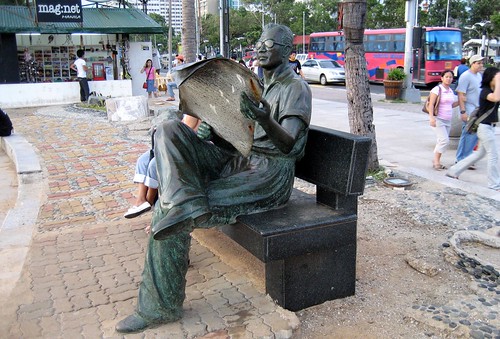
It was early Saturday morning. My father was reading his paper as he usually did before going to the office. Leaning against the arm rest of his chair, told him that I wanted to become a radio announcer someday. As was often the case, my father silently pondered upon what I had just told him for a couple of minutes and then asked, “And what would you announce?” He probably assumed I was aspiring to join the genre that Kuya Eddie and Tiya Dely popularized during that period that glued my mother to her Sony transistor radio in the afternoons.
“The time and news update!” I exclaimed.
Upon hearing my response, my father slowly folded his paper and handed it to me. “Go ahead, read me the news.”
“But this is in English.” I objected.
“But it’s still the news?” he calmly retorted.
He has got to be kidding me! But when he reached for his pipe to fill it with some Prince Albert tobacco, I knew I’d better do some reading to show him I had what it took to someday actualize my dream. However, typical of early grade school pupils, I struggled quite pathetically with those English words printed in the Manila Times. Although I proceeded as if I knew what I was doing, I was actually oblivious to all those printed words; absolutely without any idea what they meant or how they were supposed to be pronounced.
Not once did my father interrupt to correct me; he just sat comfortably on his chair as he smoked his pipe. I’d often glance up from my reading to search his face for any sign of annoyance, but he seemed undisturbed by my tediously slow attempt, interspersed with “aaahh...” However, if asked, he would patiently show me how a word is pronounced and give its meaning.
And from that time on, whenever he saw me idly sitting by the window watching cars passed by, or without anything better to do, he would ask me to read him the news.
A couple of months later on, he brought home a copy of Reader’s Digest. He didn’t tell me to read it; just nonchalantly put it where the other magazines were. Its size — being smaller than the usual magazines of my older siblings — was supposed to connote it was intended for me. Yet, he wanted me to develop the interest to explore it on my own without his direct suggestion. I did.
When he saw me going through its pages, he started to bring home Reader’s Digest on a regular basis. I would ask my eldest brother (Junior, second to Fraulein) to read an article for me while my eyes focused on every word as he read it. He would stop every now and then to translate a certain passage in Tagalog so I would get the gist of it. Fraulein was not one to waste an opportunity. As she teased her hair to a bouffant and depleted the ozone layer with excessive application of hair spray, she’d make me read some articles and horoscope predictions from her magazines. She could be harshly critical of my English sometimes so I’d feign sudden illness (death if I could) just to avoid reading to her. I rejoiced when she left for the States — not because I wanted to get rid of her, but now she could make good on her promise to buy me a Lionel train set.
And so from then on, whenever my father took me to the movies, I started paying more attention to the English dialogue -- no longer on just the swashbuckling scenes as before. I would even try to visualize some spoken words. Later on, coming across those words in the newspaper or magazine, I would pronounce them the way I had heard them spoken in the movies. Consequently, I developed the habit of reading aloud every banner and billboard I saw along Manila’s streets or along the highway on our way to the province.
Now, the tough part:
Being the youngest, I was delegated to hang the mosquito net over my parent’s bed. But before doing so, I would sit on the bed and chat with my father while my mother was busily making sure everything was in order before going to bed. It was during those times that my father would ask me to recount the scenes he had missed from the movie we saw. I should mention that whenever my father took me to the cinema on those Saturdays after lunch, for the most part, he didn’t watch it along with me; he took a nap instead. I would just nudge him whenever he started snoring.
So now, besides reading him the news from the Manila Times, I would have to narrate the scenes he missed from those movies we went to see. And if I objected, he would say he’d never again take me to the movies on Saturdays — just with the entire family on some Sundays. So there I was, a young boy pitifully telling a story in English.
By the time I reached the fifth grade, I became quite comfortable with English — reading the news to my father with more confidence while my storytelling became bearably coherent. I was also tasked with the duty to read to the visiting relatives the letters and postcards from Fraulein and Napoleon (the third child next to Junior who enlisted in the U.S. Navy) about their sightseeing adventures.
Reading the news to my father continued until high school whenever I had no school in the mornings, as well as the evenings of narrations of scenes from the movies my father and I saw together or those just with my high school friends or brothers. By this time, my narrations had become more animated and extended; replete with paraphrased dialogues, but alas — my father would oftentimes be fast asleep and snoring before I got to the end.
When my father’s health turned for the worse — becoming comatose during his final months — I continued reading him the news even though unsure if he was even listening. Nonetheless, I thought it was the least thing I could do for my father who never once discouraged me from dreaming those grandiose dreams.
Labels: Growing up memoirs
posted by Señor Enrique at 7:17 AM
| 29 comments