Thursday, October 02, 2008
CINEMA ESKANDALOSA

The only apparent aspects of this theater are its narrow entrance and the wall with the posters of the current features. Other than that, one can walk along Recto and hardly notice its existence. That is, except for one other thing: the stench that emanates from its interior.
It smells like a cocktail of stale sweat, rancid dish rag, bedraggled ditch digger's overalls, dried infant's puke, and God only knows how else to describe it.
Hence, there's no way this theater would go unnoticed when you pass by it. However, this distinctly foul smell is rather universal, for I've smelled it before in New York's seedy Times Square area before it got Disneyfied -- whenever I passed by any movie house that featured soft porn or adult film. Therefore, this odor is not exclusively indigenous to this movie theater in Manila.
Even If you've never been anywhere near this part of Recto Avenue, you may still have seen this theater in the evening news or read about it in the tabloids -- being raided by the police for the scandalous activities that some of its patrons engaged in while inside the theater. I heard it gets raided at least once a month.
Nonetheless, what I find intriguing about this particular theater are the suggestive titles of its featured films. Truth be told, whenever passing by, it has become a habit to check them out. If I were one of those romance novelists who write in the local vernacular, I might start a list of these titles as reference for some future steamy, salacious scenes.
Besides the suggestive titles you see in these photographs, the following are some I remember seeing, or had heard from friends who are into local films:
- Mainit At Masikip
- Balahibong Pusa
- Diligan Mo Ng Suka Ang Uhaw Na Lumpia
- Dalawang Pisngi Ng Langit
- Malaswang Bulaklak
- Galawgaw Na Birhen
- Halakhak Sa Dilim Ng Gabi
- Palihim Na Kaligayahan
- Byahera
- Mahiwagang Kulambo
- Nagliliyab Na Pagnanasa
- Nahulog At Nadapa At Nasugatan Pa
- Huwag Gisingin Si Pacing
- Gasgas Sa Karanasan
- Sumasagitsit Na Pagmamahal
- Aliw, Kuya?
I won't dare translate these into English. For those who don't speak Tagalog, perhaps, it's time to bond with a Pinoy neighbor or co-worker and discuss these titles among yourselves. For the meantime, I should ask Simon of Video 48 to see if these bold films I was told about truly existed.

* * *
Please note:
I very much appreciate my articles and photos appearing on fellow bloggers' sites, popular broadsheets, and local broadcast news segments, but I would appreciate even more a request for permission first.
Thank you!
*
I very much appreciate my articles and photos appearing on fellow bloggers' sites, popular broadsheets, and local broadcast news segments, but I would appreciate even more a request for permission first.
Thank you!
*
Labels: entertainment, life in Manila, Manila movie theater, movies
posted by Señor Enrique at 7:42 AM
| 30 comments


Thursday, August 28, 2008
HISTORIC WASTELAND

The photograph above of the parking lot on Avenida Rizal was taken a couple of days ago. This is the site where the historic Avenue Theater & Hotel building once stood, designed by one of the country's great architects, Juan Nakpil. Built more than 70 years ago, it was completely demolished two years ago.
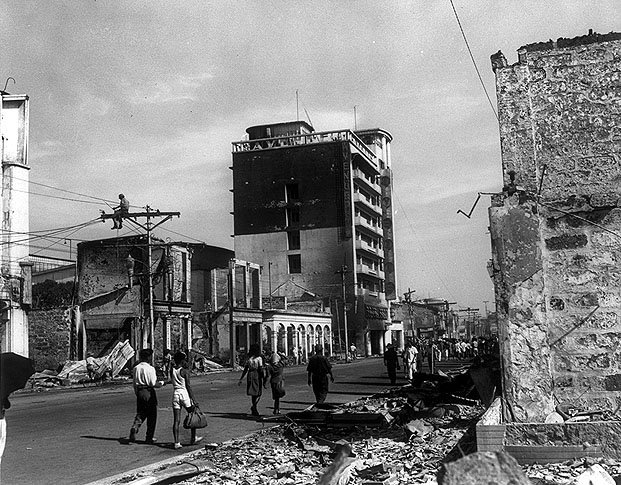
The photo at the bottom of Avenida Rizal was taken immediately after the war. The tall building in the middle was one of the few buildings that remained standing and unscathed after the intense carpet bombing during the Battle for Manila. It was the Avenue Theater & Hotel building. (Photo courtesy of UW Digital Collections)
The photo at the bottom of Avenida Rizal was taken immediately after the war. The tall building in the middle was one of the few buildings that remained standing and unscathed after the intense carpet bombing during the Battle for Manila. It was the Avenue Theater & Hotel building. (Photo courtesy of UW Digital Collections)
RELATED LINKS:
Avenue Theater: End of an Era
Capitol Theater on Escolta
Sigh-Sigh-Sigh - Walk This Way
Avenue Theater: End of an Era
Capitol Theater on Escolta
Sigh-Sigh-Sigh - Walk This Way
* * *
Please note:
I very much appreciate my articles and photos appearing on fellow bloggers' sites, popular broadsheets, and local broadcast news segments, but I would appreciate even more a request for permission first.
Thank you!
*
I very much appreciate my articles and photos appearing on fellow bloggers' sites, popular broadsheets, and local broadcast news segments, but I would appreciate even more a request for permission first.
Thank you!
*
Labels: Avenue Theater, Manila history, Manila movie theater, Rizal Avenue
posted by Señor Enrique at 7:27 AM
| 8 comments
Monday, August 11, 2008
MANILA GRAND OPERA HOTEL

According to a Philippine Daily Inquirer article, the busy intersection of Rizal Avenue and Doroteo Jose Street is the site where the Manila Grand Opera House once stood and that it is now being developed into a luxury hotel and casino complex. It will be named the Manila Grand Opera Hotel.
However, that particular lot on Rizal Avenue and Doroteo Jose was not where the Manila Grand Opera House was, but rather Galaxy Theater, and behind it was the Mapua Institute of Technology's college and high school campus complex. Except for the MIT facade and the columns that support it, everything has been demolished. The lot is now a huge parking lot and bus terminal (above photo).
From what I remember, Manila Grand Opera House was located north of Doroteo Jose, right next door to Ang Tibay Shoe Store.
My memory should serve me right since I went to school at MIT for four years, as well as have bought many shoes at Ang Tibay Shoe Store while growing up. Moreover, from our house in Misericordia and Batangas Street, the jeepney I took to school would first pass by the Opera House and then on to Doroteo Jose where I would get off.
Nevertheless, erecting a luxury hotel in this area may inspire a full blown revitalization of the entire neighborhood. Rizal Avenue was, after all, Manila's premier entertainment and shopping district.
Furthermore, according to the PDI article written by Tina Santos, the management of this luxury hotel and casino complex intends to maintain its historic ambiance as a venue of arts and culture shows, providing visitors and its guests a glimpse of its colorful past.
There will be posters of different plays staged at the MGOH, as well as a section of the lobby to be designated to showcase photographs, paintings, artifacts, memorabilia and news clippings about the events that MGOH had hosted and personalities who performed there.
The article went on to say:
Manila Grand Opera House was the venue in the 1900s for performances by both local and foreign stars. And that in her book "Theater in Manila 1846-1946," Cristina Lanonico-Buenaventura said it was the place for visiting opera companies, Rizal Day celebrations and assemblies of national significance, including the inauguration of the first Philippine Assembly on Oct. 16, 1907, by United States Secretary of War William Howard Taft.
In the 1890s, the venue, which was then made of a circular wooden structure with a nipa roof, was called H.T. Hashim's National Cycle Track before its
name was changed to Teatro Nacional where the Russian Circus and some American theater companies performed.
Several years later, in 1902, the teatro became MGOH after it was transformed into an opera house by Italian impresario Balzofiore in time for visiting Italian opera company. Seats were divided into three classifications: Palco proscenio for the dignitaries, butaca or orchestra for most theatergoers, and gallery, the least expensive section.
However, in 1942, after about two decades of hosting opera and zarzuela productions, a new owner, Toribio Teodoro, the owner of Ang Tibay Shoes and known as the "shoe king of the Philippines, acquired the property. He lived there when the Japanese seized his house and shoe factory during World War II.
A series of unfortunate events then happened one after the other: The structure was badly damaged by flood the following year and burned down a
few months later.
But right after the war, reconstruction of the building began. Equipped with the latest technology, the structure was intended to be a first-class cinema
for cultural shows. Eventually, MGOH was dubbed as "The Theater with a History." It provided daily entertainment for the masses. For 85 centavos, people got to watch a stage show and a movie.
Its main fare were stage shows and movies with an occasional concert, opera and plays by stage and movie director (and later, National Artist) Lamberto
Avellana and Wilfrido Ma. Guerrero, among others.
It was said to be the "ultimate" place for singers, dancers and stage players to perform and it was where famous icons of vaudeville and the
zarzuela, including Atang de la Rama, Jovita Fuentes and Katy de la Cruz, reached the peak of stardom.
The MGOH also provided then future screen idols Rogelio de la Rosa and Leopoldo Salcedo and even comedians like Dolphy and Panchito, Bayani
Casimiro, Pugo and Tugo, Tugak and Pugak, Dely Atay-atayan and Chichay, among others, the boost they needed in their careers.
The opera house, which by the '60s had been transformed into a movie theater, was bought by former Ambassador to Laos Antonio Cabangon Chua from
the heirs of Teodoro.
"It was only this year that plans for building the hotel were conceptualized, " Tan said, adding that the hotel aims to serve both as a reminder of the site's historic past as well as a showcase of the latest amenities of a first-class hotel.
 But where o where exactly are they building it?
* * *
ADDENDUM
ADDENDUM
I had decided to go to Rizal Avenue this afternoon to find out for myself the exact site on which the old Manila Grand Opera House used to stand, as well as where the luxury hotel is being built.
I asked the people at the international flag store located on Rizal Avenue between Doroteo Jose and Lope de Vega. Supposedly, according to its huge sign, this store has been doing business in the same exact location for three generations.
The manager told me that Manila Grand Opera House used to be located where Music Avenue (formerly Chicks O'Clock) now stands; whereas, the site where Ang Tibay Shoe Store used to be is now occupied by the LRT Doroteo Jose Station.
As for the hotel, it is being built on Doroteo Jose, about 70 meters from Rizal Avenue, where a row of stores used to be -- school supplies, books, novelty shops, eateries, and etc. -- across the street from where the old MIT high school building once stood.
So, technically speaking, the hotel is being built in the vicinity of the site of the Manila Grand Opera House.
I had taken a video of the area:
I asked the people at the international flag store located on Rizal Avenue between Doroteo Jose and Lope de Vega. Supposedly, according to its huge sign, this store has been doing business in the same exact location for three generations.
The manager told me that Manila Grand Opera House used to be located where Music Avenue (formerly Chicks O'Clock) now stands; whereas, the site where Ang Tibay Shoe Store used to be is now occupied by the LRT Doroteo Jose Station.
As for the hotel, it is being built on Doroteo Jose, about 70 meters from Rizal Avenue, where a row of stores used to be -- school supplies, books, novelty shops, eateries, and etc. -- across the street from where the old MIT high school building once stood.
So, technically speaking, the hotel is being built in the vicinity of the site of the Manila Grand Opera House.
I had taken a video of the area:
*
* * * *
RELATED LINKS:
Manila's Movie Theaters
Quiapo and the Golden Age of Filipino Movies
Where Avenue Theater Once Stood
Avenida Rizal
Capitol Theater
Clover and Opera House - Video 48
Cinema Treasures
Ang Tibay Shoes
Manila's Movie Theaters
Quiapo and the Golden Age of Filipino Movies
Where Avenue Theater Once Stood
Avenida Rizal
Capitol Theater
Clover and Opera House - Video 48
Cinema Treasures
Ang Tibay Shoes
* * *
Please note:
I very much appreciate my articles and photos appearing on fellow bloggers' sites, popular broadsheets, and local broadcast news segments, but I would appreciate even more a request for permission first.
Thank you!
I very much appreciate my articles and photos appearing on fellow bloggers' sites, popular broadsheets, and local broadcast news segments, but I would appreciate even more a request for permission first.
Thank you!
Labels: Growing up memoirs, Manila Grand Opera House, Manila history, Manila movie theater
posted by Señor Enrique at 11:59 AM
| 25 comments
Thursday, May 24, 2007
MANILA'S MOVIE THEATERS
 Those who may still remember the grandeur of Galaxy Theater during its heyday may be saddened to see this photograph.
The Galaxy is one of the few surviving buildings designed by National Artist Pablo Antonio, Sr. It is of Art Moderne design, an architectural style that came about in the 1930s along with Art Deco. Many theaters along Avenida Rizal during the '50s and '60s boasted such designs in answer to America's Hollywood and Broadway.
Sadly, the Galaxy's present owners are planning to demolish it to make way for a 22-story condominium on the site.
Hopefully, according to Richard Tuason-Sanchez Bautista, resident architect of the National Commission for Culture and Arts (NCAA), this is the first building in the area that may be saved from destruction and conserved; unlike the Avenue Theater, designed by National Artist Juan Nakpil, that was recently torn down and converted to a parking lot, much to the great dismay of our cultural historians and conservationists.
The NCCA as represented by Richard is helping the developer, Zosima Inc., headed by administrator Primitivo Garcia III, to preserve the Galaxy Theater building, or at least, its facade.
The Philippine Daily Inquirer published a detailed account of this matter, "Preservation, modernity come together in Manila."
Incidentally, it was Richard who was kind enough to provide me with a list of movie theaters along Avenida Rizal during the '50s and '60s and up to the present (some may have been already demolished as indicated). He also included some movie houses in some other areas of Manila. You see, I was unable to come up with such information when I went to the National Library last month.
So, ladies and gentlemen, here is the list:
Starting from Blumentritt to Plaza Lacson (formerly Plaza Goiti) along Avenida Rizal:
1. Manila Theatre- demolished sometime during the '90s
2. Cine Noli - still in business
3. Pearl - closed but still standing
4. Scala - designed by Pablo Antonio - now being used as a Christian church
5. Forum - designed by Pablo Antonio - only facade remains; roofless and abandoned
6. Manila Grand Opera House - gone
7. Galaxy - designed by Pablo Antonio - still standing
8. Dynasty - gone
9. Capri - closed; buiding might have been demolished
10. Roxan - closed; buiding might have been demolished
11. Odeon - gone
12. Avenue - gone
13. Universal - still standing but no longer operational
14. Jennets - open
15. Lords - open
16. Ever (formerly Rialto) - closed but building still standing
17. State - designed by Juan Nakpil - gone
18. ideal - designed by Juan Nakpil (Pablo Antonio contributed in designs during various dates) - gone
19. Clover - gone
20. Illusion - gone
Along Claro M. Recto Avenue (formerly Azcarraga):
1. Roben - still operational
2. Vista 1 and 2 - designed by Juan Nakpil - still operational
3. Hollywood - still operational
4. Podmon - demolished; now LRT2 station
5. Dilson - still operational
6. Eastern - still standing but now a school
7. Tandem - still standing but closed
8. Miramar - still standing but closed
9. Maxim - still standing but closed
10. Manila Theater 1 and 2 - gone
11. Ever Gotesco - still operational
Along Ronquillo:
1. Majestic - gone
Along Ongpin:
1. King's - now a small mall (tiangge) with restaurant).
There was another theater along Ongpin which has been converted to President Restaurant
Along Escolta:
1. Capitol - only the facade remains
2. Lyric - demolished
Along Florentino Torres:
1. De Luxe - demolished
2. Republic - demolished
Along Quezon Boulevard and Evangelista Street (Quiapo):
1. New Love - still standing but closed
2. Cinerama (now Isetann with multiplex theaters on fifth floor)
3. Gala - now a beer/strip bar
4. Crown - still standing but closed
5. Lider (Ginto) - still operational
6. Globe - now a small mall (tiangge) but Globe Lumpia House still open
7. Life - designed by Pablo Antonio - still standing but closed
8. Boulevard - gone
9. Times - designed by Luis Araneta - operational
10. Main - designed by Juan Nakpil still standing - now used by Dating Daan organization
Dalisay was also listed in this section, but I think Dalisay was once adjacent to Cine Noli in Blumentritt which is now gone.
Along Espana (Sampaloc):
1. Baron (Mercury) - gone - now Chow King restaurant
Along Dapitan:
1. Dapitan - gone
Along Herran:
1. Major - still standing but closed
2. Bellevue - still operational but may soon close
3. Dart - gone - now a supermarket
4. Paco - designed by Pablo Antonio - gone
6. Robinson's - open
7. Gaiety - designed by Juan Nakpil - closed
There was also another along Adriatico near Quirino
This list may remind some readers of others not included so please let us know.
Again, many thanks to Richard Tuason-Sanchez Bautista of NCCA, as well as to Joy Tang and Manolo Noche of Heritage Conservation Society for their valuable input.
 A view of Avenida Rizal from Carriedo Street (circa: 1960s)
Photo courtesy of University of Wisconsin - Madison Libraries

* * *
Please note:
I very much appreciate my articles and photos appearing on fellow bloggers' sites, popular broadsheets, and local broadcast news segments, but I would appreciate even more a request for permission first.
Thank you!
*
I very much appreciate my articles and photos appearing on fellow bloggers' sites, popular broadsheets, and local broadcast news segments, but I would appreciate even more a request for permission first.
Thank you!
*
Labels: Manila movie theater
posted by Señor Enrique at 11:30 PM
| 84 comments
Tuesday, August 15, 2006
CAPITOL THEATER ON ESCOLTA
 It was designed by Juan Nakpil in 1935 using local indigenous motifs for its art deco ornamentations.
Its front elevations portray Filipinas in their native garb set against a tropical backdrop; depicting more of a distant rural landscape than the usual urbanized setting common in Escolta’s commercial district during the ‘30s.
Capitol Theater is one of the two cinema houses along the strip of Escolta that I remember during my youth; the other is Lyric. Regrettably, like most of the movie theaters on Rizal Avenue where we used to go, it is now closed. The building, however, stands just as majestically as ever.
The most fond memory I have of Capitol Theater was one early Sunday morning. Along with my brothers and cousins, we rushed the Chinese proprietor, Mr. Yu, to bag some special bola-bola siopao and bottles of Coca-Cola for us to take out. He just opened his noodle shop a few minutes earlier, and was now quizzically glancing at us as he hurriedly prepared our order. He knew me because my father and I frequented his eatery near the Santa Cruz Church.
I told him that we wanted to be the very first on line to buy tickets and enter Capitol Theater when it opened that morning. As he handed us our brown bags, he still had that confused look etched on his face so, as if in unison we all yelled in delight, Thunderball!
We were just about to run out of his shop when he yelled for me to stop as he put some buchi in another brown bag. Mr. Yu knew how much I love these fried ground glutinous rice balls filled with sweet mongo bean paste, but I had to tell him I didn’t have enough money for them. He insisted that I take the bag anyway; saying he would just charge my father when he saw him. I grabbed it from his hand while saying a quick thank you and dashed out of his shop to catch up with my brothers and cousins already about to cross the street leading towards Escolta.
Capitol Theater was at that time showing the much anticipated fourth James Bond movie, Thunderball, which starred Sean Connery as British Secret Service agent, Commander James Bond 007. And as planned, with Escolta’s fine shops still closed, we started the line in front of the theater that early Sunday morning.
The release of this movie underscored the people’s insatiable craving for spy stories; reflecting the public’s pervading cold war anxiety and intrigue for the mysterious yet intrepid secret agents. Television producers were also quick to exploit the growing demand for anything spy mania by creating shows like The Man from U.N.C.L.E., I Spy, The Wild Wild West, and Get Smart.
Thunderball further dazzled the James Bond fans with his de riguer transports such as the famous Aston Martin DB5 and the "Bell Rocket Belt" used to escape from a building. There were also the high-tech gadgets such as the waterproof watch and camera with a built-in Geiger counter and the underwater jet pack that was armed with a spear gun. Most astonishing was Bond’s “rebreather” — a small scuba set that can be carried unnoticed and, when used, provided a few minutes of air in underwater emergency.
And of course, there were Bond’s three conquests — Luciana Palluzzi as Fiona Volpe, Claudine Auger as Domino and Molly Peters as Patricia Fearing. Thunderball would later prove to be the most successful of all the James Bond flicks, raking in millions of dollars in box office tickets worldwide. It also confirmed the movie star status of its leading man, Sean Connery.
And so it was. All those fond memories while I gazed at the remains of the old Capitol Theater in Escolta, Manila. As I headed towards Jones Bridge, it suddenly dawned on me what I had seen earlier, but didn’t pay that much attention to — a new building was erected on the spot where Mr. Yu’s noodle shop used to be. I thought of him and the many times my father and I went to eat at his shop -- on late Saturday afternoons after seeing a movie.
Memories indeed linger from which time and tide had washed away.
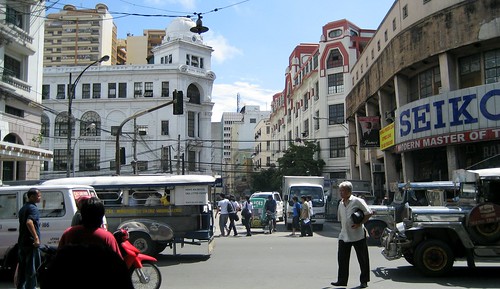
View of Escolta leading to Jones Bridge from Santa Cruz Church.
Labels: Growing up memoirs, Manila movie theater
posted by Señor Enrique at 5:25 AM
| 28 comments